There is a particular pleasure in road travel that no flight can replicate - the pleasure of watching the landscape change, of understanding geography through movement, of arriving somewhere and having felt the distance between where you started and where you are.
The drive from Delhi to Jaipur - 270 kilometers southwest along National Highway 48 and the older NH 48 (formerly NH 8) - is one of India's great road journeys. It is not a motorway dash through featureless countryside. It is a transition between worlds: from the layered Mughal and colonial capital of Delhi, through the flat agricultural plains of Haryana, across the dramatic rocky threshold of the Aravalli Hills, and into the desert-edged kingdom of Rajasthan - a journey that in terms of landscape, history, and cultural character covers as much ground as any equivalent distance on earth.
In a luxury private car - climate-controlled, comfortably appointed, with a professional driver and the ability to stop wherever interest demands - this journey is genuinely extraordinary. And with the knowledge of what to look for and where to stop, it becomes one of the finest travel experiences the Golden Triangle offers.
At Golden Triangle Tours, we make this drive with our guests hundreds of times each year. This is everything we know - every stop worth making, every hidden gem along the route, every detail that transforms a road transfer into a road trip.
The Delhi to Jaipur road journey covers four distinct geographic and cultural zones:
Zone 1 - Greater Delhi and the National Capital Region (0 to 50 km) The urban fabric of Delhi extends further south than most travelers expect - Gurugram (Gurgaon), India's most modern corporate city, sits immediately south of Delhi and represents one of the most dramatic urban transformations of the twenty-first century. Glass towers, international hotels, and global corporate campuses line the highway for the first 30 kilometers before the landscape begins its transition.
Zone 2 - The Haryana Plains (50 to 150 km) Flat, agricultural, and historically significant - Haryana was the heartland of ancient India, and the landscape here - despite its apparent simplicity - passes through territory associated with the Mahabharata, with the battles of Panipat, and with the agricultural tradition that has fed northern India for millennia. The mustard fields in winter, the wheat fields in spring, the monsoon-green paddy in September - the seasonal transformation of these plains is one of the drive's underappreciated pleasures.
Zone 3 - The Aravalli Threshold (150 to 220 km) The Aravalli Hills - among the oldest mountain ranges on earth, geologically speaking - emerge from the plains around Alwar and Shahpura, announcing the approach to Rajasthan with dramatic rocky ridgelines, dry scrub forest, and the particular quality of light that Rajasthan's landscape produces. This is the most visually striking section of the drive.
Zone 4 - Rajasthan Approach and Jaipur (220 to 270 km) The final approach to Jaipur through the Amber Pass - the historical entry point through the Aravalli Hills into the Jaipur Valley - is framed by the fort walls of Amber on the ridgeline above and the city's rose-colored skyline ahead. Arriving in Jaipur through this approach, with Amber Fort visible on the hillside as you enter the city, creates an arrival experience of extraordinary theatrical power.
Travel from Delhi to Jaipur in Luxury & Comfort
Enjoy a premium road trip between Delhi and Jaipur with a private chauffeur, luxury vehicle, and flexible sightseeing stops along the way. Visit historic landmarks, scenic destinations, and hidden attractions while experiencing a smooth, relaxing, and personalized journey.
The Vehicles: Choosing Your Road Trip Experience
At Golden Triangle Tours, the Delhi to Jaipur journey is made in a range of private vehicles depending on guest preference and group size. Here is our vehicle guidance for this specific road:
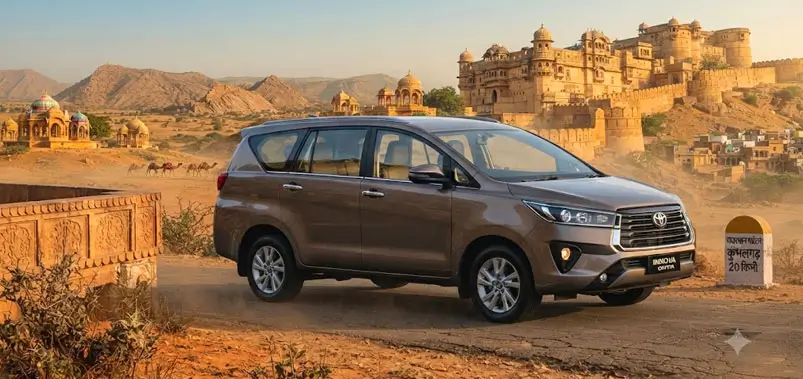
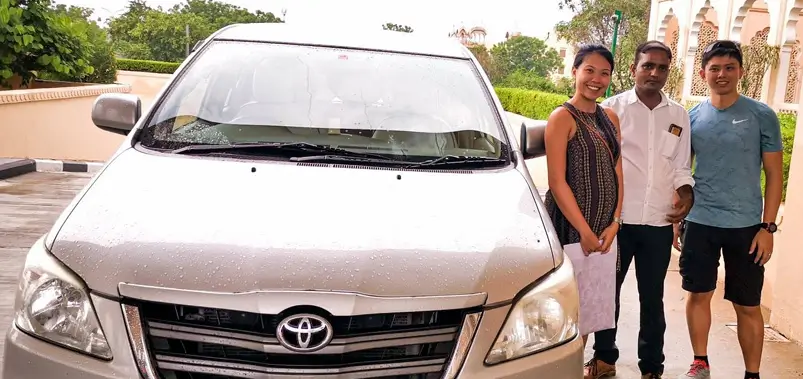
Toyota Innova Crysta (Best for 2 to 4 travelers): The most popular choice for the Delhi–Jaipur journey - spacious, reliable, air-conditioned, and comfortable on both highway and the occasional rough village road when detours call. The Innova's height provides good visibility of the passing landscape - important on a journey where the view is part of the experience.
Mercedes E-Class or BMW 5 Series (Best for couples or solo travelers seeking maximum comfort): For guests who want the journey itself to be a luxury experience, the Mercedes E-Class or BMW 5 Series with a professional chauffeur elevates the road trip to a genuinely different level. The ride quality, cabin silence, and seating comfort make even the longest stretches entirely pleasant. Recommended particularly for honeymoon couples and guests who prioritize the experience of the journey itself.
Mercedes S-Class or BMW 7 Series (Ultra-luxury): For guests who want nothing less than the finest possible road experience - the S-Class or 7 Series provides extraordinary cabin luxury, and the Delhi–Jaipur road is smooth enough to enjoy it fully.
Toyota Hiace or Force Urbania (For families of 5 to 8): Spacious, reliable minivans that provide comfortable seating for larger groups. Air-conditioned, with individual window views - important for the landscape sections of the journey.
Golden Triangle Tours provides all vehicles with:
The Complete Stop-by-Stop Guide
Stop 1: Gurugram - A Brief Glimpse of Modern India (30 km from Delhi)
Most road trip guides skip Gurugram entirely - and for the landscape traveler, this is appropriate. But for guests interested in understanding India's economic transformation, a brief conversation while passing through this glass-and-steel cityscape - narrated by your guide - provides extraordinary context for everything that follows. The contrast between Gurugram's 21st-century corporate towers and the ancient stone forts you will visit in Jaipur five hours later is one of the most dramatic culture-gap experiences available on the Golden Triangle.
Time required: No stop - observe while driving through.
Stop 2: Dharuhera - The Highway Dhaba Experience (60 km from Delhi)
Dhabas - the roadside restaurants that line Indian highways - are one of the great institutions of Indian road culture. At their best, a dhaba serves extraordinarily good North Indian food in a setting of cheerful informality: metal plates, wooden benches, tandoor bread pulled fresh from a clay oven, dal that has been simmering since before dawn.
At Golden Triangle Tours, we know the specific dhabas on the Delhi–Jaipur highway that serve genuine quality - run by families who have been feeding highway travelers for generations, with kitchens that are clean, ingredients that are fresh, and food that is better than many restaurant meals.
A dhaba breakfast stop - paratha (layered flatbread) with fresh white butter and pickle, masala chai in a clay cup, watching the morning traffic of trucks and motorcycles and the occasional camel cart - is one of the most authentic and enjoyable experiences available on this road. For guests who want a taste of genuine North Indian highway culture without compromising on food safety, your guide's recommended dhaba is the answer.
Time required: 30 to 45 minutes Best for: Breakfast or mid-morning tea stop on early departure itineraries
Stop 3: Neemrana Fort Palace - The Cliff-Top Heritage Hotel (120 km from Delhi)
Neemrana Fort Palace is one of the finest heritage hotel properties in India - a fifteenth-century Rajput fort converted into an extraordinary boutique hotel that cascades down a rocky cliff face in a series of terraces, pools, and garden courtyards. It is one of India's pioneer heritage conservation projects and remains among the most visually dramatic hotel properties in the country.
For the Delhi–Jaipur road traveler, Neemrana offers two possibilities:
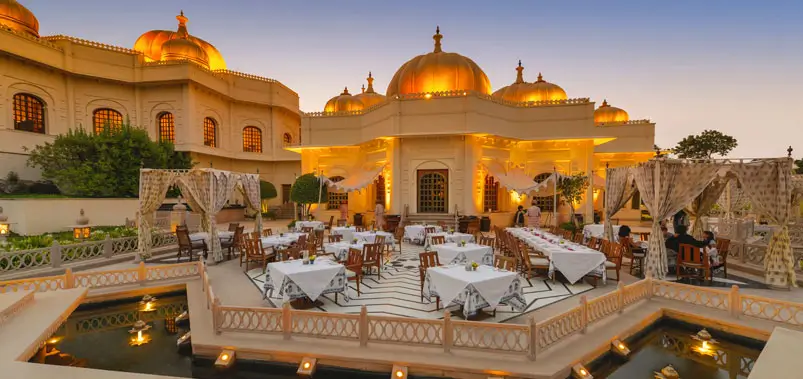
Option A - A Coffee or Lunch Stop: The fort's terrace restaurants are open to non-resident visitors for breakfast, lunch, and tea. Stopping for a long lunch at Neemrana - on one of the terraced restaurant levels, looking across the Rajasthan plain toward the Aravalli Hills - is one of the finest midpoint stops on the entire road. The heritage property walk included with a meal visit gives you a sense of the fort's architecture and history in a focused, beautiful form.
Option B - An Overnight Stop (Highly Recommended for Extended Itineraries): For guests with time and interest, spending a night at Neemrana Fort Palace - breaking the Delhi–Jaipur journey into two leisurely days - is one of the most rewarding additions to a luxury Golden Triangle itinerary. The pool at Neemrana, set in a rocky terrace with sweeping views across the plain, is one of the most dramatically beautiful swimming pools in India. The heritage suite accommodations are extraordinary - thick stone walls, carved wooden furniture, arched doorways, and a silence that the fort's cliff-top position above the highway preserves completely.
At Golden Triangle Tours, we design Neemrana overnight itineraries for guests who want to make the road journey itself a destination - arriving from Delhi in the afternoon, exploring the fort at leisure, spending the evening at the terrace restaurant with sunset views, and continuing to Jaipur the following morning refreshed.
Time required: 1 to 2 hours for lunch stop | Overnight for full experience Distance from Delhi: 120 km (approximately 2 hours)
Stop 4: Alwar - The Forgotten Royal City (160 km from Delhi)
Alwar - capital of the former princely state of Alwar - is one of the most historically significant and least visited cities on the Delhi–Jaipur corridor. Founded in the eighteenth century by the Rajput rulers of the Naruka clan, Alwar sits in the foothills of the Aravallis with a dramatic fort, a beautiful city palace, and a tradition of royal patronage that produced some of Rajasthan's finest miniature paintings.
Bala Quila (Alwar Fort): Rising on a rocky ridge above the city, Bala Quila is one of the oldest and most dramatically positioned forts in Rajasthan - predating the more famous Amber Fort by several centuries. The fort is accessible by a rocky path and offers panoramic views across the Alwar Valley and the surrounding Aravalli landscape. It is rarely visited by Golden Triangle travelers - making it one of the most genuinely uncrowded heritage experiences on the circuit.
City Palace and Government Museum: The Alwar City Palace houses a government museum with a collection of extraordinary quality - Mughal miniature paintings, royal weapons, ornamental horse carriages, and a library of illuminated manuscripts. For guests with a serious interest in Rajput art and history, the Alwar museum is a revelation.
Sariska Tiger Reserve: Sariska National Park - just outside Alwar - is a tiger reserve with a fascinating and troubled history: its tigers were entirely poached out in the early 2000s, and the reserve has been painstakingly restocked with tigers transferred from Ranthambore. For guests who want wildlife without the Ranthambore commitment, a morning jeep safari at Sariska can be combined with an Alwar visit as a single extended stop.
Time required: 2 to 3 hours for fort and palace | Half-day for Sariska safari addition Distance from Delhi: 160 km (approximately 2.5 to 3 hours)
Stop 5: Siliserh Lake - The Maharaja's Lakeside Palace (175 km from Delhi)
Siliserh Lake - a beautiful artificial lake created in 1845 by the Maharaja of Alwar as a water supply reservoir - is surrounded by the forested Aravalli foothills and dominated by the Lake Palace (now converted into a heritage hotel by the Rajasthan Tourism Development Corporation).
The view from the Lake Palace terrace - across the still water to the forested hills, with water birds on the lake surface and occasional wildlife visible at the water's edge - is one of the quietest and most beautiful moments available on the Delhi–Jaipur road.
For boating: Small boats can be rented from the lake shore for a gentle 30-minute row on the water. The combination of the forested hills, the historic palace, and the complete absence of the highway's noise creates an atmosphere of extraordinary tranquility.
At Golden Triangle Tours, we include Siliserh Lake as a stop for guests with time and interest - particularly for those combining an Alwar visit with the lake. It is not on the main highway and requires a 15-kilometer detour - a detour that the scenery fully rewards.
Time required: 45 minutes to 1.5 hours Distance from Delhi: 175 km
Stop 6: Abhaneri Step Well (Chand Baori) - India's Most Extraordinary Hidden Wonder (200 km from Delhi, 65 km from Jaipur)
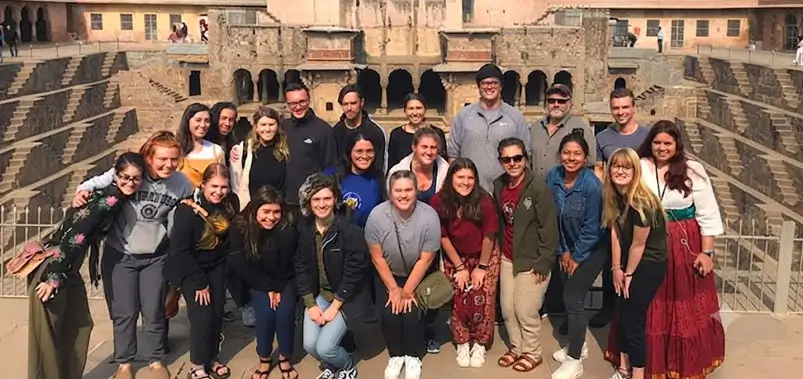
Chand Baori - the ancient step well at Abhaneri village - is one of the most extraordinary architectural structures in India and one of the least known to international travelers.
Built in the ninth century by Raja Chanda of the Nikumbha dynasty, Chand Baori descends 20 meters below ground level through 3,500 narrow steps arranged in perfect geometric symmetry on three sides of the well - 13 stories of steps, each level slightly narrower than the last, creating a hypnotically precise triangular descent that appears to defy both physics and imagination.
The fourth side of the well is occupied by a royal pavilion - used by the Maharaja and his court to descend to the water's edge - decorated with elaborate carved stone panels of astonishing quality. The entire structure, from the water's surface to the ground above, is 35 meters - deeper than many multi-story buildings.
Chand Baori is not a tourist site in any conventional sense - there are no large parking areas, no souvenir stalls, no audio guides. It is an ancient structure in a rural village that happens to be one of the most beautiful things built by human hands anywhere in the world, and that most Golden Triangle travelers drive past without knowing it exists.
At Golden Triangle Tours, we include Chand Baori as a standard stop on the Agra–Jaipur road (it lies on this route as well as the Delhi–Jaipur route). For guests traveling directly from Delhi to Jaipur via NH48, a 15-kilometer detour through Bandikui accesses Abhaneri and adds one of the journey's finest experiences with a 45-minute time investment.
Time required: 45 minutes to 1 hour Distance from Jaipur: 65 km (approximately 1 hour)
Stop 7: Sambhar Salt Lake - India's Largest Inland Salt Lake (80 km from Jaipur)
Sambhar Salt Lake - the largest inland salt lake in India and a Ramsar Wetland of International Importance - spreads across the flat Rajasthan desert approximately 80 kilometers west of Jaipur (a 30-kilometer detour from the main highway).
The lake's surface, depending on season and water level, alternates between vast salt flats (brilliant white in the dry season, shimmering with heat haze), shallow pink-tinged brine pools (the pink color caused by halophilic bacteria, similar to the famous pink lakes of Australia), and seasonal wetlands that host thousands of flamingos and other migratory birds from November through February.
The visual effect - vast, flat, otherworldly - is unlike anything else on the Golden Triangle circuit. The salt-harvesting operations (traditional salt production has been practiced at Sambhar for over 1,000 years) are visible at the lake's edge, and the small Shakambhari Devi Temple on the lake shore is one of the oldest in Rajasthan.
For guests with an interest in unusual natural landscapes or bird photography, Sambhar is one of the most distinctive stops available on the approach to Jaipur. The flamingo viewing in November through February is particularly extraordinary.
Time required: 1 to 1.5 hours Distance from Jaipur: 80 km (approximately 1.5 hours from city center)
Stop 8: Amber Pass - The Royal Entrance to Jaipur (12 km from Jaipur)
The approach to Jaipur through the Amber Pass - the historical gateway through the Aravalli Hills into the Jaipur Valley - is the journey's finest finale and one of the most dramatically staged city arrivals in India.
As your car crests the Aravalli ridge and begins its descent into the Jaipur Valley, Amber Fort appears on the hillside to your left - its massive stone walls following the ridgeline, its towers and bastions clearly visible, the lake of Maota glinting below its walls. Ahead, the Pink City's roofscape spreads across the valley floor, the distant dome of the Hawa Mahal just visible above the uniform rose-washed skyline.
This is the moment when travelers who have driven from Delhi - having watched the landscape transform across 270 kilometers from the Mughal capital's haze to the clear desert air of Rajasthan - understand fully what the journey has delivered. You have not merely traveled between two cities. You have crossed a cultural frontier, following a road that Mughal emperors, Rajput warriors, British administrators, and centuries of ordinary traders and pilgrims have traveled before you.
At Golden Triangle Tours, we time the Delhi–Jaipur drive so that this arrival happens in the late afternoon golden hour - when the light is at its most beautiful on the Amber Fort walls and the Jaipur skyline. The late afternoon light on the Pink City - the rose-colored sandstone turning deeper amber, the shadows long and dramatic - is one of the finest visual experiences the Golden Triangle delivers.
Recommended Delhi to Jaipur Route Options
Option A: The Direct Journey (5 to 5.5 hours driving)
Delhi → NH48 → Jaipur
Minimal stops - perhaps a dhaba breakfast and a brief Neemrana coffee stop. Best for guests with limited time who want to arrive in Jaipur with energy for an afternoon palace hotel check-in and evening exploration.
Recommended for: Guests on tight 7-day itineraries who are visiting Agra separately and traveling directly between Delhi and Jaipur.
Option B: The Heritage Road Trip (Full Day - 8 to 9 hours)
Delhi → Dhaba breakfast → Neemrana Fort lunch → Alwar Fort → Chand Baori → Jaipur
The full heritage road trip experience - three major stops, one extraordinary lunch, and arrival in Jaipur in the golden hour. This option requires an early departure from Delhi (7:00 AM) and works best for guests who have already explored Agra and are traveling from Delhi to Jaipur as a dedicated journey day.
Recommended for: Guests with 9 to 10-day itineraries, guests with a strong interest in heritage architecture and rural Rajasthan, guests for whom the journey is as important as the destination.
Option C: The Two-Day Luxury Road Trip
Day 1: Delhi → Neemrana Fort Palace (overnight) Day 2: Neemrana → Alwar → Chand Baori → Sambhar Lake → Jaipur
The most immersive option - turning the road journey into a complete destination in itself. Two days, two distinctive overnight experiences, and the full collection of hidden stops between Delhi and Jaipur.
Recommended for: Guests with extended itineraries (10 to 14 days), guests who specifically want to experience Neemrana Fort as a destination, guests returning to India and looking for a new dimension to a familiar circuit.
Practical Road Trip Notes
Departure timing: For Option A (direct journey), departure from Delhi between 8:00 and 9:00 AM avoids the worst morning city traffic and delivers arrival in Jaipur by early afternoon. For Option B (full heritage road trip), departure by 7:00 AM is essential to include all stops comfortably.
Road conditions: The NH48 between Delhi and Jaipur is one of India's finest highway connections - well-maintained, largely four-lane, and entirely comfortable in a private vehicle. Road quality through Alwar and the village detours is variable - good in most areas, occasionally rough through specific village sections. All routes are managed without difficulty by Golden Triangle Tours vehicles and experienced drivers.
Fuel and facilities: The main NH48 has regular fuel stations, clean rest facilities at highway service areas, and 24-hour access to essentials. Village route detours may have more limited facilities - all needs should be addressed at highway service areas before turning off the main road.
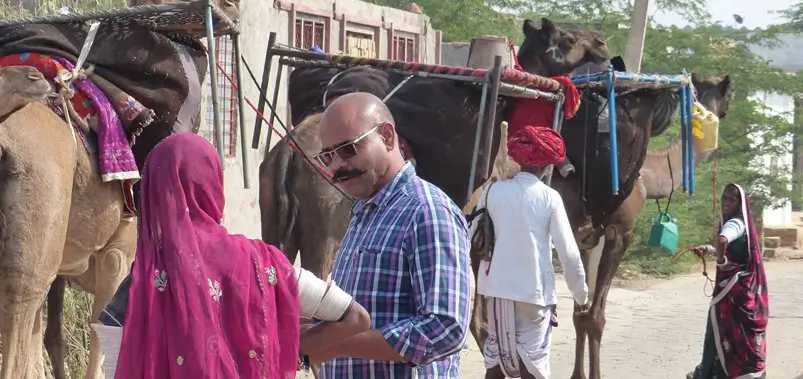
Photography opportunities en route: The Aravalli landscape between Alwar and Jaipur - rocky scrub forest, occasional peacocks on the roadside (the national bird of India, semi-wild throughout Rajasthan), ancient temples barely visible from the highway, camel carts overtaken on the approach roads - provides continuous photographic interest throughout the journey. Keep your camera accessible rather than packed.
Enjoy a Scenic Luxury Drive from Delhi to Jaipur
Turn your road journey into an unforgettable travel experience with a premium chauffeur-driven car. Relax in comfort, make optional stops at heritage sites and local attractions, and arrive in Jaipur ready to explore its royal palaces, colorful markets, and rich cultural heritage.
The Delhi to Jaipur Drive in Reverse: Jaipur to Delhi
Everything in this guide applies equally to the Jaipur–Delhi direction. For guests whose Golden Triangle itinerary ends in Jaipur with an onward international departure from Delhi's Indira Gandhi International Airport, the return drive can include any combination of the stops described above.
For a Jaipur to Delhi journey specifically:
Sunrise departure from Jaipur (6:00 AM): Allows a Chand Baori stop at 7:30 AM in quiet morning light, a Neemrana lunch stop at midday, and arrival at Delhi airport by 4:00 PM - comfortable for any evening international departure.
Golden Triangle Tours coordinates all road transfers between cities with your hotel check-out times, flight schedules, and stop preferences. You provide the destination and the time you need to arrive. We handle everything between.
Why the Road Trip Matters: India From the Window
There is a final reason to drive from Delhi to Jaipur rather than fly - and it is not about saving money (flying is often cheaper) or avoiding traffic (the highway is faster in total journey time than the flight once airport logistics are included).
It is about seeing India.
India from a plane window is a brown and green patchwork of fields, a smear of urban density, and then the runway. India from a car window - on a road that passes through agricultural villages, ancient temple towns, rocky desert foothills, and the living landscape of a civilization that is 5,000 years old and still completely active - is something else entirely.
You see the daily rhythms of rural North India: the morning chai stalls, the school children in uniforms on bicycle, the roadside shrines garlanded with fresh marigolds, the wheat harvest spread to dry on the tarmac margin, the chai wallah's kettle perpetually on the flame. You see the architectural density of a landscape where every ridge has a fort, every village a temple, every crossroads a shrine. You see the transition - from the flat, river-watered plains of the Gangetic belt to the dry, rocky, dramatic landscape of the Aravalli frontier - that makes Rajasthan feel, from the moment you cross its geological threshold, like entering an entirely different country.
This is what the road delivers. And at Golden Triangle Tours, we design the Delhi to Jaipur journey to deliver it as fully, as beautifully, and as comfortably as any road trip anywhere in the world.
We promise you a holiday where everything is taken care of from the moment you land. Trusted drivers waiting for you, handpicked hotels that fit your style, personalized itineraries designed just for your family, and a dedicated team on call 24/7. All you need to do is relax, explore, and create unforgettable memories, while we take care of every detail behind the scenes.
The direct drive on NH48 takes approximately 4.5 to 5.5 hours in a private vehicle, depending on traffic, departure time, and road conditions. Departing Delhi between 7:00 and 9:00 AM avoids the worst city traffic. With the heritage stops described in this guide (Neemrana, Alwar, Chand Baori), allow 8 to 9 hours for the full road trip experience. Golden Triangle Tours plans departure times specifically to match your hotel check-in preferences in Jaipur.
For luxury Golden Triangle travelers, driving is almost always the better experience. The drive delivers the landscape transition, the heritage stops, and the genuine understanding of the geography between the two cities that a 50-minute flight entirely eliminates. The total door-to-door time difference is smaller than it appears - airport check-in, security, boarding, and the Jaipur airport-to-hotel transfer add 3 to 3.5 hours to the flying option's headline time. In a luxury private car, the drive is comfortable, interesting, and fundamentally more rewarding than the flying alternative.
Absolutely. Neemrana Fort Palace is open to non-resident guests for lunch and coffee visits. The terrace restaurants are accessible, the views are extraordinary, and a 90-minute lunch stop here is one of the finest midpoint experiences on the entire Delhi–Jaipur road. Golden Triangle Tours recommends advance reservation for lunch during peak season (November–February) when the property is busier.
Chand Baori - located in Abhaneri village, approximately 95 kilometers from Jaipur - is a ninth-century step well (vav) that descends 20 meters below ground through 3,500 steps arranged in perfect geometric symmetry. It is one of the oldest and most architecturally extraordinary step wells in India - and genuinely one of the most visually astonishing structures on earth. It has appeared in several films (including The Dark Knight Rises and The Fall) but remains largely unknown to mainstream tourism. Golden Triangle Tours considers it one of the non-negotiable hidden stops on the Delhi–Jaipur road.
Flamingos (both Greater and Lesser flamingo species) visit Sambhar Salt Lake as migratory winter visitors - typically present from November through February. Numbers vary annually and are highest in December and January. In non-flamingo season, the lake's extraordinary visual character - salt flats, pink brine pools, traditional salt harvesting - remains a genuinely unusual and beautiful stop. Golden Triangle Tours advises on flamingo presence based on current seasonal conditions for your specific travel dates.
Yes - with appropriate vehicle selection. The Toyota Innova Crysta and Mercedes E-Class both provide comfortable entry, spacious seating, and adjustable support. Rest stops can be scheduled as frequently as needed - Golden Triangle Tours specifically designs road trip pacing for guests with mobility or health considerations. The stops described in this guide (Neemrana terrace lunch, Chand Baori viewing area, highway service facilities) all have accessible areas that allow the experience without physical difficulty.
We do not recommend night driving on Indian highways - not because the roads are dangerous in absolute terms, but because the experience of driving at night eliminates the entire landscape and heritage dimension that makes the journey extraordinary. The NH48 is a busy truck-traffic corridor at night, and the conditions for driving are less comfortable than daylight hours. Golden Triangle Tours schedules all Delhi–Jaipur journeys as daytime drives - always.
The Toyota Innova Crysta (4+1 seater, ideal for up to 4 guests with luggage) is the standard family choice. For 5 to 6 passengers, the Force Urbania or Toyota Hiace provides comfortable seating for all guests with adequate luggage space. Golden Triangle Tours matches vehicle selection to group size - never overcrowding a vehicle regardless of logistical convenience.
Absolutely - and we encourage it. A roadside chai (masala tea) stop at a genuine highway stall - the tea made in a blackened pot over a gas flame, poured into small glasses or clay cups, served with a biscuit - is one of the most authentic and enjoyable experiences available on the Delhi–Jaipur road. Your driver knows the specific stalls that our team trusts for hygiene and quality. These stops typically take 10 to 15 minutes and cost a few rupees. They are, for many guests, among the most vivid memories of the entire Golden Triangle journey.
Yes - the Amber Pass approach provides the finest first view of the Jaipur Valley and Amber Fort. For guests who want to stop and photograph this moment, your driver can pause at a safe viewpoint on the descent road. Golden Triangle Tours times this arrival for the late afternoon golden hour specifically - when the light on the fort walls and the city below is at its most beautiful. Ask your driver to stop at "the Amber viewpoint" - they know exactly the spot.
At Golden Triangle Tours-recommended dhabas, food safety is reliable - these are establishments our team has vetted over many years and whose kitchen practices we trust. The standard precautions: eat freshly cooked hot food, avoid raw salads or cut fruit, drink only bottled water. For guests with sensitive stomachs or specific dietary requirements, we advise accordingly and choose dhaba stops with menus that match your needs. For guests who prefer to carry all food from their hotel, we arrange packed hotel breakfasts for the road without any issue.
Chand Baori step well at Abhaneri - without question. A ninth-century architectural masterpiece of extraordinary geometric beauty, set in a rural Rajasthan village, requiring a modest 15-kilometer detour, visited by a fraction of the tourists who pass within an hour of it daily. It is, by the reaction of every guest we have taken there, the stop that most consistently produces genuine astonishment - the kind of astonishment that the most famous monuments on the Golden Triangle circuit are expected to produce and that this hidden wonder delivers without any preparation or expectation. If you make this drive, stop at Chand Baori.