For travellers booking a high end journey through Delhi, Agra and Jaipur, luxury begins long before the chauffeur arrives at Delhi airport. An overnight flight of eight, ten or fifteen hours can influence the first several days of a holiday, particularly when the itinerary starts soon after arrival. Choosing the right business class flight to India can therefore be as important as choosing the right palace hotel or private vehicle.
The most expensive ticket is not automatically the smartest choice. A convenient nonstop flight into Delhi may be more valuable than a more glamorous cabin requiring a long connection. A fully flat bed matters far more on a long overnight sector than on a short connecting flight. Lounge access is useful, but departure time, arrival time, baggage allowance and connection reliability can have a greater effect on the actual journey.
For a luxury Golden Triangle tour, Delhi is usually the most practical international gateway because the classic route begins with Delhi before continuing by private road transport to Agra and Jaipur. Travellers from London have several routing possibilities, while passengers from New York, the wider United States and other long haul markets need to compare nonstop services with one stop connections through major hubs.
Airline schedules, aircraft types, fares and seat configurations change regularly. Travellers should therefore verify the exact operating carrier and aircraft before purchasing a premium ticket. The principles below are more useful than simply choosing an airline because its advertisement looks luxurious.
For a Golden Triangle holiday, the most important flight decision is often the arrival airport.
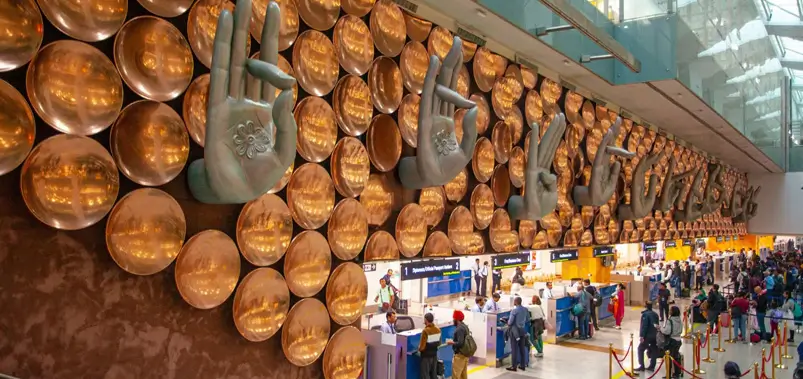
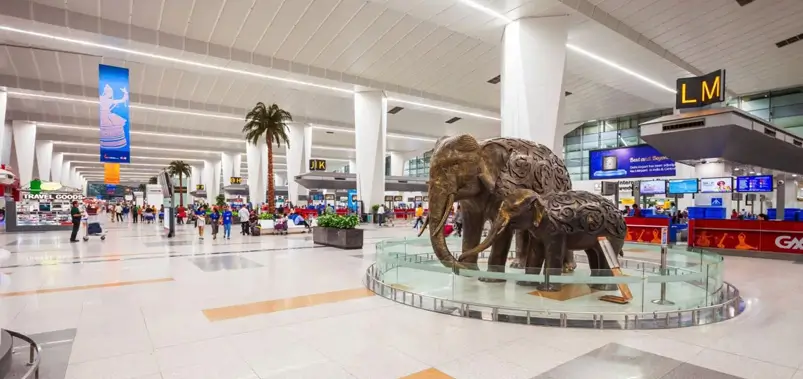
Delhi's Indira Gandhi International Airport is the natural gateway for most Delhi Agra Jaipur luxury tours. Starting in Delhi avoids adding another domestic flight before the main journey has even begun. After completing the Delhi stay, travellers can continue to Agra by private chauffeur driven vehicle and later travel to Jaipur.
This makes a nonstop flight to Delhi especially attractive when a suitable service operates from the traveller's departure city.
For UK travellers, London to Delhi is one of the most straightforward long haul approaches. Airlines commonly associated with nonstop service on the route include Air India, British Airways and Virgin Atlantic, although schedules and frequencies can change. A direct journey avoids the additional airport transit involved in connecting through the Gulf or continental Europe.
The difference becomes more important in business class.
Suppose a traveller has a choice between an approximately nine hour nonstop journey and an itinerary involving two flights plus a three hour connection. The connecting itinerary may offer a superior lounge or a more fashionable airline product, but it can add several hours to the total journey.
For a traveller spending £5,000, £10,000 or considerably more on an India holiday, losing half a day simply to obtain a marginally better airline seat may make little sense.
US travellers face a more complicated decision because geography varies enormously. A passenger leaving New York has different choices from someone departing Los Angeles, Miami, Dallas or a smaller regional airport.
Nonstop US–Delhi options can be attractive where available, particularly for travellers who prioritise total journey time. Air India has historically been an important operator of nonstop India–US routes, while route networks and individual services can change. Travellers should verify current nonstop options for their exact dates.
One stop itineraries can nevertheless be excellent.
Emirates via Dubai, Qatar Airways via Doha and Etihad Airways via Abu Dhabi are prominent options for passengers who value high quality premium cabins and are comfortable making a connection. European hubs may also work depending on the traveller's origin and fare.
The right question is not “Which airline is the best?” in isolation.
It is: which itinerary gives this traveller the strongest combination of business class seat, total journey time, connection quality, arrival time and fare?
A two hour connection can be perfectly reasonable. A seven hour connection may be unattractive unless the fare difference or stopover opportunity makes it worthwhile.
Arrival time in Delhi also deserves attention. Landing late at night may allow the traveller to go directly to the hotel and sleep, but immigration and baggage collection can push hotel arrival much later. A morning arrival provides a full day ahead, yet travellers should resist filling that day with sightseeing after an overnight flight.
For guests travelling in premium cabins, Golden Triangle Tours can structure the ground itinerary around the confirmed arrival rather than expecting the flight to fit a rigid sightseeing schedule.
Discover Delhi, Agra, and Jaipur with a tailor-made luxury itinerary, private transfers, and handpicked 5-star hotels. Let our travel experts help you make the most of your business-class journey to India.
Airline branding tells only part of the story. Business class can vary dramatically according to aircraft, route and even the specific seat installed on the aircraft operating that day's flight.
Air India is especially relevant for travellers wanting direct access to India. The airline has been renewing parts of its fleet and premium product, but passengers should pay attention to the aircraft assigned to their flight. Cabin products can differ between aircraft, so the words “Air India Business Class” do not always describe one identical seat experience.
For passengers prioritising a nonstop route, that may still be a worthwhile trade off. Eliminating a connection can save hours and reduce the number of things that can go wrong between home and Delhi.
British Airways is another important choice for London origin travellers. On aircraft fitted with its newer Club Suite product, business class provides a significantly more private experience than older layouts. The exact aircraft and seat configuration should be checked when selecting the flight because equipment substitutions can occur.
Virgin Atlantic appeals to travellers who prefer its particular service style and Upper Class product. Again, the aircraft matters. A traveller paying a premium should look beyond the cabin name and inspect the seat map and operating aircraft before confirming.
For passengers comfortable with a connection, the major Gulf airlines deserve serious consideration.
Emirates routes passengers through Dubai. Depending on aircraft, its premium experience can differ considerably. Emirates' Airbus A380 has become particularly associated with the airline's high end long haul experience, while business class layouts on other aircraft can differ. Travellers should never assume that every Emirates business class seat is identical.
Qatar Airways routes through Doha and is particularly well known among premium travellers for Qsuite on aircraft and routes where that product is offered. Qsuite's privacy and seating arrangement can be especially attractive for couples. It is important, however, to check the actual flight because Qsuite is not guaranteed simply because the ticket says Qatar Airways Business Class.
Etihad Airways via Abu Dhabi provides another premium Gulf connection. Its business class product can be attractive for travellers who prefer breaking the journey into two sectors rather than spending an extremely long period on one aircraft.
This raises an important point for business class travel from the USA to India.
Not everyone prefers nonstop travel.
A traveller who sleeps exceptionally well on an aircraft may prefer one long flight and no interruption. Another may welcome getting off the aircraft in Doha or Dubai, taking a shower in a lounge, walking around and boarding a shorter second flight.
Older travellers may have their own preferences. Some dislike navigating an additional airport. Others find an ultra long nonstop flight physically uncomfortable.
Couples can also value seat design differently. Certain modern business class products provide substantial privacy, but that privacy can make conversation between partners less convenient. Some seat configurations are better for couples, while others are particularly strong for solo travellers.
The cabin should therefore be matched to the passenger rather than chosen according to online rankings.
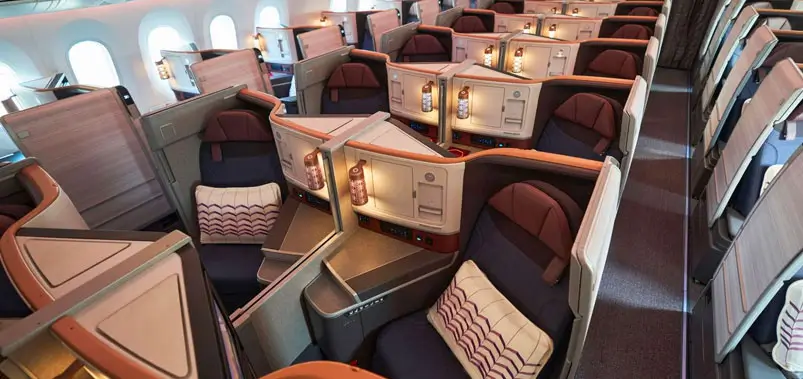
For a long haul India journey, the most valuable business class feature is usually a seat that converts into a properly flat sleeping surface.
The reason is practical rather than glamorous.
If a traveller can sleep for five or six hours during an overnight flight and arrive in Delhi reasonably rested, the premium ticket has influenced the holiday itself. A larger entertainment screen or expensive champagne may be pleasant, but it rarely changes the first day in India as much as sleep does.
Direct aisle access is another important feature. Older business class layouts sometimes require a passenger to step past another traveller to reach the aisle. Modern premium cabins increasingly avoid this problem.
For couples, seat selection matters. Two middle seats may create a more sociable arrangement on some aircraft, while window seats offer greater privacy. Seat maps should be checked before payment or immediately after booking.
A privacy door can be attractive but should not become the sole reason for choosing an inconvenient itinerary. A traveller may gain more from a nonstop flight with an excellent flat bed than from adding a connection simply to obtain a suite style seat.
Lounge access becomes particularly useful when the passenger has a connection.
At London Heathrow, New York, Doha, Dubai, Abu Dhabi and other major hubs, business class lounges can provide food, quieter seating, workspace and, at selected lounges, shower facilities. The exact lounge depends on airline, ticket, terminal and eligibility.
A shower during a long connection can be genuinely valuable before another flight. By comparison, a spectacular lounge is much less important when the passenger arrives only shortly before boarding a nonstop flight.
Fast track security or premium check-in can also reduce friction where available, although arrangements differ by airport.
Baggage allowance matters more on a luxury India vacation than many passengers initially expect. Travellers may begin with substantial luggage and then purchase textiles, handicrafts or other items during the trip. Business class baggage allowances are often more generous than economy, but the exact allowance must be checked on the ticket because airline and route rules differ.
Chauffeur transfers associated with airline tickets need particular attention. Premium airlines have changed chauffeur policies over time, and availability can depend on fare type, city and ticket conditions. Travellers should not assume that booking business class automatically includes a car from home or to the hotel.
For the India portion, arranging a dedicated airport transfer independently of the airline can be more reliable because it forms part of the wider ground itinerary.
The driver can be coordinated with the flight arrival and hotel booking, and the same travel team remains responsible if timings change.
Wi-Fi is useful for business travellers, but it should be treated as a convenience rather than a guarantee of office quality connectivity. Aircraft internet performance and complimentary allowances vary.
Food is another feature that receives disproportionate attention in airline reviews. A premium meal is enjoyable, but travellers taking an overnight flight may be better served by eating in the lounge, boarding, having a light meal and maximising sleep.
For a Golden Triangle holiday, arriving rested is worth more than staying awake for every course.
Wondering which flights, airlines, and premium upgrades are worth the investment? Get expert guidance on planning a seamless Golden Triangle tour with business-class comfort and personalized travel experiences.
Premium airfare changes constantly. Season, route, booking class, airline, departure airport, holidays and remaining seat inventory can move prices significantly.
For that reason, a single advertised fare should never be treated as a permanent business class fare to India.
As a broad premium market concept rather than a live quotation, return business class travel between London and Delhi can frequently run into several thousand pounds per passenger. US–India business class tickets can similarly reach several thousand dollars and may rise substantially during popular travel periods or when booking flexible premium fares.
For two travellers, the flight budget alone can therefore become one of the largest components of the holiday.
A couple spending approximately $10,000 on business class flights should think carefully about whether the selected schedule is actually improving their journey. Paying for premium travel while accepting an inconvenient overnight airport connection defeats much of the purpose.
The fare conditions also matter.
The cheapest business class ticket may carry restrictions on changes or refunds. A more expensive flexible fare can be worthwhile for travellers whose work commitments or family circumstances could alter the trip.
Points and miles can dramatically change the calculation.
Travellers with substantial airline miles, credit card points or transferable reward currencies may find business class redemption attractive when award seats are available. Availability can be limited, particularly for couples needing two seats on the same flight.
Upgrading from premium economy is another possibility, but travellers should not purchase a lower cabin on the assumption that a cheap upgrade will definitely appear later. Upgrade availability and pricing are controlled by the airline and can change until departure.
Cash upgrade offers sometimes appear through airline apps, websites or check-in channels. They can be appealing, but the value depends on the length of the flight and what is included.
Upgrading a one hour sector offers little benefit compared with upgrading a ten or fifteen hour overnight sector.
For a traveller considering where to spend additional money, the long haul bed should usually receive priority.
Premium economy can also be a rational alternative for travellers who cannot justify business class in both directions. Some passengers choose business class on the overnight sector where sleep matters most and a lower premium cabin on the daytime return, although ticketing combinations and pricing need to be checked.
The same logic applies to connections. If a journey contains a fourteen hour sector followed by a two hour sector, the quality of the long flight should dominate the decision.
A high end India holiday should be considered as one complete experience. An extra $2,000 spent on flights has an opportunity cost: that money might otherwise fund a suite upgrade, additional palace hotel nights, private experiences or several extra days in India.
There is no universal correct answer. The important point is to compare what the extra airfare actually changes.
The flight and the India itinerary are often booked as though they are unrelated purchases. For luxury travellers, they should work together.
A passenger landing in Delhi after an overnight journey should not be expected to begin six hours of sightseeing immediately.
Even with a flat bed business class seat, international travel involves airport transfers, check-in, security, boarding, immigration and baggage collection. The arrival day should therefore have enough flexibility for the guest to respond to how they actually feel.
A private Golden Triangle tour from Delhi Airport makes this easier.
The chauffeur can collect guests according to the confirmed arrival arrangement and transfer them directly to the hotel. Once checked in, they can decide whether they want a light meal, spa treatment, short drive or simply sleep.
Delhi can then begin properly the following day.
After two or three nights, the private road journey to Agra is relatively straightforward. Travellers do not need another airport immediately after their international arrival. A well maintained premium vehicle with sufficient luggage space is far more important than simply selecting the most expensive car badge.
Agra should receive at least enough time for the Taj Mahal without turning the visit into a race. The Taj is generally open from sunrise to sunset and normally closed to general visitors on Fridays, so flight dates and the wider itinerary should avoid creating an unnecessary scheduling conflict.
Jaipur can follow by road. Travellers returning internationally from Delhi can either drive back to Delhi according to the itinerary or use suitable domestic arrangements where appropriate.
Another option is to build a longer India journey and finish in a different international gateway. That can sometimes reduce backtracking, but the airfare must be checked carefully because open jaw tickets may price differently from simple return journeys.
For example, a longer private holiday might begin in Delhi, cover the Golden Triangle and Rajasthan, and eventually finish in Mumbai. In such a case, flying into Delhi and home from Mumbai may be more logical than returning all the way to Delhi simply because the international ticket was booked first.
This is especially important for travellers combining the Golden Triangle with Kerala or another distant region.
A domestic flight is often more sensible than spending an entire day or longer travelling overland. Business class on short domestic sectors, however, should be evaluated differently from international premium cabins. The seat and service may not resemble long haul international business class.
Travellers should check the aircraft and product rather than expecting a lie flat seat simply because the ticket says “business.”
A couple in their thirties taking a ten day anniversary holiday may prioritise privacy, cocktails and a sophisticated cabin. A traveller in their seventies may care far more about easy aisle access, minimum connections and a comfortable arrival time.
A business owner may need reliable connectivity and the ability to work before sleeping. A honeymoon couple may want two seats that allow conversation and dining together. A family may prioritise baggage and seat proximity.
These differences matter more than airline league tables.
For UK guests, a nonstop London–Delhi business class service can be particularly compelling because it keeps the journey simple. For US travellers, nonstop options should be compared carefully against high quality one stop Gulf routings. Travellers elsewhere should evaluate the same factors: total journey time, long haul seat, connection duration, arrival time, baggage and fare flexibility.
Golden Triangle Tours can then arrange the India portion around the selected flights with private airport transfers, chauffeur driven transportation, premium hotels and personal guides across Delhi, Agra and Jaipur.
The business class ticket should serve the holiday.
When the flight is chosen intelligently, travellers arrive with enough energy to appreciate Delhi rather than recover from the journey, enough flexibility to enjoy their first evening and enough comfort to begin a luxury India trip in the same spirit in which they intend to continue it.

We promise you a holiday where everything is taken care of from the moment you land. Trusted drivers waiting for you, handpicked hotels that fit your style, personalized itineraries designed just for your family, and a dedicated team on call 24/7. All you need to do is relax, explore, and create unforgettable memories, while we take care of every detail behind the scenes.
It can be particularly valuable on long overnight flights because a fully flat bed, direct aisle access, lounge facilities and priority airport services can make arrival considerably more comfortable. The value depends on fare, flight length and personal budget.
Delhi's Indira Gandhi International Airport is usually the most practical international gateway for Delhi Agra Jaipur private tours because Delhi forms one point of the Golden Triangle and provides road access towards Agra.
Air India, British Airways and Virgin Atlantic have been among the airlines associated with nonstop London–Delhi service. Schedules can change, so travellers should check current flights for their exact dates.
Not automatically. Nonstop travel reduces total journey time and connection risk, while Gulf carriers can offer highly regarded premium cabins and lounges. The stronger option depends on fare, seat product, total duration and personal preference.
No. Aircraft assignments and products vary. Travellers specifically seeking Qatar Airways Qsuite to India should verify the seat configuration of the exact flights before booking.
No. Seat designs vary by airline, aircraft and route, particularly on shorter sectors. Travellers should inspect the exact aircraft and seat map rather than relying only on the cabin name.
Premium fares fluctuate substantially. Return tickets from the UK or US can cost several thousand pounds or dollars per passenger and may rise considerably during busy periods or for flexible fares. Live pricing should always be checked for the actual travel dates.
For some travellers, yes. Premium economy can provide additional space at a lower cost than business class. Travellers who value sleep may place greater priority on business class for an overnight long-haul sector.
The two should ideally be coordinated. Arrival city, departure city and flight times can influence the most efficient route through India. A longer itinerary may also benefit from arriving in one Indian city and departing from another.
Yes. Golden Triangle Tours can structure private airport transfers and the Delhi, Agra and Jaipur itinerary around confirmed flight timings, with chauffeur-driven transportation, premium accommodation and personal guides arranged according to the traveller's schedule.