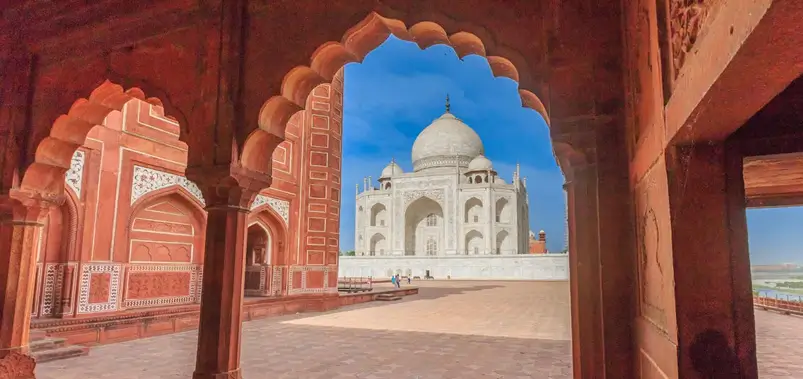
Here is the truth about most Agra visits: they are exactly half of what they could be.
The traveler arrives, visits the Taj Mahal - which is genuinely extraordinary and fully justifies its reputation - photographs the reflecting pool, spends ninety minutes inside the complex, returns to their hotel, and the next morning drives to Jaipur. Agra is checked off the list.
What remains unexplored is one of the most layered, historically rich, and experientially extraordinary cities on the Golden Triangle circuit. Agra was the capital of the Mughal Empire at its absolute zenith - under Akbar the Great, Jahangir, and Shah Jahan, three of history's most consequential rulers - for over a century. In that century, it produced not just the Taj Mahal but a constellation of monuments, a living craft tradition of global significance, a cuisine of extraordinary sophistication, and a historical narrative so dramatic and humanly compelling that no novelist could have invented it.
At Golden Triangle Tours, we design Agra experiences that go far beyond the standard visit. This guide reveals the experiences that most tourists miss entirely - and that make Agra one of the most genuinely extraordinary destinations on the Golden Triangle.
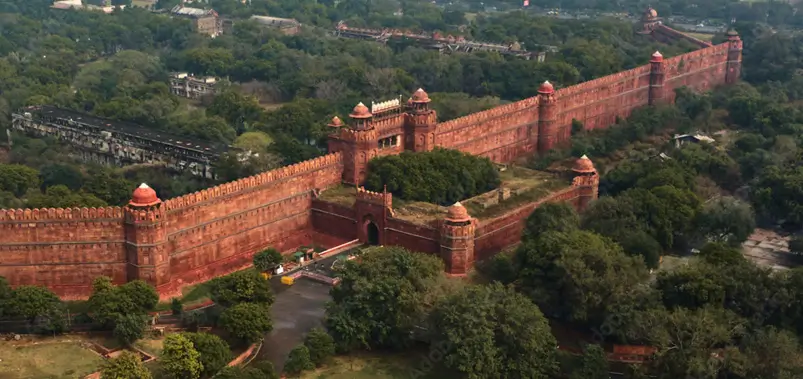
If the Taj Mahal is Agra's most beautiful monument, Agra Fort is its most historically significant - and the one that is most consistently underappreciated by travelers who rush through it to make their onward journey.
Agra Fort is a UNESCO World Heritage Site of the highest order. Built primarily by Emperor Akbar beginning in 1565, expanded by Jahangir and Shah Jahan, the fort served as the administrative capital of the Mughal Empire at its height. Emperors were born, crowned, and died within these red sandstone walls. Battles were planned here. Marriages were celebrated here. And in one of history's most poignant details, the fort's most beautiful tower became a prison - the cell from which the emperor who built the Taj Mahal spent his final years watching it from a distance.
What most tourists miss inside Agra Fort:
The Musamman Burj (Octagonal Tower): This is the room where Shah Jahan - imprisoned by his son Aurangzeb in 1658 - lived his final eight years. The tower is exquisitely beautiful: white marble inlaid with pietra dura floral work, arched openings looking north across the Yamuna River toward the distant white dome of the Taj Mahal. Standing here, knowing the story - the emperor looking at the monument he built for his wife, unable to reach it, dying with it in his sight - is one of the most emotionally resonant experiences available anywhere in India.
The Diwan-i-Khas (Hall of Private Audience): Where the emperor received his most trusted ministers and visiting dignitaries. The Peacock Throne - the most valuable throne ever made, studded with diamonds, rubies, emeralds, and pearls - once stood here before being looted by the Persian emperor Nadir Shah in 1739. The empty platform where it stood carries its own kind of historical weight.
The Jahangiri Mahal: The palace built by Akbar for his Rajput wives - a remarkable fusion of Hindu and Islamic architectural elements that represents the extraordinary cultural synthesis of Akbar's court. The carved stone brackets, the ornamental pool, and the intricate jali (latticed) screens are architectural achievements of the highest order.
The Khas Mahal and Sheesh Mahal: Shah Jahan's private palace within the fort - white marble, river views, and a smaller Hall of Mirrors that echoes the more famous Sheesh Mahal at Amber Fort in Jaipur.
At Golden Triangle Tours, we always schedule Agra Fort as a separate, dedicated half-day experience - not a rushed addition after the Taj. The fort deserves two to three hours with an expert guide who can narrate its political and personal history in full. This is the experience that makes the Taj Mahal more meaningful - because you understand the full story of the man who built it.
Fatehpur Sikri is one of the most extraordinary archaeological experiences in India - and one of the most consistently underestimated by travelers who treat it as a footnote to the Taj Mahal visit.
Located 40 kilometers west of Agra, Fatehpur Sikri was built by Emperor Akbar the Great beginning in 1571 as his new imperial capital - a complete city of red sandstone, conceived from scratch, built in less than fifteen years, and abandoned in 1585 when the water supply proved insufficient to sustain a population of hundreds of thousands.
The city was never sacked, never burned, never gradually dismantled for building materials. It was simply vacated - and in the centuries since, the desert slowly filled in the gardens, the wells ran dry, and the most completely preserved Mughal city in existence sat largely undisturbed.
Walking through Fatehpur Sikri today is an experience of uncanny completeness. The structures are intact. The scale is imperial. The Buland Darwaza - the Gate of Magnificence built by Akbar to commemorate his conquest of Gujarat - rises 54 meters above the entrance courtyard, the largest gateway in India and one of the most breathtaking architectural approaches in the world.
What your expert Golden Triangle Tours guide reveals at Fatehpur Sikri:
The Panch Mahal (Five-Story Palace): A cascading stepped pavilion of 176 columns - each one different in design, incorporating Hindu, Jain, Buddhist, and Islamic architectural elements - that was used as a wind tower and pleasure pavilion by the imperial harem. The mix of styles is not accidental: it reflects Akbar's famous religious pluralism, his synthesis of all the great traditions of his empire into a single architectural statement.
Diwan-i-Khas (Hall of Private Audience at Fatehpur Sikri): The most architecturally unusual space at the site - a single-room hall with a central carved stone pillar that branches into a circular platform at the top, connected to the four corners of the room by narrow bridges. Akbar is said to have sat on the central platform to receive his closest advisors, who reached him by the four bridges - a spatial arrangement that gave him supremacy while maintaining access. The symbolism is extraordinary.
The Tomb of Salim Chishti: The white marble shrine of the Sufi saint whose prophecy is said to have predicted the birth of Akbar's son (later Emperor Jahangir). Pilgrims still visit this tomb daily, tying threads to the marble lattice screens in supplication - a living religious practice in a city that has otherwise been empty for 440 years.
At Golden Triangle Tours, we include Fatehpur Sikri as standard in our Agra itineraries - typically scheduled on the drive from Delhi to Agra (Day 3 of the standard itinerary), arriving in Agra in the afternoon having already experienced one of India's most extraordinary archaeological sites.
Mughal cuisine - developed in the imperial kitchens of Akbar, Jahangir, Shah Jahan, and Aurangzeb over nearly two centuries - is one of the great culinary traditions of the world. Its influence on North Indian cuisine as a whole is so pervasive that most dishes eaten across northern India today descend directly from Mughal court recipes. The dum cooking technique (slow-cooking in sealed vessels over low heat), the use of saffron and edible silver, the perfuming of rice with kewra (screwpine water), the richness of korma - all of these are gifts of the Mughal kitchen.
In Agra, this culinary tradition can be experienced at its most authentic. At Golden Triangle Tours, we arrange private royal Mughal dining experiences for our guests that go beyond the standard restaurant visit:
Peshwari at ITC Mughal: The Peshwari restaurant at ITC Mughal is widely acknowledged as one of the finest Indian restaurants in the country - specializing in the hearty, aromatic cooking of the Northwest Frontier tradition that the Mughals brought from Central Asia to the subcontinent. The Sikandari Raan (whole leg of lamb marinated for 48 hours and slow-roasted in a tandoor) is a dish that requires advance ordering and rewards the commitment entirely. The Dal Bukhara - a recipe unchanged in over 30 years, slow-cooked for 18 hours - is one of the most celebrated lentil preparations in India.
In-Room Dining at Oberoi Amarvilas: For guests who want the Taj Mahal as the backdrop to their Mughal culinary experience, a private in-room or terrace dinner at Oberoi Amarvilas - with the monument visible throughout - prepared by the hotel's kitchen team using Mughal-inspired recipes, served by a dedicated butler, is one of the most extraordinary dining experiences available in India.
At Golden Triangle Tours, we pre-arrange all dining reservations - including specific dishes that require advance notice (the Sikandari Raan at Peshwari must be ordered 24 hours ahead) and private room setup at Amarvilas for terrace dining experiences.
The Taj Mahal is inlaid with pietra dura work - semi-precious stones set into white marble to create flowers, vines, and calligraphic inscriptions of extraordinary delicacy. This technique was practiced by craftsmen brought specifically from Persia, Florence, and Central Asia by Shah Jahan, and the tradition has been practiced in Agra by their descendants ever since.
Today, Agra's marble inlay workshops are the direct inheritors of the Taj Mahal's craft legacy - family workshops in the streets south of the monument where craftsmen using tools unchanged in four centuries continue to produce work of extraordinary beauty.
At Golden Triangle Tours, we take guests to vetted, certified marble inlay workshops - not the tourist-trap shops near the East Gate that sell machine-made products with painted rather than inlaid designs. In a genuine workshop, you see:
The stone cutting: semi-precious stones (malachite, lapis lazuli, carnelian, mother-of-pearl, turquoise) cut into precise shapes using a diamond-tipped blade barely 2mm wide.
The channel carving: a craftsman using a small chisel to cut channels in white Makrana marble - the same quarry that supplied the Taj Mahal - with a precision that requires years of practice to develop.
The setting: each stone piece fitted into its channel, secured with a combination of pressure and resin, then ground and polished until the surface is completely smooth - indistinguishable by touch from the surrounding marble.
The result: a piece of inlaid marble that carries directly on its surface the same technique used to create the most beautiful building in the world, made by the direct descendants of the craftsmen who built it.
Purchases from these workshops - a small inlaid plate, a jewelry box, a larger decorative panel - are among the most meaningful souvenirs available anywhere on the Golden Triangle. They are also, for equivalent quality, substantially less expensive than equivalent craftsmanship in any international market.
Mehtab Bagh (Moonlit Garden) - located directly across the Yamuna River from the Taj Mahal on the north bank - is one of the most extraordinary and least visited heritage sites in Agra.
Built by Emperor Babur (the founder of the Mughal Empire) in the 1520s and restored by Shah Jahan, Mehtab Bagh was designed as the riverside approach to the Taj Mahal - the final garden before the river crossing that would deliver a visitor to the monument's north gate (now closed). From its raised terrace, the view across the Yamuna River to the Taj Mahal is the most dramatic perspective on the monument available anywhere.
The sunset experience at Mehtab Bagh is one of Agra's finest moments - the Taj Mahal turning amber in the western light, its reflection trembling in the river below, the evening calls of birds from the riverside trees, and perhaps twenty other visitors in the entire garden. The contrast with the crowded forecourt of the main complex is total.
At Golden Triangle Tours, we incorporate Mehtab Bagh into every Agra itinerary - typically as the late afternoon extension after the main Taj Mahal visit. For guests staying two nights at Oberoi Amarvilas, we sometimes arrange the sunrise Taj Mahal visit from the main complex on Day 4 morning and the Mehtab Bagh sunset viewing on Day 3 evening - giving guests both ends of the daily light spectrum across two visits.
The story of Mehtab Bagh adds further dimension: Shah Jahan is said to have planned a Black Taj Mahal - a mirror monument in black marble for his own tomb - on this very site, connected to the white Taj Mahal by a bridge across the Yamuna. Archaeological excavations have found evidence of the foundations and black marble fragments that support this theory. The vision - two monuments, one white and one black, mirroring each other across the river - is so extraordinary that its non-realization (Shah Jahan was imprisoned before construction began) is one of history's great architectural might-have-beens.
Agra's bazaars are among the most authentic and least touristy on the Golden Triangle circuit - partly because most visitors spend so little time in the city beyond the Taj Mahal that the bazaars remain largely the domain of local traders rather than tourist shops.
What to seek in Agra's markets with a Golden Triangle Tours guide:
Agra Leather: The city has been a center of leather craft since the Mughal period, when the imperial household required saddles, harness, footwear, and decorative leather goods of the highest quality. Today, Agra leather goods - particularly shoes, bags, and belts - are made to traditional craft standards at a fraction of comparable international retail prices. Your guide takes you to established leather workshops (not the tourist shops near the Taj gate) where quality is genuine and the craft is visible.
Petha - Agra's Unique Sweet: Petha is a translucent candy made from the ash gourd (white pumpkin) - a confection that has been produced in Agra for centuries and is almost exclusively associated with this city. The finest Petha is made in the traditional workshops of Noori Gate in the old city - available in dozens of flavors (plain, saffron, angoori/grape-shaped, pan/betel leaf) and sold in ornate boxes that make beautiful gifts. Your guide knows which shops sell the genuine article rather than mass-produced versions.
Mughal-era Spice Market: The narrow lanes of Agra's spice market - sacks of dried chilies, turmeric, cumin, coriander, fennel, and the complex Mughal spice blends (garam masala formulations that date to imperial recipes) - are an extraordinary sensory experience. The prices are a fraction of international retail. The quality is exceptional.
For guests staying two nights in Agra - which Golden Triangle Tours strongly recommends - a private boat ride on the Yamuna River at sunrise is one of the most unusual and beautiful experiences available in the city.
Departing from the riverside ghats (stepped embankments) below Agra Fort at approximately 5:30 AM, a private wooden boat drifts slowly along the Yamuna as the sun rises behind you and the Taj Mahal - on the opposite bank, its white dome emerging from pre-dawn mist - comes into view ahead.
The river perspective on the Taj Mahal - seen from the water, from the angle that Shah Jahan himself saw it being constructed from the Musamman Burj of Agra Fort - is unlike any available from within the main complex. The monument is further away, smaller against the sky, and surrounded by the river and its banks in a way that reveals its relationship to the Yamuna - a relationship that was architecturally intentional, the river serving as the Taj Mahal's northern boundary and reflective surface in Shah Jahan's original design.
At Golden Triangle Tours, we arrange private boat rides through trusted operators - clean, safe vessels with comfortable seating and an experienced boatman who knows the optimal positions along the river for viewing and photography. This experience is typically arranged for the morning of Day 3 - before the Fatehpur Sikri drive - or for the early morning of the Agra Fort day.
Itimad-ud-Daulah - known colloquially as the Baby Taj - is a mausoleum built by Empress Nur Jahan between 1622 and 1628 for her father Mirza Ghiyas Beg, who served as chief minister to Emperor Jahangir.
It is, architecturally, one of the most important buildings in the history of Indian art - not because of its scale (it is relatively small compared to the Taj Mahal) but because it was the first Mughal structure built entirely in white marble and the first to use pietra dura inlay extensively as a decorative technique. The Taj Mahal - built five years later - took both of these innovations and elevated them to perfection. Visiting Itimad-ud-Daulah before or after the Taj Mahal creates an extraordinary before-and-after narrative of Mughal architectural evolution.
The building is extraordinarily beautiful in its own right - delicate, intricate, set in a formal Persian garden with a central water channel. The pietra dura work here is different in character from the Taj Mahal - more geometric, more colorful, incorporating patterns of wine cups, flower vases, and cypress trees that the more spiritually austere Taj does not include. It is, in the words of many architectural historians, the more personally expressive of the two buildings - less cosmic in intention, more humanly intimate.
At Golden Triangle Tours, we include Itimad-ud-Daulah as a standard element of the Agra experience for guests who have a second day in the city - typically visited in the late afternoon of Day 3 or the morning of Day 4 before the Taj Mahal sunrise, allowing guests to appreciate the architectural lineage that makes the Taj Mahal comprehensible as the culmination of a specific artistic tradition.
Everything described in this guide - Agra Fort's prison tower, Fatehpur Sikri's ghost city, the marble inlay workshops, Mehtab Bagh at sunset, the Yamuna River boat ride, Itimad-ud-Daulah, the Mughal dining experience, Agra's bazaars - cannot be experienced in a single day alongside the Taj Mahal.
The single-night Agra visit forces a brutal prioritization: the Taj Mahal and one other experience, rushed. Everything else is lost.
Two nights at Oberoi Amarvilas - our consistent recommendation for every luxury guest - allows the complete Agra experience: Agra Fort and Mehtab Bagh on the arrival day, Taj Mahal sunrise on the second morning, Fatehpur Sikri en route from Delhi, marble workshops and Itimad-ud-Daulah as additional elements depending on interest and energy.
Two nights in Agra creates a complete chapter - not a rushed stop. And the chapter that Agra can deliver - the full Mughal narrative, the architectural lineage, the living craft tradition, the extraordinary dining, and the most beautiful building on earth seen in multiple lights - is one of the finest chapters available to any traveler anywhere in the world.
We promise you a holiday where everything is taken care of from the moment you land. Trusted drivers waiting for you, handpicked hotels that fit your style, personalized itineraries designed just for your family, and a dedicated team on call 24/7. All you need to do is relax, explore, and create unforgettable memories, while we take care of every detail behind the scenes.
If you have only one day, the Taj Mahal must take priority - sunrise visit, interior, Mehtab Bagh. However, Agra Fort is a genuine UNESCO World Heritage Site of extraordinary historical significance, and skipping it entirely leaves a significant gap in the Agra experience. Our strong recommendation is two nights in Agra - which makes the question moot. For guests locked into one day, we schedule a brief 90-minute Agra Fort visit in the late afternoon, prioritizing the Musamman Burj (Shah Jahan's prison tower) as the single most emotionally significant space.
Allow 2 to 2.5 hours for a meaningful visit - enough time for the major structures (Buland Darwaza, Diwan-i-Khas, Panch Mahal, Jama Masjid, Tomb of Salim Chishti) with your expert guide providing full historical context. A rushed 45-minute visit misses the depth that makes Fatehpur Sikri extraordinary. Golden Triangle Tours schedules it as a dedicated mid-journey stop on the Delhi to Agra drive, allowing sufficient time without disrupting the afternoon Agra arrival.
Genuine pietra dura inlay work uses actual semi-precious stones - malachite, lapis lazuli, turquoise, carnelian, mother-of-pearl - individually cut and set into channels carved in white marble. The surface, when you run your finger across it, is completely smooth - the stone pieces flush with the surrounding marble. Fake products use paint applied to the surface to simulate inlay - you can feel the slight ridge between the "inlaid" pattern and the background. A second test: genuine inlay is cool to the touch (stone) while painted imitations are not significantly cooler than room temperature. Golden Triangle Tours takes guests only to verified, certified workshops - this is a commitment we make explicitly to every Agra guest.
Yes - the Yamuna River boat ride offers a view of the Taj Mahal's north face (river face) from the water. The monument is visible from the river at a distance of approximately 200 to 300 meters, depending on the river's water level and the path of the boat. This is not as close or as frontal as the main complex view, but it offers the unique perspective of seeing the Taj Mahal as it was seen from the water - as Shah Jahan intended in his original design. Photography from the boat is excellent, particularly in the warm light of early morning.
Not inferior - different. Itimad-ud-Daulah is a smaller, more intimate, and in some respects more personally expressive building than the Taj Mahal. It is architecturally important as the direct precursor - the building that established white marble and pietra dura inlay as the signature medium of Mughal imperial architecture. For travelers with an interest in architectural history, it is as important to see as the Taj Mahal itself. For travelers focused primarily on the visual impact of India's monuments, it is a significant secondary experience rather than an essential primary one.
Petha is a translucent confection made from ash gourd - unique to Agra and one of the most distinctive food souvenirs available anywhere on the Golden Triangle. The finest Petha is produced by Panchhi Petha - the most respected traditional producer in the city, with shops near Agra Cantt railway station and in the main market. Avoid the Petha sold directly outside the Taj Mahal complex - quality is inconsistent. Golden Triangle Tours guides know exactly which shops sell the genuine article.
Fatehpur Sikri is 40 kilometers west of Agra on the road toward Jaipur - making it ideally positioned either as a stop en route from Delhi to Agra (on the Delhi–Agra journey) or as a day excursion from Agra by private car. The drive from Agra to Fatehpur Sikri takes approximately 45 minutes to 1 hour in a private vehicle. Golden Triangle Tours handles all logistics - the stop is built into the itinerary rather than requiring separate arrangement.
The boat ride is available October through June - during most of the non-monsoon year. During monsoon season (July to September), the Yamuna water levels rise significantly and river boat activities may be suspended depending on conditions. During peak season (October to March), the river is at its most photogenic - clear water, gentle current, and the Taj Mahal visible at its architectural best from the water.
? Late afternoon - 4:00 to 6:00 PM in cooler months, 3:00 to 5:00 PM in summer - provides the finest light for photography at Agra Fort and the most atmospheric conditions for the Musamman Burj view across the Yamuna toward the Taj Mahal, which is lit by the warm western sun in late afternoon. Golden Triangle Tours schedules Agra Fort for the late afternoon of the arrival day (Day 3) - after checking into Oberoi Amarvilas - taking advantage of this light.
The finest Mughal cuisine in Agra is found at Peshwari restaurant at ITC Mughal - which is genuinely among the best Indian restaurants in the country. Beyond hotel dining, Golden Triangle Tours recommends a few specific local establishments known to serve excellent North Indian and Mughal-influenced food at a fraction of hotel prices. The Chaat and street food of Agra - particularly the savory snacks of the lanes near Kinari Bazaar - are also exceptional and entirely safe when navigated by an experienced guide.
Yes - categorically. Fatehpur Sikri is one of the ten most significant archaeological sites in India, an extraordinary UNESCO World Heritage Site, and an experience that transforms the understanding of the Mughal Empire in a way that no amount of Taj Mahal context can match. It is 40 kilometers from Agra - a modest addition to the Delhi-Agra drive. The 2-hour visit delivers understanding and visual experience that no other stop on the Golden Triangle replicates. Golden Triangle Tours includes Fatehpur Sikri as standard - not as an optional extra.
Because we design an Agra experience that goes far beyond the standard Taj-and-leave itinerary. When a traveler stands in Shah Jahan's prison tower knowing the full story of his imprisonment, visits Fatehpur Sikri and understands the complete Mughal narrative, watches the Taj Mahal emerge from the Yamuna mist on a morning boat ride, and dines at a table where the monument is visible throughout the evening meal - Agra is not just a monument stop. It is a complete, emotionally extraordinary chapter of one of the world's great travel experiences. That is what we design. Every time.