Most people who visit the Taj Mahal see it the same way.
They arrive mid-morning, join a queue at the South Gate or East Gate, shuffle through security screening with several hundred other tourists, walk the long sandstone pathway to the main forecourt, pause at the reflecting pool for a photograph, enter the mausoleum briefly, and leave within ninety minutes - slightly overwhelmed, slightly underwhelmed, and not entirely sure why one of the most famous experiences in the world felt somehow incomplete.
The problem is not the Taj Mahal. The problem is the approach.
The Taj Mahal is not a monument that rewards the standard tourist itinerary. It is a monument that rewards time, silence, knowledge, and deliberate planning. When those four elements are present - when you arrive at the right moment, with the right guide, with the right hotel at your back and the right table reserved for dinner - the Taj Mahal does not merely impress. It devastates, in the best possible sense. It becomes one of those rare travel experiences that genuinely changes something about how you see the world.
At Golden Triangle Tours, we have designed royal Taj Mahal experiences for thousands of international guests over two decades. This is everything we know - the private access strategies, the exclusive dining arrangements, the hidden viewing points, the historical depth that transforms a monument visit into a life memory.
Before we get into specifics, it is worth establishing what a royal experience of the Taj Mahal actually consists of - because it is not about VIP ropes or exclusive zones that simply don't exist. The Taj Mahal is a UNESCO World Heritage Site governed by the Archaeological Survey of India - there are no truly "private" access arrangements that place you alone in the monument.
What a royal Taj Mahal experience actually means is this:
Timing that gives you near-solitude. The gap between "near-empty" and "completely full" at the Taj Mahal is approximately 45 minutes - the window between gate opening at sunrise and the arrival of the main crowd. In that window, the experience is transformative.
A guide whose knowledge matches the monument. The difference between a mediocre guide and an expert historian at the Taj Mahal is the difference between reading a Wikipedia article and reading a great novel about the same subject. The monument does not change. The understanding of it changes completely.
A hotel that makes the Taj Mahal part of your entire day - not just the two hours you spend inside it. The Oberoi Amarvilas achieves this. No other hotel on earth does.
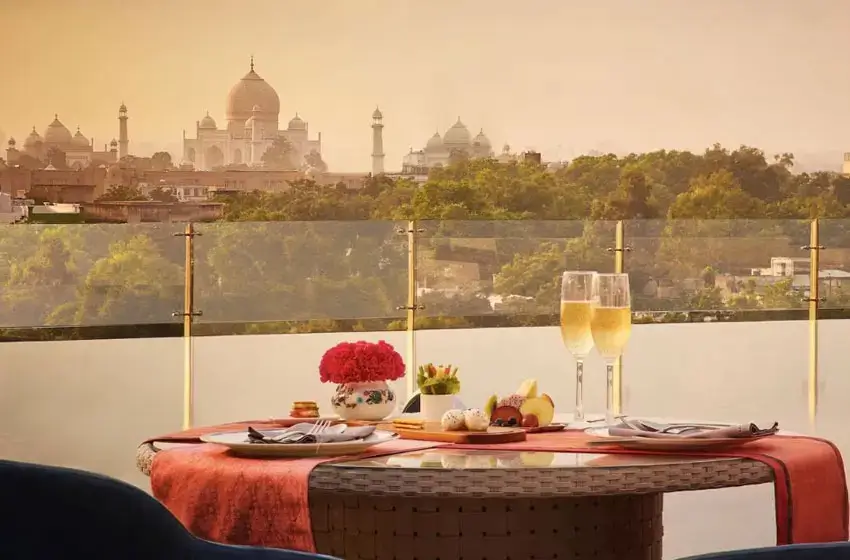
Dining experiences that use the monument as their backdrop. A private dinner with the illuminated Taj Mahal visible throughout your meal is available - when properly arranged.
Alternative perspectives - the riverside view from Mehtab Bagh, the view from the Agra Fort ramparts - that reveal dimensions of the monument most tourists never discover.
These are the elements of a royal experience. None require exclusivity zones. All require exceptional planning.
The foundation of any royal Taj Mahal experience is the Oberoi Amarvilas - and this is not a preference. It is a categorical fact.
Oberoi Amarvilas is the only hotel in the world where every single room, suite, and dining space has a direct, unobstructed view of the Taj Mahal. Not a partial view. Not a view from the roof terrace. Every window. Every balcony. Every bathroom. The Taj Mahal - all day, in every light, from the moment you wake to the moment you sleep.
This hotel was designed and built with a single governing principle: no room shall be without the view. The result - a Mughal-inspired property of extraordinary elegance, set on slightly elevated ground 600 meters from the East Gate - is the most singular hotel setting in India.
What the Amarvilas experience adds to your Taj Mahal journey:
Pre-dawn watching from your balcony. Before your sunrise tour, the Taj Mahal emerges slowly from darkness directly in front of you. The first light - a pale brightening of the marble against a dark sky - happens from your own private space, before you have even left your room. This private preview is something available nowhere else on earth.
The full day narrative. Staying at Amarvilas means you observe the Taj Mahal across its entire daily transformation - the rose-gold of sunrise, the brilliant white of midday, the warm amber of late afternoon, the mysterious blue of twilight, and the silver-white of moonlight. No other hotel allows you this complete experience.
Return at leisure. Unlike guests staying at other Agra hotels who make a single planned visit, Amarvilas guests can - and do - return to look at the Taj Mahal casually throughout the day. From the restaurant terrace over breakfast. From the pool lounger in the afternoon. From the balcony after dinner. The monument becomes a constant companion rather than a checked item on a list.
Room recommendation: Request a Premier Room or Premier Suite with Taj View - all rooms technically have the view, but the upper-floor rooms with private balconies maximize the experience. At Golden Triangle Tours, we note specific room preferences with every Amarvilas reservation.
The Taj Mahal sunrise experience is covered in comprehensive detail in our dedicated Taj Mahal Sunrise Private Tour guide. Here, in the context of the royal experience, the key point is this:
The sunrise visit is not optional for a royal Taj Mahal experience. It is mandatory.
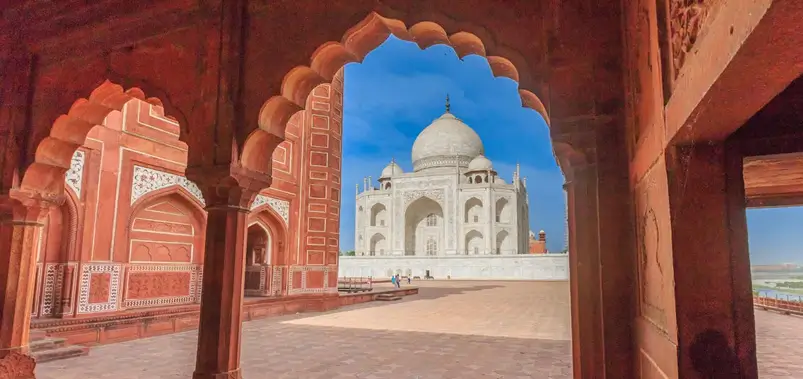
The difference between the Taj Mahal at sunrise - cool air, near-silence, soft directional light on white marble, fewer than fifty people in the entire complex - and the Taj Mahal at 10:00 AM - bright harsh light, several hundred tourists, audio guides competing with each other, the reflecting pool occupied by people taking photographs - is the difference between experiencing the monument as it was designed to be experienced and experiencing it as a crowded tourist attraction.
Shah Jahan did not design the Taj Mahal to be seen under harsh noon sun with crowds pressing on every side. He designed it to be approached with ceremony, with silence, and with the quality of light that Agra's early morning provides most perfectly.
The royal sunrise sequence at Golden Triangle Tours:
5:15 AM - Butler delivers morning tea or coffee to your Amarvilas room. The Taj Mahal is visible in the pre-dawn darkness directly outside your window.
5:30 AM - Your private vehicle departs Amarvilas for the East Gate. The journey takes less than five minutes.
5:45 AM - Your Golden Triangle Tours guide has your tickets ready. No queue, no scramble. You walk directly in.
6:00 AM (approximately) - First light touches the marble. You are standing at the near end of the reflecting pool, the Taj Mahal filling your entire field of vision, with perhaps twenty or thirty other visitors scattered across the vast complex. Your guide speaks quietly, contextually - never intruding on the silence unnecessarily.
For the next sixty to ninety minutes, the Taj Mahal is as close to your own private possession as it will ever be.
The Taj Mahal is simultaneously one of the most photographed and one of the most misunderstood structures on earth. Most visitors know the broad outline: Emperor built it for his wife. She died in childbirth. He spent twenty-one years building it. End of story.
This is like knowing that the Mona Lisa is a painting of a woman by Leonardo da Vinci. True, but so far from sufficient that it barely constitutes understanding.
A royal-level Taj Mahal experience requires a guide whose knowledge goes far deeper - and at Golden Triangle Tours, we specifically match guests with our senior historians for the Taj Mahal visit.
What your expert guide reveals:
The cosmological design. The Taj Mahal is not simply a beautiful tomb. It is a precise cosmological statement - a representation of the Throne of God as described in the Quran, with the central dome representing the heavenly vault, the four minarets as corner pillars of the universe, and the gardens representing the Islamic vision of paradise (the word paradise itself derives from the Persian word for garden, pardis). Every measurement, every orientation, every garden bed has theological significance.
The pietra dura masterwork. The Taj Mahal's white marble surface is inlaid with over 28 varieties of semi-precious and precious stones - jasper from Punjab, jade from China, lapis lazuli from Afghanistan, turquoise from Tibet, carnelian from Arabia. The floral and calligraphic inlays - visible up close in morning light in extraordinary detail - were crafted by artisans who traveled from as far as Persia and Central Asia. This is not decoration. It is one of the greatest achievements of human craft in any period of history.
The optical illusions. The Taj Mahal contains deliberate visual corrections - the minarets tilt slightly outward so that in the event of earthquake they fall away from the central structure. The calligraphy on the iwan (entrance portal) is sized progressively larger toward the top so that it reads uniformly from ground level. The proportions of the structure have been calculated to appear perfectly symmetrical from every approach angle.
The human story. Shah Jahan and Mumtaz Mahal had 14 children together across 19 years of marriage. When Mumtaz died during the delivery of their 14th child in 1631, Shah Jahan is said to have gone into mourning so profound that his hair turned white within weeks. The Taj Mahal - begun within a year of her death - was his life's work and his grief made architectural. His imprisonment by his son Aurangzeb in the Agra Fort, from where he could see the Taj in the distance, is a detail that transforms the monument from beautiful to heartbreaking.
When you know this story - fully, in its complexity and its tragedy - and you stand before the Taj Mahal at sunrise with the light changing, you are not looking at a building. You are looking at the physical form of human grief, transfigured by genius into something of incomprehensible beauty.
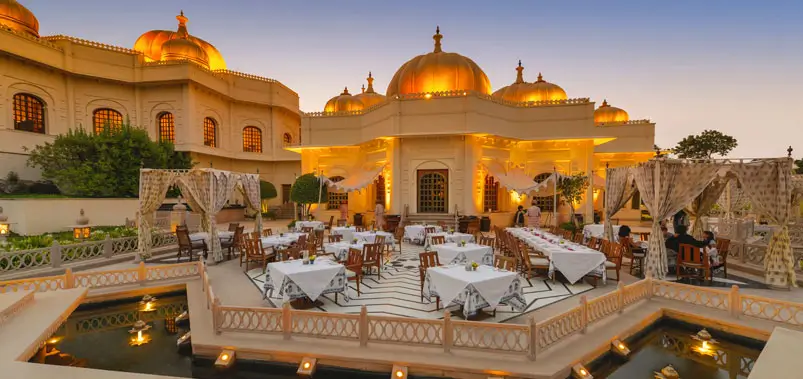
Bellevue - the Amarvilas signature restaurant - is set in a glass-fronted dining room with floor-to-ceiling windows that frame the Taj Mahal throughout every meal. Breakfast here, following the sunrise visit, is one of the finest post-sightseeing moments available anywhere in the world.
At Golden Triangle Tours, we arrange private terrace dinner reservations at Bellevue for guests who want the Taj Mahal illuminated as the backdrop to their evening meal. The hotel lights the monument grounds at night - the effect, visible through the restaurant windows, is extraordinary. A private table on the terrace, the warm Agra evening, the illuminated Taj, and a four-course dinner prepared by the Amarvilas kitchen - this is a dinner that most guests describe as the finest of their entire trip.
For an experience that goes beyond the Amarvilas setting, Golden Triangle Tours arranges private dinners within the grounds of Agra Fort - a service available to guests of select luxury operators on special request.
Dining on a candlelit terrace within the Mughal fort that Shah Jahan himself inhabited - the fort from which he watched the Taj Mahal being constructed, and from which he later watched it as a prisoner - with the monument visible in the distance across the Yamuna River, creates an atmosphere of historical resonance that no restaurant can manufacture.
This experience is arranged with significant advance notice and is not a standard offering - it represents the kind of curated arrangement that Golden Triangle Tours is positioned to create for guests who want something completely extraordinary.
Mehtab Bagh - the Moonlit Garden on the opposite bank of the Yamuna River - is the point from which Shah Jahan is said to have planned a Black Taj Mahal (a mirror monument in black marble for his own tomb, connected by a bridge across the Yamuna). The black marble garden never materialized - Shah Jahan was imprisoned before construction could begin - but Mehtab Bagh remains the finest riverside viewpoint for the Taj Mahal.
For guests who want a genuinely unusual experience, Golden Triangle Tours arranges a private sunrise breakfast at Mehtab Bagh - a prepared picnic breakfast served on the garden terrace with the Taj Mahal reflected in the Yamuna directly ahead. This is not a standard arrangement and requires specific pre-planning. But it is, for the guests we have arranged it for, among the most memorable mornings of their lives.
Most visitors see the Taj Mahal from two perspectives: the main forecourt and the interior mausoleum. A royal experience includes perspectives that most tourists never discover.
As described above - the Taj Mahal from the north bank of the Yamuna River, with its reflection in the water, seen from a near-empty garden. The monument seen from this angle - the full rear elevation and the river ghats leading to its foundations - is architecturally more dramatic than the famous frontal view. The photographs possible here are unlike any available from within the main complex.
From the Musamman Burj - the octagonal tower within Agra Fort from which the imprisoned Shah Jahan is said to have gazed at the Taj Mahal until his death - you see the monument as he saw it: small in the distance, across the wide sweep of the Yamuna River, through a carved marble screen. This view is simultaneously the most heartbreaking and the most beautiful perspective on the Taj Mahal available anywhere. Understanding what it meant to the man who built it - to see his greatest creation as a prisoner, knowing he would never walk its gardens again - transforms the entire experience.
Walking to the eastern or western edge of the Taj Mahal complex and viewing the monument from a 45-degree angle - with the red sandstone mosque on one side and the open Yamuna river landscape on the other - provides a compositional perspective that reveals the relationship between the white marble central structure and its surrounding elements in a completely different way from the frontal view. This angle is significantly less photographed and produces images of considerable architectural beauty.
On the five nights surrounding each full moon, the Archaeological Survey of India operates a special moonlight viewing of the Taj Mahal - a timed entry of small groups (approximately 50 people per session) who experience the monument by moonlight. The white marble at full moon - luminous, ethereal, completely silent - is an experience of such beauty that many guests who arrange this viewing describe it as superior even to the sunrise experience.
At Golden Triangle Tours, we track full moon dates and incorporate moonlight viewing into itineraries for guests whose travel dates align. Permits for this experience are limited and must be booked weeks in advance. If your travel dates coincide with a full moon, we prioritize this arrangement.
A royal Taj Mahal day - sunrise tour at 5:30 AM, fort visit, Mehtab Bagh, expert historical narration, private dinner arrangements - is emotionally and physically full. The afternoon, between sightseeing and dinner, is best spent at the Oberoi Amarvilas spa.
The Amarvilas spa offers a full range of Ayurvedic and international wellness treatments - signature Mughal-inspired oil massages, aromatherapy, and body treatments using ingredients that connect your spa experience to the history of the region. The spa's treatment rooms are set in a beautifully designed facility adjacent to the hotel's garden terrace.
At Golden Triangle Tours, we pre-book couples spa treatments at Amarvilas for guests who want this scheduled into their day - ensuring your preferred treatment time (typically 2:00 PM to 4:00 PM) is confirmed before arrival in Agra.
The Taj Mahal was built by craftsmen whose skills have been inherited, practiced, and refined across nearly four centuries in the workshops of Agra. Visiting these workshops - with your Golden Triangle Tours guide connecting you to the genuine artisans rather than tourist shops - creates a profound link between the monument and its living craft legacy.
Marble inlay workshops: The same pietra dura technique used to create the Taj Mahal's floral inlays is practiced today by families whose ancestors worked on the original monument. Watching a craftsman set a piece of turquoise into a pre-carved marble channel - slowly, precisely, with tools that have not changed in 400 years - and then connecting what you are watching to the inlay work you examined on the Taj Mahal itself that morning, creates a connection to the monument that photographs and guidebooks cannot provide.
At Golden Triangle Tours, we take guests to vetted, certified marble inlay workshops - not the tourist-trap shops near the gate - where quality is genuine and the craftsmen are the real inheritors of the Taj Mahal tradition. Purchases from these workshops are among the most meaningful souvenirs our guests bring home.
Here is how a complete royal Taj Mahal day looks, as designed by Golden Triangle Tours for our luxury guests:
5:15 AM - Morning tea delivered to your Oberoi Amarvilas balcony. First observation of the Taj Mahal in pre-dawn darkness.
5:30 AM - Private vehicle departs for East Gate. Guide has tickets ready.
5:45 AM to 8:00 AM - Taj Mahal sunrise private tour: reflecting pool, exterior photography, interior mausoleum, expert historical narration.
8:15 AM - Transfer to Mehtab Bagh for riverside view and photography.
9:00 AM - Return to Oberoi Amarvilas for full breakfast at Bellevue with Taj view.
10:30 AM - Agra Fort visit with private expert guide: imperial apartments, Musamman Burj (Shah Jahan's prison tower with distant Taj view), audience halls.
12:30 PM - Return to Amarvilas. Lunch at hotel.
2:00 PM to 4:00 PM - Couples spa treatment at Amarvilas (pre-booked).
4:30 PM - Marble inlay workshop visit with guide.
6:00 PM - Sunset viewing from Mehtab Bagh (optional, highly recommended).
7:30 PM - Private candlelit dinner on Amarvilas terrace with illuminated Taj Mahal view. Four courses, wine, the monument glowing white in the distance throughout your meal.
9:30 PM - Return to your suite. The Taj Mahal is still visible from your balcony - silver-white under the night sky.
This is a complete day. It is also one of the finest days available to any traveler anywhere in the world.
We promise you a holiday where everything is taken care of from the moment you land. Trusted drivers waiting for you, handpicked hotels that fit your style, personalized itineraries designed just for your family, and a dedicated team on call 24/7. All you need to do is relax, explore, and create unforgettable memories, while we take care of every detail behind the scenes.
Yes - through specific arrangements at Oberoi Amarvilas. The Bellevue restaurant's terrace tables look directly at the illuminated Taj Mahal throughout the evening. For a truly private setup - a dedicated terrace table reserved exclusively for your group with personalized menu and service - this requires advance arrangement through Golden Triangle Tours, typically 2 to 3 weeks before arrival. This is one of the most requested special experiences we arrange for our Agra guests.
For guests whose travel dates align with the full moon, absolutely yes. The Taj Mahal by moonlight - luminous white marble against a dark sky, the complex near-silent, the air cool and still - is an experience that many guests describe as even more moving than the sunrise visit. The permit process requires advance booking and specific timing. At Golden Triangle Tours, we incorporate this automatically into itineraries where the dates align.
Without question. Agra Fort is a UNESCO World Heritage Site of the highest significance - and the detail of Shah Jahan's imprisonment there, within sight of the Taj Mahal he built, adds a dimension of historical poignancy that makes the monument itself more meaningful. Visiting Agra Fort after the Taj Mahal - rather than instead of it - is what we recommend for every guest who has sufficient time in Agra.
Mehtab Bagh (Moonlit Garden) is a Mughal garden on the opposite (north) bank of the Yamuna River, directly across from the Taj Mahal. From its terrace, the monument's rear elevation and river front - rarely seen in photographs - are visible with the river between, creating a perspective of extraordinary drama. It is significantly less crowded than the main complex. The story of Shah Jahan's planned Black Taj Mahal on this site adds historical depth. We include it as standard in all our Agra itineraries.
A minimum of two nights is essential - one night for the Agra Fort arrival visit and settling in, a second night for the sunrise experience and full day exploration. Two nights at Oberoi Amarvilas is our standard recommendation, and guests who allow a third night consistently describe a deepened appreciation of both the monument and the hotel. Rushing through Agra in a single night is, in our experience, one of the most common Golden Triangle regrets we hear from guests who have done exactly that.
Pietra dura (Italian for "hard stone") is the art of inlaying semi-precious and precious stones into carved marble to create decorative patterns - flowers, vines, calligraphic inscriptions. On the Taj Mahal, this technique was executed with extraordinary sophistication using over 28 varieties of stones imported from across Asia and the Middle East. The inlay work is visible up close as intricate floral panels around every doorway, arch, and surface of the monument. Craftsmen in Agra's marble workshops practice the same technique today - visiting one of these workshops creates a living connection to the Taj Mahal's artistic legacy.
It is a completely different experience - smaller, more distant, more historical in significance. The view from the Musamman Burj (Shah Jahan's prison tower) is not about the scale of the monument but about understanding the story of the man who built it. Seeing the Taj Mahal from the tower where its creator spent his final years in captivity, knowing he would die having never walked its gardens again, is one of the most emotionally resonant experiences available in Agra.
Bellevue is open to non-resident guests for lunch and dinner with advance reservations. However, the private terrace arrangements that Golden Triangle Tours creates - dedicated tables, personalized menus, special occasion setups - are most effectively coordinated for guests staying at the hotel. Non-residents can enjoy the standard dining experience; the full royal dinner arrangement is most accessible for Amarvilas guests.
Morning fog and mist - common at Agra from December through February - create an extraordinary, almost supernatural atmosphere around the Taj Mahal. The monument emerging slowly from white mist, its marble glowing with diffused light rather than direct sun, creates images of exceptional beauty. Many professional photographers specifically travel to Agra in foggy season for precisely this atmosphere. If mist is present during your sunrise visit, embrace it completely.
Yes - though it is important to manage expectations. The interior of the Taj Mahal mausoleum is relatively small - a central octagonal chamber containing the ornamental cenotaphs of Shah Jahan and Mumtaz Mahal (the actual graves are in a lower vault below, closed to visitors). The interior's value lies in its scale - smaller than the exterior suggests, creating an intimate atmosphere - and in the extraordinary pietra dura inlay work that covers every surface. Photography is not permitted inside. Your guide's narration of the interior is more valuable than any photograph.
Yes - for guests staying two nights in Agra, we frequently arrange both. The sunrise experience at the main complex and an evening visit to Mehtab Bagh for the sunset riverside view across the Yamuna give you the complete daily arc of the monument in two completely different emotional registers. The morning is spiritual and quiet; the evening is warm, golden, and deeply romantic.
Independent visitors to the Taj Mahal queue for tickets, navigate security without guidance, and visit without historical context. They see a beautiful building. Our guests arrive with tickets ready, walk directly through security with a guide who has prepared specifically for their interests, spend the exact right amount of time at each element of the complex, hear the full story of Shah Jahan and Mumtaz Mahal told in its complete and moving form, and return to a hotel where the monument is still visible from their balcony. They experience something profoundly different - and they know it the moment they stand in that forecourt at sunrise and realize that the experience is exactly as extraordinary as they hoped it would be.