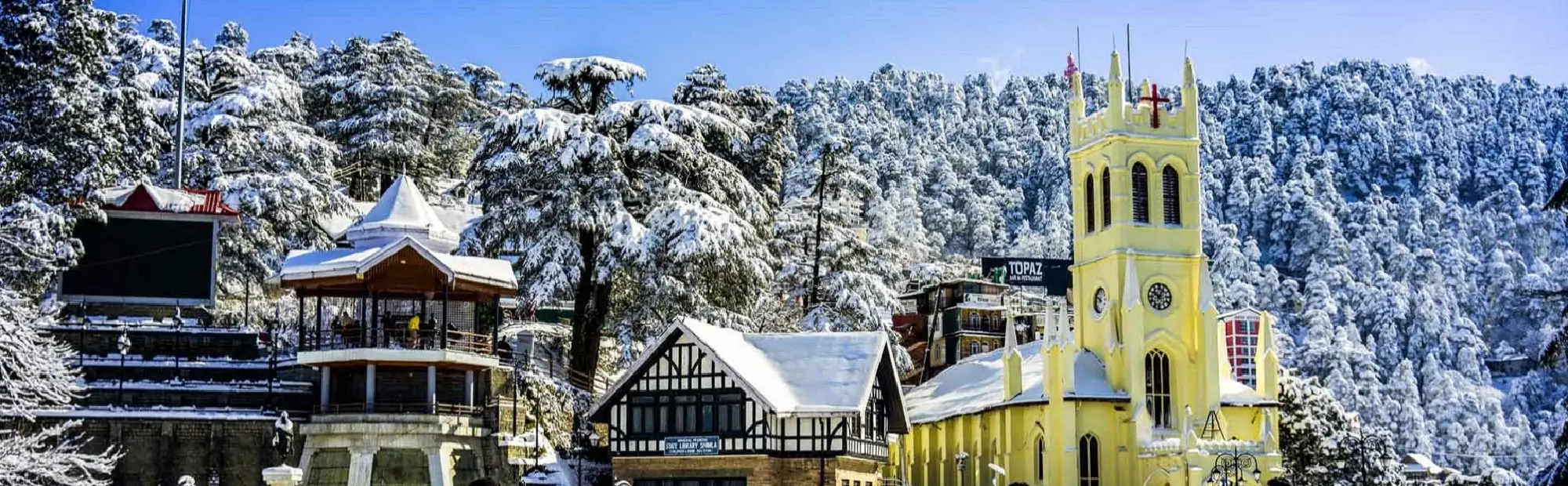
Shimla is one of India’s most well-known hill stations, located in the state of Himachal Pradesh in the lower Himalayan range. Once the summer capital of British India, Shimla combines colonial architecture, mountain scenery, and cool climate into a destination that feels distinctly different from India’s plains.
For international travellers, Shimla offers a refreshing contrast after visiting Delhi, Agra, or Rajasthan. The air is cooler, pine forests replace desert landscapes, and panoramic mountain views dominate the horizon.
Unlike purely spiritual or wildlife destinations, Shimla blends leisure, history, and scenic relaxation. It is well suited for travellers seeking a comfortable Himalayan introduction without venturing into high-altitude or remote regions.
Shimla’s appeal lies not only in its scenery but also in its colonial-era charm and walkable town center.

The Ridge, Mall Road, Christ Church, Viceregal Lodge, Jakhoo Temple

March – June & September – November
Pleasant temperatures and clear mountain views.

2 Days
Two days allow exploration and short excursions.

English, Hindi
English is widely spoken in hotels and shops.
Shimla’s historical importance dates back to the 19th century when it became the summer capital of British India. Government officials relocated here during the hot months to escape the heat of Delhi.
The town retains strong colonial influence, visible in buildings such as Christ Church and the Viceregal Lodge (also known as Rashtrapati Niwas). The Viceregal Lodge once housed the British Viceroy and played a significant role in political decisions during the independence era.
Walking along The Ridge and Mall Road, visitors encounter European-style architecture mixed with Indian mountain culture. The pedestrian-friendly center makes Shimla easy to explore without heavy traffic.
Shimla is perched at an elevation of approximately 2,200 meters (7,200 feet). The surrounding landscape includes cedar forests, rolling hills, and distant snow-capped peaks during winter months.
Morning mist often drifts across valleys, while sunsets create golden hues over layered mountain ridges.
Compared to high-altitude destinations like Leh Ladakh, Shimla remains accessible and comfortable for most travellers, including families and senior visitors.
Situated atop Jakhoo Hill, Jakhoo Temple offers panoramic views over Shimla and surrounding mountains. Dedicated to Lord Hanuman, the temple is known for its towering statue visible from across town.
Visitors can reach the temple via road or a short uphill walk. The elevated position provides some of the best photography opportunities in the area.
Shimla’s rhythm is relaxed. Evenings are often spent strolling along Mall Road, browsing local handicraft shops, or enjoying mountain cuisine in cafés and restaurants.
The town also serves as a base for short excursions to nearby destinations such as Kufri, known for scenic viewpoints and winter snowfall.
Unlike busier Indian cities, Shimla’s pedestrian core makes it easier to navigate without congestion.
One of Shimla’s highlights is the Kalka–Shimla railway, a UNESCO-listed mountain railway. The narrow-gauge train travels through tunnels and over bridges, offering scenic views across hills and valleys.
For international travellers, the train journey becomes part of the destination experience, adding heritage and nostalgia to mountain travel.
Shimla changes character across seasons:
Summer provides relief from heat, while winter offers a chance to experience Himalayan snow without extreme altitude.
Shimla offers a wide range of accommodations — from heritage hotels to modern mountain resorts. Some properties occupy restored colonial buildings, enhancing the historical atmosphere.
Luxury travellers can choose boutique mountain retreats offering valley views and curated dining experiences.
Because the town is built along slopes, walking may involve stairs and inclines.
Temperatures remain cooler than the plains year-round. Even during summer, evenings can be cool.
Warm clothing is recommended for winter visits.
Advance booking is advisable during peak season (April–June).
Shimla is accessible from North India.

Shimla Airport (limited connections)

Road connections from Delhi and Chandigarh

Kalka–Shimla toy train route
We promise you a holiday where everything is taken care of from the moment you land. Trusted drivers waiting for you, handpicked hotels that fit your style, personalized itineraries designed just for your family, and a dedicated team on call 24/7. All you need to do is relax, explore, and create unforgettable memories, while we take care of every detail behind the scenes.
Shimla is known for its colonial heritage and mountain scenery.
Two days are generally sufficient.
Yes, it is accessible and comfortable.
Yes, during winter months.
A pedestrian shopping and walking area.
Yes, it is considered safe.
Yes, it is approximately 7–8 hours by road.
Yes, especially in tourist areas.
A UNESCO-listed heritage railway route.
It is moderate altitude, comfortable for most travellers.
March to June and September to November.
No, but it is a popular mountain extension.