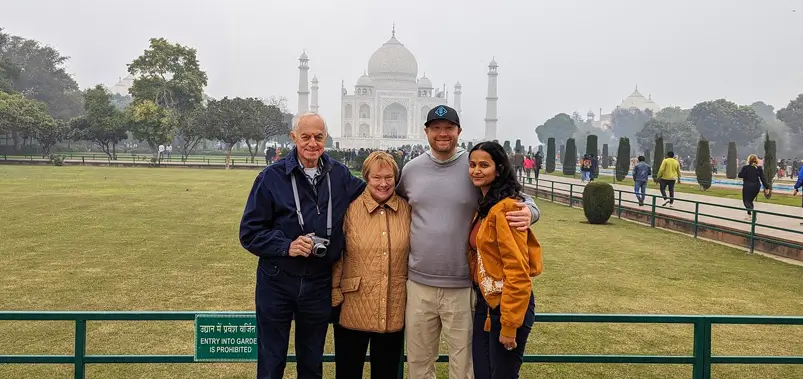
A private helicopter Taj Mahal tour sounds like the ultimate luxury day trip from Delhi: leave the capital without sitting in highway traffic, fly directly toward Agra, look down over North India's landscape, visit the Taj Mahal with a private guide, and return to Delhi the same day. For travelers from the United States who are accustomed to private aviation, helicopter transfers, and highly customized itineraries, the idea is immediately appealing.
There is, however, one extremely important point that needs to be understood before paying for such a trip.
A legitimate private helicopter service to Agra is not the same as a sightseeing helicopter circling directly over the Taj Mahal.
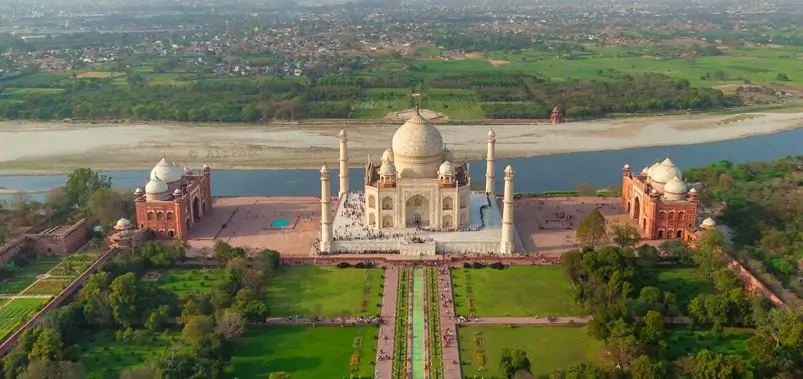
The Taj Mahal is protected by strict security restrictions. Official visitor information states that drone cameras are strictly prohibited inside and around the Taj Mahal, and security reporting identifies a protected no fly area around the monument. Visitors should therefore be skeptical of marketing that appears to promise a close helicopter orbit over the marble dome or unrestricted aerial photography immediately above the monument.
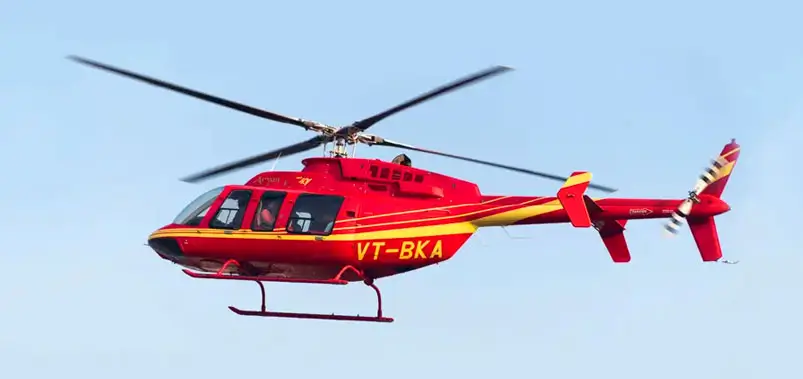
What can be arranged is much more realistic: a private helicopter or charter aircraft can transport travelers between Delhi and the Agra region, subject to aircraft availability, approved operating permissions, aviation conditions, landing arrangements, weather, and the operator's current schedule. After landing, travelers continue by private road transfer to the Taj Mahal and complete the monument visit on the ground.
That can still be exceptionally luxurious.
It can also cost thousands of dollars for a journey that many travelers could complete comfortably by private car or premium train for a small fraction of the price.
The real question is therefore not whether a helicopter to Agra is impressive. It unquestionably is. The question is whether the advantages—time savings, privacy, aviation experience, convenience, and exclusivity—justify the cost for your particular itinerary.
For some travelers, absolutely.
For others, a luxury private car from Delhi to Agra provides a more practical experience with far less operational complexity.
.webp)
The phrase Taj Mahal helicopter tour is frequently used online in ways that can create the wrong expectation.
A genuine charter itinerary normally begins from an approved aviation facility in or around Delhi rather than from a hotel lawn or arbitrary city location. Passengers complete operator required identification and security procedures before boarding the aircraft.
The helicopter then flies toward Agra using approved aviation routes.
Upon arrival in the Agra area, it lands at an approved facility rather than beside the Taj Mahal. A private vehicle and local guide should be waiting to transfer passengers from the landing point to the monument.
From that point onward, the sightseeing experience is essentially a premium private Agra visit.
A good itinerary normally includes the Taj Mahal, and travelers with adequate ground time may also include Agra Fort, lunch at a high end hotel, and possibly another selected attraction before returning to the aircraft.
One charter company currently markets a Delhi–Agra–Delhi helicopter package with four hours of waiting time. Its published package figure is ₹200,000 for the same day helicopter arrangement, while the same page also lists helicopter charter pricing starting from approximately US$4,747 for Delhi–Agra–Delhi. The difference illustrates why charter pricing should never be treated as a simple fixed ticket fare: aircraft type, actual availability, repositioning, flight duration, permissions, taxes, handling charges, and operating conditions can materially change a quotation.
For a genuinely premium trip, travelers should therefore be comfortable with a broad working budget rather than searching for one universal “Taj Mahal helicopter ticket.”
A realistic private helicopter charter can easily run in the range of approximately $4,500 to $8,000+ for the aircraft movement, with higher quotes entirely possible depending on helicopter model, passenger count, repositioning requirements, landing arrangements, and the operator.
Larger or more prestigious aircraft can cost considerably more.
This is normally a charter cost for the aircraft rather than a per person economy style fare. Four travelers sharing one suitable helicopter may therefore find the effective cost per person easier to justify than a couple chartering the same aircraft.
The quotation should state exactly what is included.
Ask whether the price covers aircraft positioning, flight time, crew, waiting time in Agra, landing charges, ground handling, taxes, private transfers in Agra, local guide, monument admission, meals, and any additional fees.
Never assume all of these are automatically included because a package is marketed as a “helicopter Taj Mahal tour.”
A truly high end service should also coordinate the ground experience. Saving time in the air and then spending an hour trying to locate a vehicle in Agra defeats the purpose of charter travel.
Your private car should be waiting when the helicopter lands. The guide should already be confirmed. Taj Mahal tickets should be arranged in advance whenever current ticketing procedures allow. The day's monument schedule should also account for the Taj Mahal's most important weekly restriction: the monument is closed to general visitors every Friday. The official Taj Mahal website confirms that it is otherwise open from approximately 30 minutes before sunrise until 30 minutes before sunset.
That Friday closure alone can invalidate an expensive charter itinerary if the trip is arranged carelessly.
This is the question premium travelers should ask before anything else.
The practical answer is that visitors should not expect a private sightseeing helicopter to circle directly above the Taj Mahal for photographs.
The monument is a highly protected site with strict aerial security measures. Official Taj Mahal guidance explicitly prohibits drone cameras inside and around the monument, and reporting on security enforcement describes a 500 meter protected no fly radius around the mausoleum.
Recent security measures have become even more sophisticated. Reporting has described anti drone systems around the Taj Mahal, reflecting the seriousness with which authorities treat unauthorized aerial activity near the monument.
This distinction is particularly important because luxury marketing sometimes uses aerial Taj Mahal photographs next to helicopter tour advertisements. That does not mean passengers will reproduce those same perspectives during a charter flight.
Approved helicopter routing depends on aviation authorities, security requirements, operational conditions, and the specific flight authorization.
A legitimate charter operator should be completely transparent about this.
Ask directly:
“Will the helicopter legally fly over or circle the Taj Mahal, or is this simply a helicopter transfer to Agra?”
If the answer is vague, request clarification before sending payment.
A reputable operator should not need to exaggerate the service. Flying privately from Delhi to Agra is already a premium experience. There is no need to promise an unauthorized close aerial pass.
Foreign travelers should apply the same caution to drones.
Do not bring a recreational drone expecting to launch it near the monument. Official Taj Mahal guidance states clearly that drones are prohibited inside and around the complex.
Even carrying unnecessary drone equipment into a highly secured monument area can create avoidable delays.
Leave it at the hotel.
There is no universal private helicopter Taj Mahal tour price because helicopters are chartered according to aircraft type and operating requirements rather than sold like fixed seat tourist buses.
For premium budgeting, it is safer to think in several levels.
A smaller charter helicopter suitable for a limited passenger load may produce a Delhi–Agra–Delhi quotation somewhere around $4,500 to $6,500 under favorable circumstances.
A larger helicopter, premium aircraft, difficult repositioning, high demand, additional waiting time, or more complex handling requirements could move the charter toward $7,000 to $10,000+.
Specialized VIP aircraft and bespoke arrangements can exceed that level substantially.
One commercial charter provider currently advertises Delhi–Agra–Delhi helicopter pricing starting around US$4,747, which provides a useful market reference but should not be interpreted as a guaranteed rate for every travel date.
Travelers should also budget for ground services.
A premium private Agra vehicle, licensed English speaking guide, monument tickets, high quality lunch, airport or helipad handling, and coordination services can add several hundred dollars depending on the service standard.
If the party wants a luxury suite for day use at a top Agra hotel, private dining, professional photography, or special assistance, the amount increases further.
For a couple, a complete high end helicopter day might therefore reasonably require a budget around $5,500 to $8,500+.
For four or five guests traveling together, the economics become more interesting because much of the aircraft cost is spread across the group.
Weight matters as well.
Helicopter operators do not determine capacity solely by the number of seats visible in a brochure. Passenger body weight, luggage, fuel requirements, weather, temperature, altitude, and aircraft performance can affect permitted load.
Every passenger may need to provide accurate weight information before the flight.
Large luggage should not be assumed acceptable.
For a same day Agra excursion, bring only what is necessary. Heavy baggage can create operational issues and is usually pointless because you are returning the same day.
Payment and cancellation terms deserve scrutiny because helicopter operations are vulnerable to weather and aviation restrictions.
Ask what happens if the flight cannot operate.
Will you receive a refund? Will the operator reschedule? Are repositioning expenses non refundable? Are government charges retained? Is a road alternative automatically substituted?
Those details matter when thousands of dollars are involved.
For most American travelers, this is the comparison that determines whether the charter makes sense.
Delhi to Agra is connected by the Yamuna Expressway, making the road journey relatively straightforward compared with many other intercity drives in India.
A private luxury vehicle will generally require approximately three to four hours each way, depending on starting point, Delhi traffic, stops, and conditions.
A helicopter can reduce time spent in transit, but the difference is not simply “four hours in a car versus 60 minutes in a helicopter.”
Charter passengers still need to travel from the Delhi hotel to the departure facility, complete aviation formalities, board the aircraft, land in Agra, transfer from the landing point into the city, and repeat the process for the return journey.
The true door to door saving may therefore be meaningful but smaller than the flight time comparison suggests.
A private car has several advantages.
You leave directly from your hotel.
There is no baggage weight concern for ordinary day trip items.
The schedule is more flexible.
Weather is less likely to cancel the entire transfer.
You can stop when necessary.
Your chauffeur remains available throughout the day.
The cost is dramatically lower.
For a high end private car—particularly a premium SUV, luxury MPV, or Mercedes class vehicle where available—a couple may spend hundreds rather than thousands of dollars.
Travelers should not dismiss that option merely because helicopter travel sounds more glamorous.
The drive itself can be comfortable when properly arranged. A clean premium vehicle, bottled water, experienced chauffeur, appropriate rest stop, and early departure can produce a very easy day.
Helicopter travel becomes more compelling when time has an unusually high value.
A chief executive visiting Delhi with only one free day, a celebrity requiring enhanced privacy, a family chartering multiple aircraft sectors, or travelers already accustomed to private aviation may view several thousand dollars as reasonable in exchange for reduced road exposure.
A honeymoon couple visiting India for two weeks may obtain far greater value by spending that same $6,000 on two nights at an exceptional palace hotel in Rajasthan.
That is the financial comparison luxury travelers should make.
Do not compare the helicopter with an economy taxi.
Compare the helicopter with what the same money could buy elsewhere in the itinerary.
.webp)
Rail can also be an efficient alternative between Delhi and Agra.
Fast trains connect the two cities, and journey times on selected services can be significantly shorter than driving.
The advantage is cost and efficiency.
The disadvantage is that the travel experience is still structured around a public departure schedule. Guests must leave the hotel in time for the station, pass through the station environment, board the train, manage luggage appropriately, and arrange ground transportation at both ends.
For travelers seeking maximum privacy, rail cannot compete with a charter helicopter.
For travelers interested only in reaching Agra quickly, however, premium rail can represent outstanding value.
This is another reason the helicopter should not be sold simply as the “fastest possible Taj Mahal tour.”
The right transportation depends on where your Delhi hotel is located, flight or train schedules, the number of travelers, baggage, desired arrival time, and whether Agra is a day trip or overnight stay.
An overnight Agra visit also changes the equation completely.
If you are staying at The Oberoi Amarvilas, for example, a private road transfer followed by a luxury overnight stay may feel more rewarding than spending a large amount on a same day helicopter charter.
Amarvilas is positioned close to the Taj Mahal and is renowned for views toward the monument from much of the property. A significant portion of the helicopter budget can instead fund a premium room or suite, private dining, spa time, and a sunrise Taj Mahal visit.
For many leisure travelers, that creates a richer luxury experience.
If a helicopter charter is selected, the itinerary should be built around the Taj Mahal rather than around the aircraft.
The first requirement is avoiding Friday.
The official Taj Mahal site confirms that general visitor access is closed on Fridays.
The next consideration is daylight.
The Taj Mahal is open from approximately 30 minutes before sunrise until 30 minutes before sunset, which makes early morning and late afternoon visits particularly desirable for light and temperature.
A same day helicopter arrival may not realistically deliver the classic sunrise experience unless the aircraft is approved to operate early enough and all logistics align.
If sunrise is essential, staying overnight in Agra is usually the cleaner solution.
For a day charter, an excellent schedule might begin with an early departure from Delhi, followed by arrival in Agra in the morning.
A pre-positioned luxury vehicle should transfer the guests directly toward the Taj Mahal parking zone. Official guidance notes that polluting vehicles are not permitted within 500 meters of the Taj Mahal, with designated parking areas and battery buses or golf carts used for the final approach.
This means even a Rolls Royce, Mercedes, or premium SUV cannot simply drive directly to the Taj Mahal entrance.
The private guide should already have the appropriate tickets and understand the entry procedure.
Allow approximately two hours for the Taj Mahal rather than trying to complete it in 45 minutes.
Travelers paying thousands of dollars to fly privately should not then rush through the reason they came.
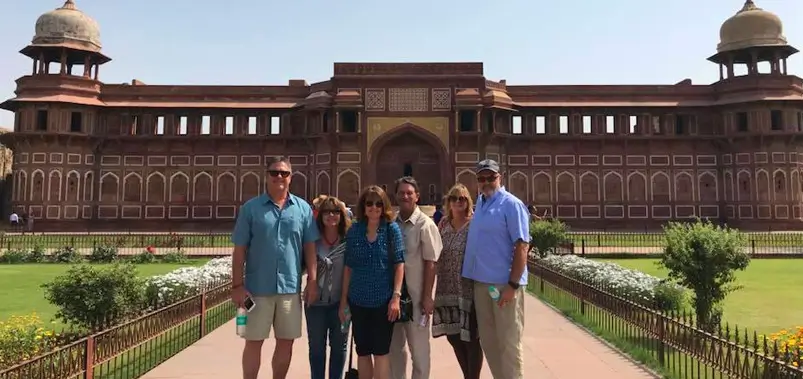
After the Taj Mahal, continue to Agra Fort.
The fort is open from sunrise to sunset, and the current foreign visitor admission is listed at ₹650 on ordinary days.
Allow approximately 60 to 90 minutes.
Lunch can then be taken at a leading luxury hotel. This also gives travelers a clean, air conditioned environment and proper restroom facilities before returning to the aircraft.
If the charter includes only four hours of aircraft waiting time, the ground itinerary must be managed very carefully.
Four hours disappears quickly once road transfers, security, monument visits, and lunch are included.
Travelers wanting a relaxed visit should consider paying for additional waiting time if operationally available rather than forcing Agra into an artificial rush.
A luxury Taj Mahal helicopter tour makes the most sense for travelers whose priorities align with what private aviation genuinely provides.
It works particularly well for very high net worth travelers who already use private aviation and value time above the additional cost.
It can suit business travelers who have a limited free window in Delhi and cannot comfortably allocate seven or eight hours to road transportation.
It can suit celebrity or high profile guests who prefer reducing exposure to long public movements.
It can work for small affluent private groups because the aircraft cost can be distributed across several passengers.
It can also make sense simply as a personal indulgence.
Luxury travel does not always require a financial justification. Some travelers want to arrive in Agra by helicopter because they have dreamed of doing it. If the cost is comfortable and expectations are realistic, there is nothing wrong with choosing the experience for its own sake.
It is less compelling for travelers who assume the main benefit is flying directly above the Taj Mahal.
That expectation should be corrected before booking.
It is also questionable for travelers operating within a defined luxury trip budget.
If $5,000 to $8,000 represents a meaningful percentage of the entire India travel budget, there are usually stronger places to spend the money.
That amount could fund exceptional palace accommodation, several domestic business class flights, a larger chauffeur driven vehicle for an entire Rajasthan journey, private guides, high end dining, and multiple additional experiences.
The helicopter is therefore best viewed as an ultra premium transportation upgrade, not an essential component of a luxury Golden Triangle Tour.
Private aviation should always be booked around safety first.
The cheapest quotation should never automatically win.
Ask the charter provider what helicopter type is being proposed, who operates the aircraft, what regulatory approvals apply, where the aircraft will depart and land, what passenger weight restrictions exist, and what happens during poor weather.
North India can experience visibility problems, particularly during periods of fog.
A helicopter schedule may be affected by visibility, weather, air traffic restrictions, security requirements, and other aviation factors outside the tour operator's control.
Travelers connecting directly to an international flight after a helicopter excursion should therefore be extremely cautious.
Do not build an itinerary in which a charter returning from Agra is your only realistic way to reach an international departure.
A weather disruption could create a major problem.
Whenever possible, keep a substantial buffer.
The charter company should also explain its cancellation and refund terms in writing.
Your India tour operator can coordinate the overall journey, but the actual aviation operation needs to be handled by an appropriately authorized aviation provider.
For guests booking through Golden Triangle Tours, the practical role of the company is to coordinate the helicopter charter with the Agra ground itinerary: private airport or landing point transfers, guide, Taj Mahal timing, Agra Fort, dining, and return schedule.
That creates a single premium travel flow rather than leaving the guest to coordinate an aircraft company, Agra guide, car supplier, and monument tickets separately.
There is one alternative that deserves serious consideration before chartering a helicopter: stay overnight in Agra.
Drive from Delhi in a premium chauffeured vehicle, check into a top hotel, enjoy the afternoon without rushing, visit Mehtab Bagh or another selected viewpoint when appropriate, have dinner, sleep properly, and enter the Taj Mahal close to sunrise the following morning.
The official monument hours begin approximately 30 minutes before sunrise, and early entry gives travelers a completely different atmosphere from midday.
For leisure travelers, this often produces a more meaningful experience than a frantic high cost day trip.
A budget of several thousand dollars can fund an exceptional room or suite, private vehicle, high quality guide, meals, and a far slower schedule.
After the Taj Mahal and Agra Fort, continue toward Jaipur rather than returning to Delhi.
That routing is exactly what makes the traditional Golden Triangle Tour so efficient.
Delhi to Agra, Agra to Jaipur, and Jaipur back to Delhi creates a continuous circuit. There is no need to fly back and forth solely for the sake of saying the Taj Mahal was visited in one day.
A helicopter becomes more rational when Agra is an isolated side trip from Delhi.
When Agra already sits inside a multi city Golden Triangle itinerary, the road route is usually superior.
That difference is essential.
For a private Delhi–Agra–Jaipur luxury tour, invest in the best vehicle you find comfortable and use the journey to move forward through the itinerary.
For an executive with six free hours in Delhi, investigate the helicopter.
For a traveler seeking an extraordinary aviation experience and unconcerned about the cost, book the helicopter with realistic expectations.
And for anyone being promised a private flight circling close above the Taj Mahal, verify exactly what is legally and operationally being offered before paying.
The most luxurious trip is not the one with the most expensive transportation. It is the one in which money is spent where it materially improves the experience.

We promise you a holiday where everything is taken care of from the moment you land. Trusted drivers waiting for you, handpicked hotels that fit your style, personalized itineraries designed just for your family, and a dedicated team on call 24/7. All you need to do is relax, explore, and create unforgettable memories, while we take care of every detail behind the scenes.
Yes, subject to operational availability, but it is often unnecessary for a standard Delhi–Agra–Jaipur Golden Triangle Tour because Agra naturally lies on the road route between Delhi and Jaipur. Helicopter travel makes more sense when Agra is being visited as a separate same-day excursion from Delhi.
It can be worthwhile for travelers who highly value time, privacy, private aviation, and exclusivity. For most leisure travelers, a premium private car and an overnight luxury stay in Agra provide considerably better value.
The flight itself is much faster, but travelers must include transfers to aviation facilities, security procedures, boarding, Agra ground transportation, and handling time. The door-to-door advantage is therefore smaller than simply comparing helicopter flight time with road time.
Official visitor information states that the Taj Mahal opens approximately 30 minutes before sunrise and closes 30 minutes before sunset, except on Fridays.
No. The Taj Mahal is closed to general visitors every Friday. This is particularly important when arranging an expensive private charter.
Exact flight time depends on the departure facility, helicopter type, aviation routing, and operating conditions. Travelers should ask the charter operator for the expected block time for the actual aircraft being proposed rather than relying on a generic advertised figure.
Usually, private helicopter services are priced primarily as an aircraft charter, not like ordinary airline tickets. The effective per-person price therefore falls when several passengers share a suitable aircraft.
A realistic premium budget is approximately $4,500 to $8,000+ for a private helicopter charter, depending on aircraft type, availability, passenger load, repositioning, waiting time, and operating charges. More exclusive aircraft can cost considerably more.
Travelers should not expect a sightseeing helicopter to circle directly over the Taj Mahal. The monument has strict aerial security protections, and official guidance prohibits drones in and around the site.
A private helicopter can potentially be chartered from Delhi to the Agra area, subject to aviation approvals, aircraft availability, weather, and landing arrangements. Passengers then continue by private vehicle to the Taj Mahal.