Jaipur does not ease you gently into its food. The first time a plate of pyaaz kachori arrives at your table, dark gold from the fryer, shining with ghee, served with three chutneys that range in colour from auburn to vivid green, you will understand immediately that this city takes eating seriously.
Rajasthani street food is unlike anything else in India. It was shaped by a landscape that offered very little fresh produce and a great deal of extreme heat, which meant the cuisine developed around techniques of deep frying, drying, pickling, and preserving, combined with generous quantities of spices that were both delicious and practically useful as preservatives. The result is food that is intensely flavoured, frequently very spicy by international standards, and almost universally satisfying.
The good news for first time foreign visitors is that Jaipur's street food is overwhelmingly vegetarian. You will encounter almost no meat on the street food circuit, which makes navigating it considerably simpler than in other Indian cities. The not so good news is that the spice levels can be genuinely challenging, and a few dishes require a slight leap of faith.
This guide covers the ten best street foods to try in Jaipur, with honest assessments of spice level, specific locations, approximate prices, and practical advice for visitors who are new to the experience.
Spice levels are real. Jaipur's street food is prepared for local palates, which have developed a genuine tolerance for chilli heat that most foreign visitors have not. Several dishes in this guide are very spicy indeed. Spice ratings are included for each entry so you can plan accordingly.
Hygiene varies. The general principle for street food in any Indian city is to eat from busy stalls where the turnover is high and food is cooked fresh in front of you. A popular stall with a queue of locals is almost always safer than an empty one. Avoid pre-cooked food that has been sitting for any length of time.
Water. Drink only bottled or purified water. Do not accept tap water or ice in drinks from street stalls.
Masala Chowk is the best starting point for nervous first timers. This organised open air food court near Albert Hall Museum brings together over twenty well known Jaipur street food vendors under one roof, in a cleaner and more structured environment than the street stalls. Entry costs Rs 10. It is an excellent introduction to the full range of Jaipur street food without the navigation challenge of the old city lanes.
Cash is king. Most street food stalls and older establishments accept cash only. Carry small denomination notes.
Stomach adjustment. Give your digestive system a day or two to adjust to Indian food before throwing everything at it. Start with milder items and work your way towards the more challenging ones.
Savor Jaipur's Authentic Flavors with a Private City Tour
Go beyond the famous attractions and experience Jaipur through its delicious street food, colorful bazaars, historic landmarks, and vibrant local culture. Travel comfortably in a private chauffeur-driven car and enjoy a personalized sightseeing tour at your own pace.
.webp)
Spice level: Medium to high Price: Rs 20 to Rs 40 per piece Best time: Morning, from around 8:00 AM
Pyaaz kachori is the definitive street food of Jaipur and the dish that most accurately represents the character of the city's cuisine. It is a disc of whole wheat dough, roughly the size of a fist, stuffed with a filling of spiced onions, lentils, dried mango powder, green chilli, and a complex mixture of aromatic spices. It is then deep fried in oil until the pastry is crunchy and golden, and served hot with two or three chutneys: typically a dark tamarind chutney, a vivid green coriander and mint chutney, and a spiced potato curry on the side.
The outside is crisp and shatters when you bite into it. The inside is soft, dense, and intensely savoury. The combination of the pastry, the filling, and the chutneys is something that takes a moment to understand and then becomes immediately compelling.
Where to go: Rawat Mishthan Bhandar, established in 1985, has multiple locations in Jaipur but the most famous is near Sindhi Camp, Station Road. This is widely regarded as the best kachori in Jaipur and the queue in the morning moves quickly despite its length. A second branch is on MI Road. The kachoris are made continuously throughout the morning and are best eaten within minutes of coming out of the fryer. They are considerably less good cold.
Honest note: The filling is heavily spiced. If you are sensitive to chilli heat, eat slowly and use the tamarind chutney rather than the green chutney, which is the spicier of the two.

Spice level: None (sweet drink) Price: Rs 40 for half kulhad, Rs 80 for full kulhad Best time: Morning, opens around 8:00 AM. Frequently sold out by noon
Lassi is a yoghurt based drink made by churning curd with water or milk and sweetening it with sugar. In most of India it is a pleasant, unremarkable refreshment. At the original Lassiwala on MI Road, it is something considerably more.
The original Lassiwala, formally named Kishan Lal Govind Narain Agarwal, has been operating from the same spot on MI Road since 1944. The lassi is served in a disposable clay cup called a kulhad, topped with a thick layer of malai (cream) that has been skimmed from fresh milk. It is cold, thick, sweet without being cloying, and flavoured with nothing other than the natural sourness of good curd and the sweetness of sugar.
The clay cup is part of the experience. The earthen taste it imparts to the lassi is subtle but real, and is part of what makes drinking from a kulhad different from drinking from a glass.
Important: Several adjacent shops have adopted the Lassiwala name to attract custom from visitors who do not know which shop is original. The original is Shop Number 312 on MI Road. Look for it specifically. The others are not bad but they are not the same.
Honest note: The lassi here is thick enough that a full kulhad is genuinely filling. If you have just eaten kachori, start with the half portion.

Spice level: Very high Price: Rs 15 to Rs 30 per piece Best time: Morning and evening
Mirchi bada is not for the faint of heart and is included in this guide with a genuine warning attached. It is a large green chilli, typically 10 to 12 centimetres long, stuffed with a filling of spiced mashed potato, coated in a chickpea flour batter, and deep fried until the batter is golden and crisp.
The chilli itself is the long Jaipur variety, which is considerably hotter than the mild green peppers common in European and North American cuisines. Even the stuffing contains chilli. The overall experience is intensely, eye wateringly spicy, and it is eaten habitually as a breakfast item in Jaipur.
Foreign visitors who try mirchi bada without preparation are frequently surprised by the heat. Those who try it knowingly and enjoy spice tend to find it one of the most memorable food experiences in Jaipur.
Where to go: Rawat Mishthan Bhandar serves a reliably good version. Street stalls around Badi Chaupar in the Walled City also sell them from early morning.
Honest note: Eat this with yoghurt or lassi nearby. Dairy is the most effective relief for chilli heat. Water will not help.
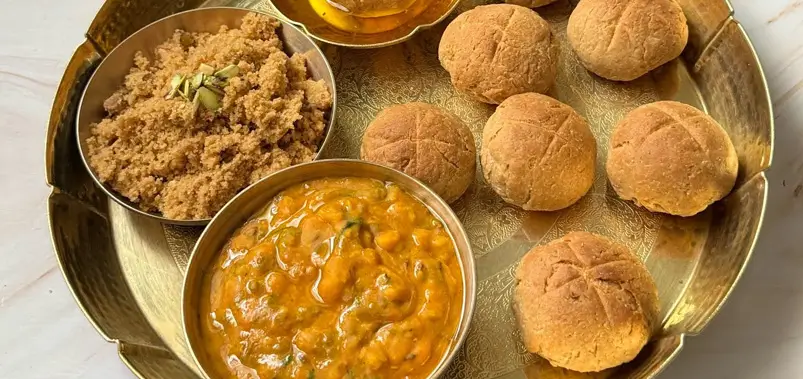
Spice level: Medium (dal is spiced, baati is neutral, churma is sweet) Price: Rs 150 to Rs 300 for a full portion at a restaurant Best time: Lunch or dinner
Dal baati churma is technically not a street food but a complete meal, and it is included here because no guide to eating in Jaipur is complete without it. It is the most significant dish in Rajasthani cuisine and the one that most clearly represents the food culture of the region.
The dish has three components. Baati are dense round balls of whole wheat dough, traditionally baked in a clay oven or over open coals until the outside is hard and the inside is soft. Before serving they are broken and soaked in generous quantities of melted ghee. Dal is a thick lentil curry, heavily spiced and deeply savoury. Churma is the sweet component: baati that has been fried rather than baked, then crumbled and mixed with sugar or jaggery, ghee, and cardamom.
The three elements are eaten together, and the combination of the savoury richness of the ghee soaked baati, the spiced depth of the dal, and the sweetness of the churma is extraordinary. It is a heavy meal, built for people who spend their days working outdoors in a hot climate, and it is entirely filling.
Where to go: Masala Chowk near Albert Hall Museum has a dedicated dal baati churma stall where it is made fresh in the traditional style. LMB (Laxmi Misthan Bhandar) on Johri Bazaar also serves a reliable version in a clean sit down environment. For the most atmospheric setting, Chokhi Dhani on the outskirts of Jaipur serves it as part of a traditional Rajasthani dinner.

Spice level: None (sweet) Price: Rs 30 to Rs 50 per piece Best time: Morning or as a sweet finish after a savoury meal
Mawa kachori is the sweet cousin of pyaaz kachori and one of the most distinctive sweets in Jaipur. The same fried pastry shell is filled with a mixture of mawa (reduced milk solids), dry fruits, coconut, and cardamom, then deep fried and dipped in sugar syrup so that it is simultaneously crispy, soft, sweet, and rich.
It is a heavier, more indulgent item than most Western desserts, and the combination of the fried pastry and the sweet filling is an acquired taste for some visitors. First time tasters often find it very sweet indeed. Those who grew up with similar traditions find it deeply comforting.
Where to go: Rawat Mishthan Bhandar is the most famous source for mawa kachori in Jaipur and serves them alongside the savoury pyaaz kachori. The contrast between the two on the same visit is illuminating.
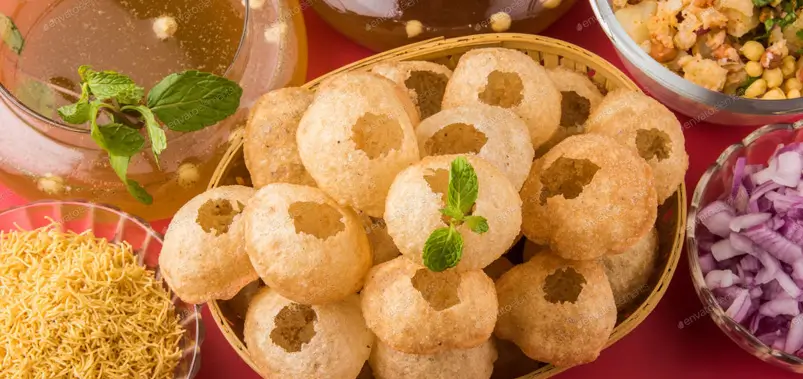
Spice level: Medium to high, depending on the water Price: Rs 20 to Rs 40 for a portion of six Best time: Evening
Golgappa is known by different names in different parts of India. In Delhi it is pani puri. In Mumbai it is puchka. In Jaipur it is golgappa, and the Jaipur version has its own particular character.
The dish consists of small hollow crispy spheres of semolina dough, about the size of a golf ball, which are filled at the stall with a mixture of spiced mashed chickpeas or potato, and then filled with flavoured water and eaten immediately in a single mouthful. The water is the defining element: it is typically made with tamarind, mint, coriander, and a combination of spices that produces a flavour simultaneously sour, spicy, cooling, and complex.
The ritual of eating golgappa is part of the pleasure. You stand at the stall, the vendor fills each sphere individually and hands it to you one at a time, and you eat each one in a single mouthful before the water has a chance to soak through the crispy shell. It is a communal, unhurried, sociable street food experience.
Where to go: Stalls along Johari Bazaar and around Badi Chaupar in the Walled City serve golgappa from the late afternoon. Masala Chowk also has reliable options in a slightly more organised setting.
Honest note: The water at some stalls is made with tap water, which is not suitable for foreign visitors. At reputable stalls this is made with purified water, but it is worth asking or observing the preparation. Masala Chowk is the safest option for first timers.
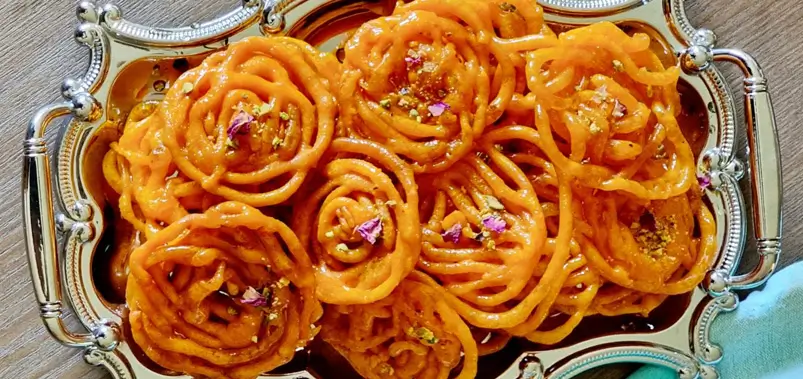
Spice level: None (sweet) Price: Rs 30 to Rs 60 per 100 grams Best time: Morning, when served hot from the fryer
Jalebi is one of the most beloved street sweets in North India and Jaipur's version, eaten hot and fresh from the fryer, is one of the best in the country.
The preparation involves piping a fermented batter in tight spirals directly into hot oil, frying until crispy, and then immediately submerging in warm sugar syrup. The result is a tangled golden orange coil that is crunchy on the outside and soaked through with sweet syrup on the inside.
The key to good jalebi is eating it within minutes of being made. Hot from the fryer, the contrast between the crispy exterior and the syrup saturated interior is remarkable. Cold jalebi from a tray that has been sitting for an hour is an entirely different and less interesting experience.
Where to go: Samrat Restaurant on Chaura Rasta in the Walled City is famous for its jalebi and has been serving them since before most visitors were born. The morning rush between 8:00 and 10:00 AM is the right time to go, when the jalebis come directly from the fryer in continuous batches.
Pair it with: Rabri, a thick condensed milk preparation flavoured with cardamom and saffron, is the traditional accompaniment to jalebi in Jaipur. The contrast of the sweet, syrupy jalebi and the cool, creamy rabri is one of the classic flavour combinations in Rajasthani food.
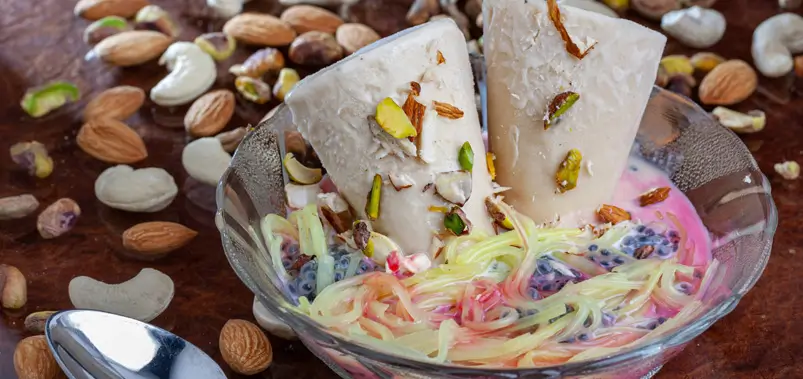
Spice level: None (sweet and creamy) Price: Rs 50 to Rs 100 per serving Best time: Afternoon or evening
Kulfi is the traditional Indian frozen dairy dessert, made from slowly simmered and reduced milk that is poured into moulds and frozen. Unlike Western ice cream, which is churned to incorporate air and create lightness, kulfi is dense, rich, and intensely milky. The most common flavours in Jaipur are malai (cream), pista (pistachio), and kesar (saffron).
Kulfi falooda combines a stick of kulfi with a bed of vermicelli noodles called falooda, a splash of rose syrup, and a drizzle of milk, served in a tall glass. The combination of textures and temperatures, cold kulfi melting into sweet milk soaked noodles, is one of those food experiences that is difficult to describe but easy to understand the first time you encounter it.
Where to go: Pandit Kulfi on Bapu Bazaar is one of the most famous kulfi vendors in Jaipur and has been serving from the same location for decades. Indian Ice Cream also on Bapu Bazaar specialises in kulfi falooda and is a consistent local favourite.

Spice level: Mild aromatic spice, not chilli Price: Rs 10 to Rs 30 per cup Best time: Morning, or whenever you need a rest
Masala chai is not unique to Jaipur but the city's version is worth mentioning because it is particularly good. Jaipur chai tends to be stronger, milkier, and more heavily spiced than in many other parts of India, with a generous hand applied to ginger, cardamom, and clove.
It is also the social lubricant of every street food tour. When you need a rest from walking the bazaars, when you want to stand somewhere and observe the city without purpose, when you have eaten something very spicy and want something warm and restorative, the answer in Jaipur is always chai.
Where to go: Sahu Ki Chai on Chaura Rasta in the Walled City is one of the most famous chai stalls in Jaipur and has a devoted local following. Gulab Ji Chai Wale near Ganpati Plaza is another institution, particularly good in the early morning. Beyond these names, any small chai stall with a kerosene stove and a cluster of locals standing around it is invariably a good option.
How to order: Ask for one cutting chai. A cutting is a half portion, served in a small glass, and is the standard street serving size. If you want a full cup, ask for a full glass.
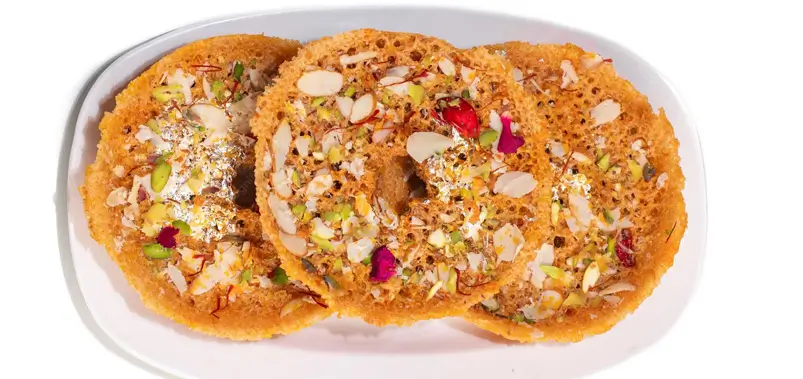
Spice level: None (sweet) Price: Rs 50 to Rs 200 depending on size and toppings Best time: Monsoon season (July to September) and Teej festival period. Available at specialist sweet shops year round
Ghewar is the most distinctive sweet in Rajasthan and one of the most technically demanding to make correctly. It is a large disc-shaped sweet made from a batter of flour, ghee, and water that is poured in a thin stream into a cylindrical mould of very hot oil. The batter sets in a porous honeycomb lattice as it fries, creating a structure that can absorb enormous quantities of flavouring.
The most traditional version is soaked in sugar syrup and topped with a thick layer of reduced milk cream called rabri, then scattered with saffron strands, crushed pistachios, and edible silver leaf. The result is simultaneously crunchy, soft, sweet, milky, and rich in a way that does not translate well to description but is immediately clear on first taste.
Ghewar is technically a seasonal sweet, traditionally made during the monsoon period and particularly associated with the festival of Teej. However, specialist sweet shops in Jaipur produce it year round to meet tourist demand.
Where to go: Rawat Mishthan Bhandar makes one of the most reliable ghewars in Jaipur. LMB (Laxmi Misthan Bhandar) on Johri Bazaar is another trusted source. For the full seasonal experience, visit during July or August when the ghewar made for Teej is at its most elaborate and the city's sweet shops display towers of the freshly made discs in their windows.
Discover the Real Taste of Jaipur Beyond the Tourist Trail
Experience Jaipur like a local with a private guided tour that combines authentic Rajasthani cuisine, traditional eateries, bustling old markets, and iconic heritage sites. Travel in a comfortable private car with an experienced driver and create unforgettable memories throughout your journey.
Understanding where the best food is concentrated saves time and prevents aimless wandering in the wrong direction.
MI Road: The most accessible area for foreign visitors and home to the original Lassiwala and a branch of Rawat Mishthan Bhandar. Also the location of LMB just off the main road in Johri Bazaar. This strip is manageable on foot and requires no navigation through narrow lanes.
Badi Chaupar and Johri Bazaar: The heart of the Walled City food scene. Kachori stalls open here from early morning. Golgappa carts appear from late afternoon. The streets around the main square have the most concentrated street food activity in the old city.
Masala Chowk: Located near Albert Hall Museum, this organised open air food court brings together over twenty of Jaipur's most famous street food vendors in one place. Entry is Rs 10. It is significantly cleaner and more structured than the street stalls, making it the best option for visitors who want variety without navigation stress. The Dal Baati Churma, kachori, golgappa, and kulfi falooda are all available here from reputable vendors.
Chaura Rasta: A street in the Walled City that runs between Johri Bazaar and Tripolia Bazaar. Famous for Samrat's jalebi and several good chai stalls. Less visited by tourists than the main bazaar areas.
Bapu Bazaar: Good for kulfi falooda and sweets in the afternoon and evening.
Eat from busy stalls. A queue of local customers is the most reliable indicator of quality and food safety. High turnover means fresh food cooked continuously.
Eat food that is cooked in front of you. Avoid pre-cooked items sitting in trays. Kachori, mirchi bada, jalebi, and golgappa are all prepared to order or in continuous batches and are best and safest when eaten immediately.
Start mild, then escalate. If you are new to spicy food, begin with lassi, jalebi, and mawa kachori before working up to pyaaz kachori and mirchi bada. Your tolerance will develop faster than you expect over a few days.
Carry antacid tablets. Not because the food is bad but because the quantity and richness of Rajasthani street food, combined with the adjustment your digestive system is making, can occasionally produce discomfort. An antacid is useful insurance.
The mornings are best. Most of Jaipur's best street food is at its peak in the morning hours between 8:00 and 11:00 AM. Kachori, jalebi, and lassi are all morning specialities and are significantly better fresh than later in the day.
Lassiwala sells out. The original Lassiwala on MI Road frequently runs out of lassi by noon or early afternoon. If it is on your list, go before 11:00 AM.
Ask about spice levels. Most street food vendors in Jaipur are accustomed to foreign visitors and will understand if you gesture a request for less chilli. The phrase kam mirchi (less chilli) is understood by essentially every food vendor in the city.
7:45 AM: Arrive at Badi Chaupar in the Walled City. Begin with a cutting chai from one of the small stalls in the lanes adjacent to the square.
8:00 AM: Pyaaz kachori from a stall near the square. Eat standing, with tamarind chutney.
9:00 AM: Walk to MI Road. Stop at the original Lassiwala (Shop 312) for a half kulhad lassi with malai. This is the correct antidote to the kachori spice.
9:30 AM: Walk along MI Road to Rawat Mishthan Bhandar for a mawa kachori. This brings the morning full circle from savoury to sweet.
10:00 AM: Continue into Johri Bazaar. The street is beginning to fill with activity. This is a good time to walk the bazaar before the midday crowds arrive.
Evening addition: Return to the Walled City for golgappa at a Johari Bazaar stall around 5:00 PM. End at Samrat on Chaura Rasta for fresh hot jalebi with rabri.
We promise you a holiday where everything is taken care of from the moment you land. Trusted drivers waiting for you, handpicked hotels that fit your style, personalized itineraries designed just for your family, and a dedicated team on call 24/7. All you need to do is relax, explore, and create unforgettable memories, while we take care of every detail behind the scenes.
Yes. A guided food walk through the Walled City is one of the most enjoyable ways to experience Jaipur street food for the first time. A good guide knows which specific stalls are reliable, can explain the cultural context of each dish, will navigate the narrow lanes efficiently, and can translate the menu at stalls where no English is displayed. For a private food walk through the Walled City as part of your Jaipur visit, get in touch with our team and we will arrange it as part of your itinerary.
Street food in Jaipur is very affordable for foreign visitors. A pyaaz kachori costs Rs 20 to Rs 40. A full kulhad of lassi costs Rs 80. Jalebi is priced by weight at around Rs 30 to Rs 60 per 100 grams. A full dal baati churma meal at a street restaurant costs Rs 150 to Rs 300. A sitting at Masala Chowk covering five or six items should cost Rs 200 to Rs 400 in total.
Kulfi is the traditional Indian frozen dairy dessert, made from slowly reduced and sweetened full-fat milk poured into moulds and frozen without churning. Unlike Western ice cream, it contains no air and is therefore much denser and more intensely milky. Kulfi falooda combines a kulfi stick with vermicelli noodles, rose syrup, and milk in a glass. It is served at stalls on Bapu Bazaar, with Pandit Kulfi being one of the most famous vendors in the city.
Cutting chai is a half-portion of masala tea served in a small glass. It is the standard street serving size in Jaipur and most of North India. To order, simply say "ek cutting chai" (one cutting chai). If you want a full-sized cup, say "ek full chai" or "ek glass chai." Chai in Jaipur is made with milk, black tea, sugar, and spices including ginger, cardamom, and sometimes clove and cinnamon. It is served hot and sweet.
The concern with golgappa is the water used to make the flavoured filling liquid, which at some stalls may be tap water that is not safe for foreign visitors. Masala Chowk is the safest option for first-time visitors. At reputable stalls in Johri Bazaar you can ask whether purified water is used. Avoid golgappa from very small, isolated stalls with no visible queue.
The four best areas for street food in Jaipur are MI Road (Lassiwala, Rawat Mishthan Bhandar, LMB), Badi Chaupar and Johri Bazaar in the Walled City (kachori, golgappa, chaat), Chaura Rasta (jalebi at Samrat, chai), and Bapu Bazaar (kulfi falooda). Masala Chowk is the best single location combining multiple options.
Ghewar is a large disc-shaped sweet unique to Rajasthan, made from a fried batter in a honeycomb structure, soaked in sugar syrup and topped with rabri cream, saffron, and pistachios. It is traditionally a monsoon season sweet, particularly associated with the festival of Teej in July and August. During this period, ghewar freshly made for the festival is exceptional. It is available year-round at sweet shops including Rawat Mishthan Bhandar and LMB
Masala Chowk is an organised open-air food court located near Albert Hall Museum in central Jaipur. It brings together over twenty of Jaipur's most famous street food vendors in one place, with a small entry fee of Rs 10. It is cleaner and more structured than the street stalls of the Walled City and is the best option for foreign visitors who want to try a wide range of Jaipur street food without navigating the old city lanes. Dal baati churma, kachori, golgappa, chaat, kulfi, and many other dishes are all available here.
Dal baati churma is the most significant dish in Rajasthani cuisine, consisting of three components: baati (dense wheat balls baked and soaked in ghee), dal (thick spiced lentil curry), and churma (sweet crumbled wheat with jaggery and cardamom). The best places to eat it in Jaipur are Masala Chowk (street food version), LMB on Johri Bazaar (clean sit-down restaurant), and Chokhi Dhani on the outskirts of the city (traditional cultural setting with folk performances).
The original Lassiwala is Shop Number 312 on MI Road, formally named Kishan Lal Govind Narain Agarwal. It has been operating since 1944. Several adjacent shops have adopted the same name to attract custom from visitors who do not know which is the original. Look for Shop 312 specifically. The lassi is served in a clay kulhad with thick cream on top and is frequently sold out by early afternoon.
Genuinely spicy. Jaipur street food is prepared for local palates that have developed a real tolerance for chilli heat. Pyaaz kachori is medium to high on a sensible heat scale. Mirchi bada is very spicy indeed. Lassi, jalebi, mawa kachori, ghewar, and kulfi are not spicy at all. Start with the milder items and adjust upward as your tolerance develops.
The vast majority of Jaipur street food is vegetarian. The city's food culture is deeply rooted in vegetarian traditions, and the best-known dishes including pyaaz kachori, dal baati churma, lassi, jalebi, and ghewar are all entirely vegetarian. Non-vegetarian street food exists but is less common in the central areas.
Yes, with sensible precautions. Eat from busy stalls with high turnover, choose food that is cooked fresh in front of you, drink only bottled water, and avoid pre-cooked items sitting in open trays. Masala Chowk near Albert Hall Museum is the most hygienic and organised street food venue in Jaipur and is the recommended starting point for visitors who are cautious about food safety.
Pyaaz kachori is the most famous and most representative street food in Jaipur. It is a deep-fried whole wheat pastry stuffed with spiced onions and lentils, served with tamarind chutney and a potato curry on the side. The best version is found at Rawat Mishthan Bhandar, which has been serving kachori since 1985. No visit to Jaipur is complete without eating one fresh from the fryer in the morning.