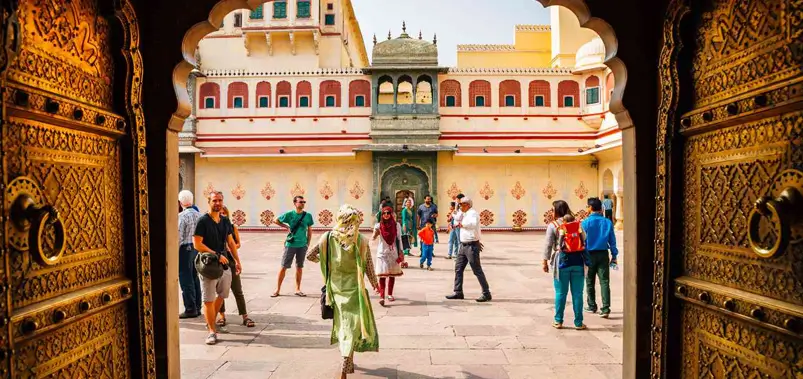
You step through one of the old city gates and the world changes immediately. The noise is different. The smell is different. The scale is different. Motorbikes thread their way between pedestrians carrying bundles of fabric on their heads. A chai vendor pours tea in a practised, theatrical arc from half a metre above the cup. The scent of jasmine garland sellers mingles with woodsmoke from a street food cart. And on every side, as far as you can see in every direction, rise pink buildings: uniform in colour, endlessly varied in detail.
This is the Walled City of Jaipur, one of the most remarkable urban environments in Asia. It is not a preserved heritage zone sealed off behind ticket barriers and kept alive purely for tourism. People live here. Families have run the same shops for six or seven generations. Weddings take place in courtyards that have hosted weddings for three hundred years. Children walk to school through lanes that look now very much as they did when the city was built in 1727.
For a first time foreign visitor, the Walled City can feel overwhelming. There is a great deal to see, the streets do not always follow obvious logic, the markets require both energy and patience, and the sheer density of sensory experience can be difficult to process.
This guide is designed to make your visit coherent, enjoyable, and genuinely memorable. It covers history, architecture, landmarks, markets, food, practical logistics, and everything else you need before you go.
To understand the Walled City of Jaipur, you need to understand the man who built it.
Maharaja Sawai Jai Singh II was one of the most intellectually remarkable rulers in Indian history. He was an astronomer, a mathematician, a diplomat, and an administrator. By the early 18th century, he had determined that his existing capital at Amer, a hilltop fortress 11 kilometres to the north, could no longer accommodate the growing population and expanding trade of his kingdom.
On 18 November 1727, Jai Singh II laid the foundation of an entirely new city on the plains below Amer. This was not an organic settlement that grew over centuries. It was conceived in its entirety before a single stone was laid, designed by the architect and scholar Vidyadhar Bhattacharya according to principles drawn from the ancient Sanskrit text Manasara, which deals with the ideal layout of a city.
The result was India's first planned city: a grid of wide streets dividing the urban area into nine rectangular sectors called chowkris, two of which were reserved for the royal palace complex and government buildings, and seven for the general population divided broadly by profession and community. Markets, temples, residences, and craft workshops were each assigned to specific zones. The main commercial streets were lined with colonnaded shopfronts of uniform height and width, creating a consistent visual rhythm that you can still read clearly today.
The city was enclosed from the beginning by a substantial fortified wall, roughly 6 kilometres in circumference, pierced by seven gates that controlled entry and exit from different directions. The wall was built of the same pink toned sandstone that would later give the city its famous colour.
It took approximately four years to construct the main palaces, streets, and walls. Within a generation, Jaipur had become one of the most prosperous trading cities in northern India, known above all for its gemstone trade, its metalwork, its textiles, and its extraordinarily skilled craftspeople.
In July 2019, the Walled City of Jaipur was inscribed as a UNESCO World Heritage Site, recognised under three criteria: for the exchange of cultural values it represents, for its outstanding example of planned urban development, and for its direct association with a living tradition that has continued without interruption from the 18th century to the present day.
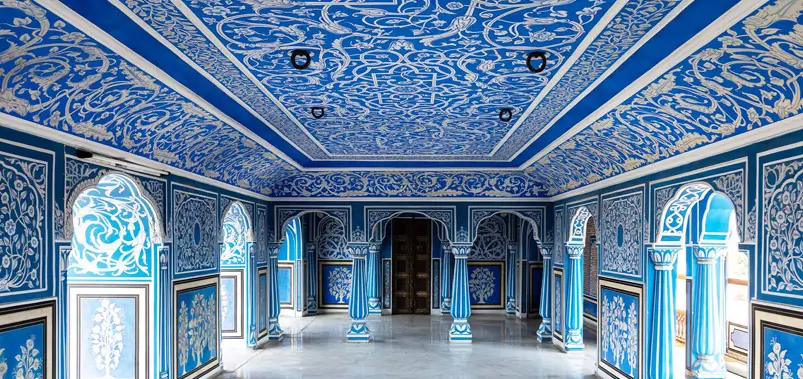
The Pink City is not a name that Jaipur has always had. For the first 150 years of its existence, the city's buildings were in various natural tones of sandstone, lime plaster, and local paint.
The transformation happened in 1876, when Maharaja Ram Singh II received news that Albert Edward, Prince of Wales and heir to the British throne, was to visit India. In Rajasthani culture, pink (or terracotta) is the colour of hospitality and welcome, and the Maharaja decided that the entire city should be painted this colour to honour his royal guest.
The scale of what was accomplished is difficult to appreciate today. In a matter of weeks, every building in the Walled City was repainted in the same terracotta pink tone. The effect was extraordinary, and the name stuck.
What makes this more remarkable is what happened next. Rather than fade over the following decades, the pink identity became so central to Jaipur's character that successive governments chose to maintain it. Today, all buildings within the Walled City are legally required to be maintained in the same terracotta-pink shade. This is not a heritage guideline but an enforceable regulation. Before major festivals, the government organises repainting projects to ensure the effect is kept intact.
The same paint formula used in the 19th century is still in use today. Jaipur is, as far as anyone knows, the only city in the world with a legally protected monochromatic colour scheme covering an entire historic urban area.
One further detail worth knowing: the pink colour helps keep buildings cooler. In Rajasthan's extreme summer heat, the terracotta pigment reflects a portion of solar radiation that darker colours would absorb. It is a practical choice as much as an aesthetic one.
Discover hidden temples, colorful bazaars, historic havelis, and authentic local experiences inside Jaipur's UNESCO listed Walled City. Let an experienced guide help you uncover stories and places that most tourists miss.
The original fortified wall of the Walled City of Jaipur was punctuated by seven gates, each controlling access from a different direction. Several of these remain standing and are significant landmarks in their own right.
Chandpole Gate faces west, its name derived from the Hindi word for moon. It is one of the two main arterial gateways into the old city from the modern city and handles a continuous flow of traffic and pedestrians throughout the day.
Surajpole Gate faces east, towards the rising sun. Traditionally, the Maharaja would ride out through this gate to greet the sunrise on ceremonial occasions. Today it is the busiest entry point from the direction of the new city.
Tripolia Gate is one of the grandest surviving gateways, with three arched passageways. Its name comes from the Sanskrit for three doors. By tradition, only the Maharaja could pass through the central arch. The gate stands between the City Palace and Tripolia Bazaar and remains one of the most architecturally impressive structures in the Walled City.
Sanganeri Gate in the south east connects the old city towards the village of Sanganer, historically the centre of Jaipur's hand block printing and paper making trades.
Ajmeri Gate on the southern side faces in the direction of Ajmer and, by extension, Mecca, reflecting the significant and longstanding Muslim community within the Walled City and its contribution to Jaipur's textile and gem trade.
New Gate was added later than the others as the commercial pressure on the city's southern edge increased. It connects towards the modern city's MI Road area.
Ghee Walon Ka Darwaza is the smallest and least visited of the original gates, named after the ghee (clarified butter) traders who historically operated nearby.
The Walled City of Jaipur is architecturally distinctive in several ways that are worth understanding before you walk its streets.
The grid plan is the most immediately visible feature. Unlike virtually every other historic Indian city, where streets follow terrain and accumulated habit over centuries, the streets of Jaipur were laid out in straight lines before any building was constructed. The main streets are wide, designed for royal processions and heavy commercial traffic. Secondary streets are narrower. The smallest lanes are pedestrian only. The system works with a clarity that feels almost modern.
The chowkris (city sectors) each had their own character. Certain communities lived and worked in specific areas, a system that has partially persisted. The gem cutters and jewellers of Johri Bazaar occupy roughly the same territory their ancestors occupied in 1727. The lac bangle makers of Maniharon Ka Rasta (Lane of the Bangle Makers) behind Tripolia Bazaar have been in the same lanes for generations.
The uniform shopfront colonnades along the main streets are a deliberate design feature. Every commercial building along the principal routes was required to present the same colonnade height and width to the street. The individual buildings behind each colonnade vary enormously, but the street facade is consistent. This creates the remarkable visual rhythm that distinguishes the main bazaar streets from anything you will find in other Indian cities.
The architectural style blends Rajput and Mughal traditions. The Rajputs preferred open courtyards, carved stone screens (jalis), ornamental brackets, and towers. The Mughal influence brought arched gateways, pietra dura stone inlay work, and formal garden layouts. In the Walled City of Jaipur, these two traditions sit side by side and often combine within a single building in ways that feel entirely natural.
The Walled City of Jaipur contains several of the most visited monuments in Rajasthan. All of them are within comfortable walking distance of each other. Understanding each before you arrive saves time and helps you decide where to spend longest.
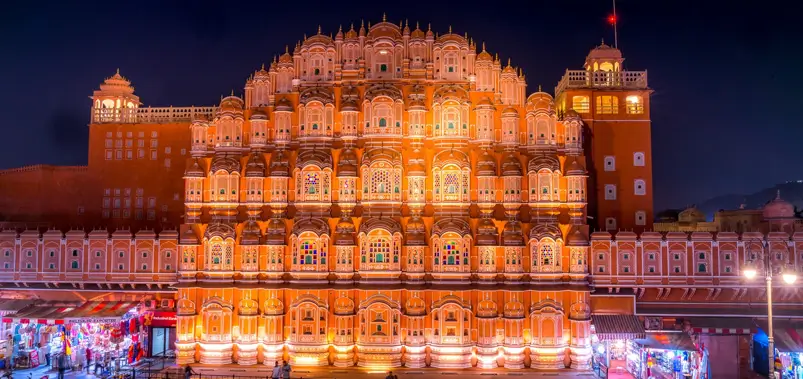
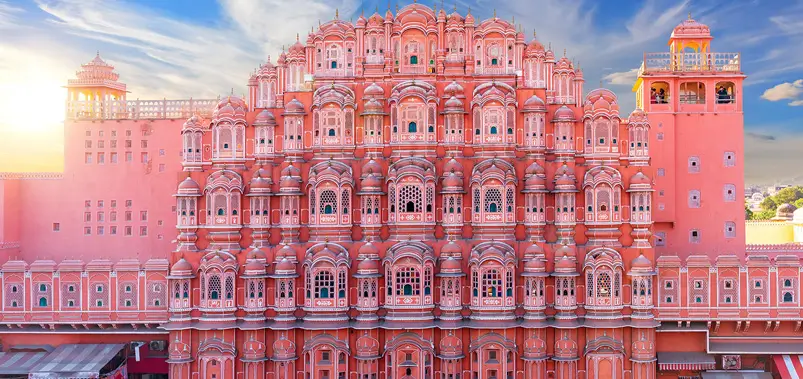
The Hawa Mahal is the defining image of Jaipur and one of the most photographed facades in all of India. Built in 1799 by Maharaja Sawai Pratap Singh, it is five storeys of pink sandstone honeycombed with 953 small windows called jharokhas, each screened with delicately carved stone lattice.
The building was designed to solve a specific social problem. Royal women of the period observed strict purdah and could not appear in public. However, they wished to observe the street festivals, royal processions, and daily life of the city below. The Hawa Mahal was built as an observation screen: a facade so complex and so deep that the women behind it could see everything on the street without being seen themselves. The screened windows also functioned as a passive ventilation system, channelling breezes through the building during Rajasthan's hot summers. The name translates directly as Palace of Winds.
The interior of the Hawa Mahal is modest compared to the exterior and consists largely of small chambers and narrow corridors leading to the various levels of windows. The upper floors offer views across the bazaar below and towards the City Palace and Jantar Mantar.
The most impressive views of the Hawa Mahal are from outside. The best vantage point is the rooftop of the building directly opposite, several of which house cafes. Early morning light, when the sun strikes the pink sandstone from the east, produces the most atmospheric photographs.
Entry fee: Rs 50 for Indian nationals, Rs 200 for foreign tourists. Open daily from 9:00 AM to 5:00 PM. Photography is permitted throughout.
.webp)
The City Palace complex is one of the largest and most extraordinary royal residences in Rajasthan. It occupies roughly one seventh of the total area of the Walled City, and its construction was begun by Maharaja Sawai Jai Singh II in 1727 when the city itself was founded. Successive rulers expanded and embellished it over the following two and a half centuries.
The palace is not a single structure but a series of interconnected courtyards, palaces, pavilions, galleries, and gardens built across different periods and in subtly different architectural styles. Crucially, a significant portion of the City Palace complex remains the private residence of the royal family of Jaipur today. The current head of the family, Maharaja Sawai Padmanabh Singh, lives here. Encountering the palace as a partially living royal residence rather than a purely historic monument gives it a different character from most Indian heritage sites.
The sections open to visitors are extensive and include the following highlights:
Mubarak Mahal (Welcome Palace): A two storey building in the outer courtyard that now houses the Maharaja Sawai Man Singh II Museum, displaying an exceptional collection of royal textiles and garments. Among the most striking exhibits is a single robe made for a Maharaja who weighed over 200 kilograms, the sheer scale of which remains extraordinary to see. The collection also includes Mughal-era silks, Kashmiri shawls, embroidered court costumes, and ceremonial dress from across the centuries of Kachwaha rule.
Diwan-i-Khas (Hall of Private Audience): This courtyard contains two enormous silver urns that hold the Guinness World Record as the largest silver objects in the world. Each urn is approximately 1.6 metres tall and holds 4,000 litres. They were made for Maharaja Sawai Madho Singh II, who was deeply devout and would not drink any water except water from the Ganges. When he travelled to London in 1901 for the coronation of King Edward VII, he had the urns filled with Ganges water and carried aboard the ship so that his supply of sacred water would not be interrupted during the voyage.
Pritam Niwas Chowk: A beautifully proportioned courtyard with four ornately painted gateways representing the four seasons. Each gateway is decorated in a different colour palette and with different motifs. The Peacock Gate (representing autumn) is the most celebrated and photographed. This courtyard is one of the finest examples of decorative painting in the entire City Palace complex.
Chandra Mahal: The seven storey palace at the heart of the complex, still used as the private residence of the royal family. The lower floors are partially open to visitors. The upper floors, visible from the courtyard below, display flags indicating when the Maharaja is in residence.
Govind Dev Ji Temple: Located within the City Palace grounds, the Govind Dev Ji Temple is the personal deity of the royal family of Jaipur and one of the most significant Krishna temples in Rajasthan. The original deity was brought from Vrindavan in the 18th century by Maharaja Sawai Jai Singh II, reportedly to protect it from the iconoclastic activities of the Mughal emperor Aurangzeb. The evening aarti at approximately 6:30 PM is one of the most genuinely atmospheric religious experiences available to visitors in Jaipur. See our detailed blog on Govind Dev Ji Temple for full visitor information.
Entry fee for City Palace: Rs 700 for foreign tourists (museum entry included). Open daily from 9:30 AM to 5:00 PM.
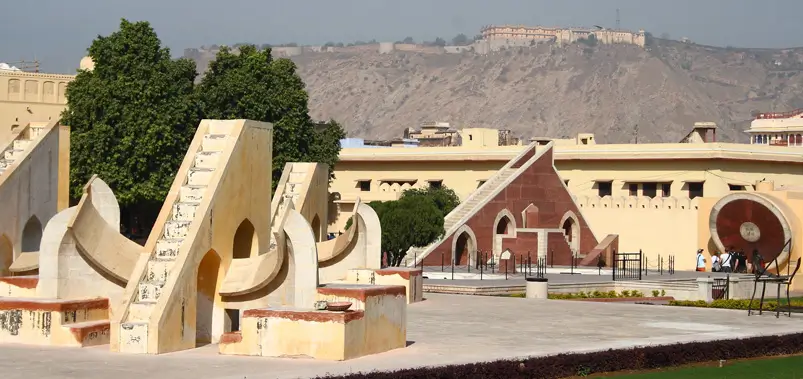
Jantar Mantar is one of the most intellectually extraordinary monuments in India and one that is consistently underappreciated by visitors who walk through it without understanding what they are seeing.
It is a collection of nineteen large scale architectural astronomical instruments, built by Maharaja Sawai Jai Singh II between 1727 and 1734. The Maharaja was one of the finest astronomers of his time, deeply engaged with both Hindu and Islamic astronomical traditions and in active correspondence with European scientists. He was dissatisfied with the accuracy of the small brass instruments then in use for astronomical observation. His solution was to build his instruments in masonry, at a scale large enough that even fractional movements could be measured precisely.
The largest instrument, the Samrat Yantra, is a gnomon (sundial) standing 27 metres high. Its shadow moves visibly in real time as you watch, and it measures time to an accuracy of two seconds. The scale of it is difficult to comprehend until you are standing beside it.
Other instruments include the Jai Prakash Yantra, a pair of hemispherical bowls calibrated to map the positions of celestial bodies, the Ram Yantra, a pair of cylindrical structures for measuring altitude and azimuth of celestial objects, and the Rashivalaya Yantra, twelve separate instruments each designed to measure the position of one of the twelve signs of the zodiac.
Jantar Mantar is a UNESCO World Heritage Site in its own right, one of the five observatories Jai Singh II built across India. It is the largest and best preserved of the five.
A licensed guide or audio guide is essential at Jantar Mantar. Without interpretation, the instruments look like abstract concrete sculptures. With context, they become one of the most remarkable scientific achievements you will encounter anywhere on a visit to India.
Entry fee: Rs 50 for Indian nationals, Rs 200 for foreign tourists. Open daily from 9:00 AM to 4:30 PM.
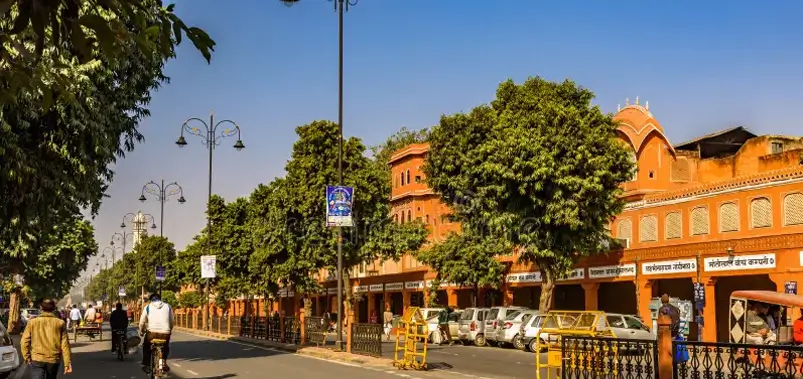
The two main chaupars (public squares) of the Walled City were built into the original grid plan as the natural gathering points of the city. Badi Chaupar (the larger square) is near Hawa Mahal and is the more active of the two. Chhoti Chaupar (the smaller square) is close to the City Palace.
In the Maharaja's time, the chaupars hosted public durbar sessions, religious celebrations, and royal processions. Today they function primarily as busy road junctions, though the four streets radiating from each square still reveal the logic of the city's grid plan with total clarity.
Standing in Badi Chaupar and looking south, you can see straight down the main street to the Hawa Mahal. Looking west, the street runs directly to Chandpole Gate. Looking east, it runs to Surajpole Gate. The city is perfectly legible from this point, which is no accident.
The Isar Lat is one of the most undervisited landmarks in the Walled City and one of the most historically significant. It is a seven storey minaret style tower built by Maharaja Sawai Ishwari Singh in 1749 to celebrate a military victory. At roughly 32 metres tall, it was for many decades one of the tallest structures in the city and offered commanding views across the entire Walled City and beyond.
Most foreign tourists walk past it without noticing. It is worth finding specifically.
.webp)
The Albert Hall Museum sits just outside the southern wall of the Walled City, within easy walking distance of New Gate and Ajmeri Gate. Built in 1876 in the Indo Saracenic style, it houses one of the most comprehensive collections of Rajasthani art, craft, and cultural artefacts in India.
The collection includes miniature paintings, Rajasthani costumes, pottery, carpets, weapons, coins, and an Egyptian mummy of considerable vintage. For visitors interested in the broader context of Rajasthani culture, an hour in the Albert Hall Museum before walking the Walled City is genuinely worthwhile.
Entry fee: Rs 40 for Indian nationals, Rs 300 for foreign tourists. Open daily except Fridays, 10:00 AM to 5:00 PM (and 7:00 PM to 10:00 PM for an evening visit).
The markets of the Walled City of Jaipur are among the finest in India. Each has its own speciality, its own architectural character, and its own rhythm. Understanding the layout before you arrive allows you to shop efficiently rather than wandering.

Johri Bazaar is the most famous market in Jaipur and the commercial heart of the Walled City. The name means Jewellers' Market and it has been exactly that since the city was founded. The bazaar runs for approximately two kilometres and is lined with shops selling gold and silver jewellery, Kundan jewellery (a Mughal technique using highly refined gold set with uncut gemstones), Meenakari jewellery (enamel work on gold or silver), and a vast range of gemstones in every form from rough crystals to precision cut finished stones.
Jaipur is one of the three most important gemstone trading cities in the world, alongside Antwerp and Bangkok. The majority of the world's emerald cutting happens in Jaipur. The city is also a major centre for sapphire, ruby, garnet, and tourmaline. Walking through Johri Bazaar, you will see tiny workshops above the shops where craftspeople sit cutting, polishing, and setting stones by hand, using techniques that have changed remarkably little over three centuries.
For guidance on buying gemstones safely in Jaipur, including how to identify a reputable dealer and what certification to look for, see our detailed guide to gemstone jewellery shopping in Jaipur.
Johri Bazaar is also an excellent place for block printed textiles, Rajasthani sarees, and traditional clothing. The lane running south from the main bazaar towards Sanganeri Gate is particularly good for fabric shopping.
Most shops open between 10:30 AM and 11:00 AM and close around 8:00 PM. Closed on Sundays.

Tripolia Bazaar runs between Badi Chaupar and Chhoti Chaupar and is one of the oldest continuously trading streets in the Walled City. Its principal speciality is lac bangles, the brightly coloured lacquer coated bangles that are one of the most distinctive craft products of Rajasthan.
The lac bangle makers work in the lanes behind the main street, particularly in a lane known as Maniharon Ka Rasta (Lane of the Bangle Makers). These are family workshops where the craft has been practised across many generations. You can watch bangles being made by hand, heated and shaped around a mandrel, inlaid with glass beads and mirror chips, and painted in vivid combinations of colour. They can be purchased very inexpensively directly from the workshops.
Tripolia Bazaar is also good for antiques (verify authenticity carefully as reproductions are common), wooden decorative items, handmade paper, and old textiles. The side lanes reward patient exploration more than the main street does.
Closed on Sundays.
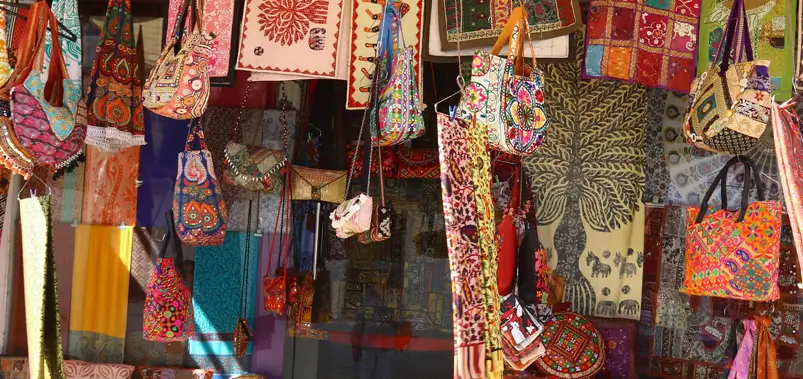
Bapu Bazaar runs parallel to Johri Bazaar and is the most practical market in the Walled City for general shopping. Its specialities are block printed and Bandhani (tie-dye) fabrics, Rajasthani embroidered textiles, and above all, mojari shoes.
Mojaris are the traditional handmade leather shoes of Rajasthan, constructed from camel leather with an upturned toe and covered in elaborate needlework embroidery. They are comfortable, lightweight, genuinely beautiful, and among the best souvenirs available anywhere in the Walled City. Quality varies significantly between shops, so examine the stitching and the leather carefully before purchasing.
Bapu Bazaar also stocks Rajasthani handicrafts, blue pottery, attar (traditional perfume), sandstone carvings, and a wide range of items that are harder to find in shops outside the old city. Prices are generally lower than in the tourist facing shops near the main monuments.
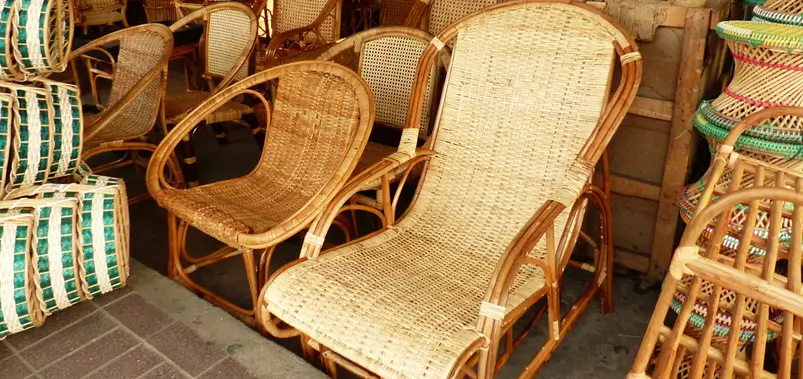
Kishanpole Bazaar is the main market for hand painted wooden furniture, lacquered wooden items, and traditional Rajasthani crafts. The scale of most furniture pieces makes them impractical as souvenirs for travellers, but smaller painted boxes, wooden toys, decorative bowls, and carved items are available at very reasonable prices and pack easily.
This market is less visited by foreign tourists than the others, which means less pressure to buy and more willingness from shopkeepers to talk about their craft.
From the Pink City's famous landmarks to its hidden gems, enjoy a stress free sightseeing experience with a private car, professional driver, and flexible itinerary designed for international travelers.
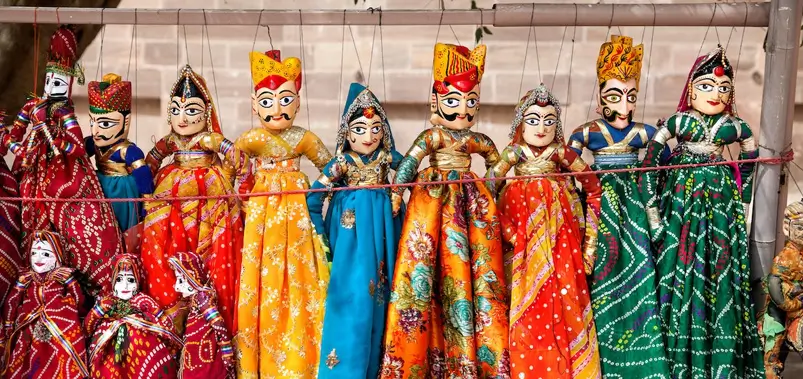
Sireh Deori Bazaar runs along the eastern side of the City Palace complex and is primarily a local market rather than a tourist one. It is the main flower market for the Walled City, supplying garlands and marigolds to the temples and households of the old city.
Walking through Sireh Deori Bazaar in the early morning, when the flower sellers are unloading their stock and the fragrance is overwhelming, is one of the more genuinely local experiences available in the Walled City. There is little to buy here as a tourist, but a great deal to see.
The Walled City is one of the finest places in India to eat traditional Rajasthani food. The streets around Badi Chaupar and along Johri Bazaar are dense with street food stalls, sweet shops, and local restaurants that have been feeding the city's residents for generations.
A detailed food guide is covered in our blog on what to eat in the Walled City of Jaipur. In brief:
Kachori is the definitive breakfast food of Jaipur's old city. A thick, deep fried pastry filled with spiced lentils and served with tamarind chutney and a spiced potato curry, it is sold from early morning at dozens of stalls around the bazaar. Rawat Misthan Bhandar near Sindhi Camp, accessible from the Walled City, is the most famous kachori shop in Jaipur and has been serving them since 1944.
Pyaaz ki Kachori (onion filled kachori) is the specifically Jaipur variant and is found in the old city lanes near Badi Chaupar.
Lassi at the famous Lassiwala on MI Road, just south of the Walled City, is among the most celebrated dairy experiences in Rajasthan. A thick, cold, cream topped lassi served in a clay cup is the correct conclusion to a morning in the old city. The shop opens around 8:00 AM and frequently sells out by early afternoon.
LMB (Laxmi Misthan Bhandar) on Johri Bazaar is the most famous sit down sweet and snack shop in the Walled City, operating since 1954. It serves the full range of Rajasthani sweets and snacks in a clean, air conditioned environment that is particularly welcome in summer.
Street food around Badi Chaupar includes samosa, mirchi bada (a large green chilli fried in chickpea batter), ghewar (a disc-shaped sweet made from fried flour drenched in syrup, available particularly in the monsoon season), and various seasonal snacks.
Chai stalls are everywhere and are uniformly excellent. Chai in Jaipur tends to be stronger, milkier, and more heavily spiced than in many other parts of India. The correct order is simply one cutting chai without specifying anything further.
The Walled City of Jaipur rewards a structured approach on the first visit. This route takes approximately a full day at a relaxed pace and covers the principal landmarks and markets without rushing.
8:00 AM: Enter through Chandpole Gate. The western gate is an excellent starting point. At this hour the shopkeepers are just opening, the light is good from the east, and the streets belong largely to residents rather than tourists. Walk east along the main street towards Badi Chaupar, observing rather than shopping.
8:30 AM: Badi Chaupar. Spend a few minutes in the main square. Look south towards the Hawa Mahal. Look east and west along the main street to understand the city's grid. Find a chai stall in one of the side lanes for the first tea of the day.
9:00 AM: Hawa Mahal. Purchase your entry ticket, go inside, and climb to the upper floors for views across the bazaar below and towards the City Palace. Then cross the street to a rooftop cafe for the better exterior view and a second tea.
9:30 AM to 12:30 PM: City Palace and Jantar Mantar. These two sites together require at least two to three hours if properly explored. Hire a licensed guide at the entrance for Jantar Mantar specifically, as the instruments require explanation to be meaningful. The City Palace museum is best visited without a guide and at your own pace.
12:30 PM: Lunch. The area around Johri Bazaar has several good options for a sit down meal. LMB is the most reliable. For street food, the lanes near Badi Chaupar remain active at lunchtime.
2:00 PM: Johri Bazaar. The market is at its most atmospheric in the afternoon when all shops are fully open and the activity is at its peak. Walk the full length of the bazaar, compare several shops before buying, and allow yourself to be drawn into side lanes where the more interesting workshops are often found.
4:00 PM: Tripolia Bazaar and Maniharon Ka Rasta. Find the lane of the bangle makers behind Tripolia Bazaar. Watch the craft being practised and buy directly from the workshop if you wish.
5:30 PM: Bapu Bazaar. The late afternoon is the best time for mojari shoe shopping and textile browsing. The light inside the bazaar improves as the sun drops lower.
6:30 PM: Govind Dev Ji Temple for Sandhya Aarti. Allow time to walk from Bapu Bazaar to the City Palace complex. The evening aarti at Govind Dev Ji Temple is one of the most genuinely atmospheric religious experiences available in Jaipur. Regardless of your own religious background, the combination of bells, lamplight, chanting, and crowd creates something that is difficult to put into words.
8:00 PM: Dinner. The restaurants along MI Road, immediately south of the Walled City, offer a range of options from traditional Rajasthani thali to North Indian and Continental cuisine.
Getting There
A private car and driver is the most comfortable way to reach the Walled City and allows you to be dropped at the specific gate closest to your starting point. If you are on a Golden Triangle tour or a private Jaipur city tour, your driver will know the most efficient approach routes. For personalised tour arrangements, get in touch with our team directly and we will plan your Walled City visit around your schedule.
Auto rickshaws are widely available from any part of Jaipur to the Walled City, at a fare of approximately Rs 80 to Rs 150 depending on your starting point. Agree the price before getting in.
Getting Around Inside
The core of the Walled City is best explored on foot. The streets become progressively narrower towards the residential lanes away from the main bazaars, and cars cannot enter many of these areas at all. Cycle rickshaws are available for those who prefer not to walk and are an enjoyable way to cover the main bazaar streets.
When to Visit
October to March is the best period. The mornings are cool and clear, the light is excellent for photography, and the festival calendar includes Diwali, Gangaur, and the Jaipur Literature Festival. April through June is very hot, with temperatures in the narrow lanes reaching 42 to 45 degrees Celsius by midday. July and August bring monsoon rains that can make some lanes wet and make the humidity considerable.
Within any given day, the early morning (8:00 to 10:00 AM) and late afternoon (4:00 to 7:00 PM) are the most rewarding times. Midday is the hottest, most crowded, and least atmospheric period.
What to Wear
Light, breathable natural fabrics (cotton or linen) are practical for most of the year. Covering shoulders and knees is not a strict requirement in the markets but is appreciated by local residents and will reduce unwanted attention considerably. If you plan to enter any temple, fully covered shoulders and legs are required. Comfortable flat shoes are essential as the paving in older lanes is uneven.
Carrying Cash
Many smaller shops and all street food stalls in the Walled City operate on cash only. Carry sufficient small denomination notes (Rs 50, Rs 100, Rs 500) before entering. ATMs are available on MI Road just outside the southern wall.
Bargaining
Bargaining is standard practice in all the bazaars of the Walled City except where fixed prices are clearly displayed. A reasonable opening position is approximately 40 to 50 percent below the asking price, after which both sides negotiate towards a middle point. Bargaining should be conducted in a relaxed and friendly manner. Walking away is a legitimate strategy and often results in the shopkeeper reconsidering. Never agree to a price you are not comfortable paying and then refuse to complete the purchase.
Photography
The Walled City of Jaipur is one of the most photogenic urban environments in Asia. Photography is generally welcome everywhere except inside some temples where it is prohibited. Ask before photographing individuals in the markets as a matter of respect.
Several heritage boutique hotels are located within or immediately adjacent to the Walled City. Staying in the old city rather than the newer hotel districts gives you access to the early morning atmosphere before the day trippers arrive and the late evening calm after they have left. These are the hours when the Walled City reveals itself most clearly as a living neighbourhood rather than a tourist attraction.
See our detailed guide to heritage boutique hotels in Jaipur for specific recommendations.
We promise you a holiday where everything is taken care of from the moment you land. Trusted drivers waiting for you, handpicked hotels that fit your style, personalized itineraries designed just for your family, and a dedicated team on call 24/7. All you need to do is relax, explore, and create unforgettable memories, while we take care of every detail behind the scenes.
Amer Fort is 11 kilometres from the Walled City, a drive of approximately 25 to 30 minutes depending on traffic. A private car and driver is the most comfortable option and can be arranged through your hotel or tour operator. Auto-rickshaws are available but the route involves busy main roads. If you are visiting both in one day, go to Amer Fort first at 8:00 AM when it opens, then travel to the Walled City for the afternoon and evening. This sequencing avoids the worst of the Amer Fort crowds and gives you the Walled City bazaars at their most atmospheric.
Kachori for breakfast, particularly pyaaz ki kachori (onion-filled) from the stalls near Badi Chaupar. Lassi from the famous Lassiwala on MI Road near the southern edge of the old city. Rajasthani thali for a sit-down lunch covering the full range of local cuisine. Street food throughout the day from the stalls around the main bazaars. See our full food guide for the Walled City for detailed recommendations and specific stall locations.
Yes. The City Palace complex is open to visitors daily from 9:30 AM to 5:00 PM. Entry for foreign tourists is approximately Rs 700, which includes the museum. A significant portion of the complex remains the private residence of the royal family. The highlights for visitors include the Mubarak Mahal textile museum, the two enormous silver urns in Diwan-i-Khas, and Pritam Niwas Chowk with its painted seasonal gateways.
Jantar Mantar is a collection of nineteen large-scale astronomical instruments built by Maharaja Sawai Jai Singh II between 1727 and 1734. It is a UNESCO World Heritage Site and one of the finest examples of pre-modern scientific achievement in the world. The largest instrument, the Samrat Yantra, measures time to an accuracy of two seconds. A licensed guide or audio guide is essential for a meaningful visit.
The best purchases in the Walled City are gemstone jewellery and certified gemstones (Johri Bazaar), lac bangles (Tripolia Bazaar and Maniharon Ka Rasta), mojari shoes and block-printed fabric (Bapu Bazaar), and blue pottery and wooden crafts (various markets). Quality varies significantly across shops so comparing prices and examining quality before committing is advisable.
Yes, with sensible precautions. The Walled City is one of the more accessible areas of Rajasthan for solo female travellers. The main bazaar streets are busy and well-populated throughout the day. Avoid quiet lanes after dark. Declining unsolicited approaches from guides or rickshaw drivers is advisable. A guided walking tour on the first day helps you orientate quickly. See our full guide on solo female travel in Jaipur for specific advice.
Yes. Bargaining is standard in all the bazaars of the Walled City except where fixed prices are displayed. A reasonable starting offer is 40 to 50 percent below the asking price. Bargaining should be friendly and unhurried. Walking away is an accepted part of the negotiation and often results in a better offer. Fixed-price shops generally display a sign indicating this.
Early morning (8:00 to 10:00 AM) and late afternoon (4:00 to 7:00 PM) are the most rewarding times. The early morning belongs to residents rather than tourists, the light is beautiful, and the food stalls are at their freshest. The late afternoon is the best time for shopping and ends with the evening aarti at Govind Dev Ji Temple.
The principal landmarks are Hawa Mahal, City Palace (including Govind Dev Ji Temple and the royal museum), Jantar Mantar, Albert Hall Museum, Badi Chaupar, and Isar Lat. The bazaars, particularly Johri Bazaar, Tripolia Bazaar, and Bapu Bazaar, are themselves significant cultural experiences and not simply places to shop.
A thorough visit covering the main monuments and the principal markets requires one full day. If you wish to include Amer Fort, which is outside the Walled City, allow two days in Jaipur. Visitors who stay in the old city often find that a second morning, specifically for the early atmosphere and the markets before the crowds arrive, adds considerably to the experience.
The Walled City of Jaipur has seven original gates: Chandpole Gate (west), Surajpole Gate (east), Tripolia Gate (central), Sanganeri Gate (south-east), Ajmeri Gate (south), New Gate, and Ghee Walon Ka Darwaza. Each was designed to control access from a specific direction and several remain standing and in use today.
Maharaja Sawai Jai Singh II founded Jaipur on 18 November 1727. The city was designed by the architect-scholar Vidyadhar Bhattacharya according to ancient Vedic principles of urban planning from the text Manasara. It was India's first comprehensively planned city, laid out in a grid before a single building was constructed.
Jaipur earned the name in 1876 when Maharaja Ram Singh II ordered the entire Walled City painted in terracotta pink to welcome the Prince of Wales. Pink symbolises hospitality in Rajasthani culture. The colour became so central to the city's identity that it was never reversed. Today all buildings within the Walled City are legally required to maintain this same pink shade, making Jaipur the only city in the world with a legally protected monochromatic colour scheme.
Yes. The Walled City of Jaipur was inscribed as a UNESCO World Heritage Site in July 2019, recognised for its extraordinary planned urban layout, its exceptional architectural heritage, and its continued function as a living city where traditional commercial, artisanal, and cultural practices have been maintained without interruption since the 18th century. It is one of the most significant UNESCO inscriptions in India in recent decades.