There is a day in Jaipur every year when the entire sky disappears.
Not literally, but almost. On Basant Panchami, hundreds of thousands of kites go up from rooftops across the city simultaneously — from the old walled city, from the neighbourhoods behind Nahargarh Fort, from terraces of havelis and concrete apartment blocks alike — until the sky above Jaipur becomes a moving, rustling canvas of colour. Red, yellow, green, blue, orange. Strings crossing strings. The distant sound of "Woh kata!" drifting across rooftops every few minutes as someone wins a kite battle and celebrates.
For a foreign tourist in Jaipur, this is one of those days that is almost impossible to plan for properly but completely unforgettable if you happen to be there. This guide will tell you what Basant Panchami actually is, what happens in Jaipur specifically, where to go, and how to get involved rather than just watching from the sidelines.
Basant Panchami, also written as Vasant Panchami, translates roughly to the Fifth Day of Spring. It falls on the fifth day of the Hindu lunar month of Magh, which means the date shifts every year. In 2027, Basant Panchami falls on February 11.
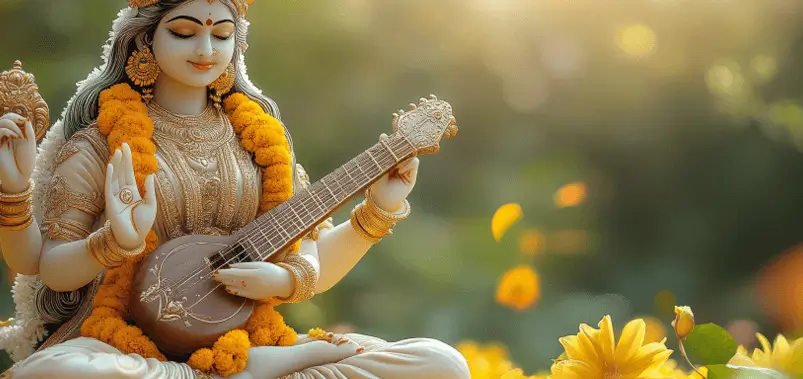
The festival honours Goddess Saraswati, the Hindu deity of knowledge, music, art, and wisdom. On this day, temples, schools, and homes across Jaipur set up small altars with her idol. Students place their textbooks, pens, and instruments at the goddess's feet and seek her blessings for the year ahead. Young children write their first letters in a formal ceremony called Vidyarambham, marking the beginning of their education. That is how deep the roots of this festival go — it is not a spectacle for outsiders, it is a living tradition that touches families at their most personal moments.
Now, the yellow. The colour connects directly to the mustard fields blooming across North India at this exact time of year. Goddess Saraswati herself is traditionally depicted in yellow, and her idols are decorated with marigolds, yellow hyacinths, and saffron offerings. In response, the entire city dresses to match. Women in yellow sarees and salwar kameez. Men in yellow kurtas and saffron turbans. Flower sellers with baskets overflowing with marigolds. Sweetshops with saffron yellow laddoos and halwa in every window.
Walking through Jaipur's old city on the morning of Basant Panchami and watching the colour shift happen organically — not because someone planned it for tourists, but because it is simply what people do — is one of those travel experiences that is very difficult to manufacture or replicate.
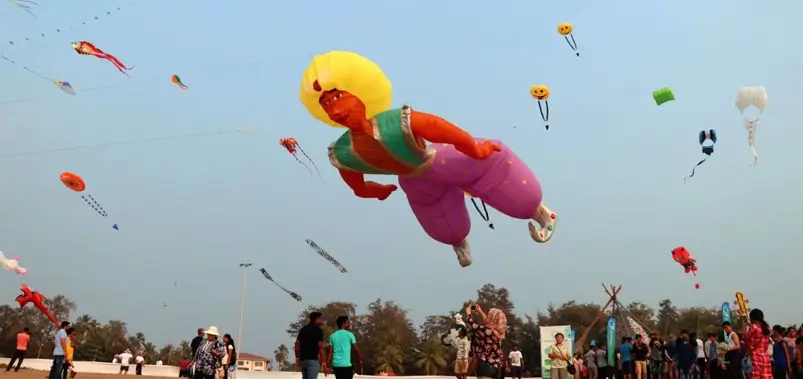
The kite flying on Basant Panchami in Jaipur is the aspect of the festival that most surprises foreign visitors, because nothing really prepares you for the scale of it.
It is not a formal event. There is no stadium, no announced start time, no ticketing system. It simply begins at dawn when the first families climb to their rooftops and send up the first kites, and it continues without pause until darkness falls. By mid-morning, the sky over Jaipur is so thick with kites that photographing the city without capturing them is nearly impossible.
The kites used in Jaipur are typically small, flat, diamond shaped paper kites in bright solid colours — red, green, yellow, blue, white. They are flown on a string called manjha, which in traditional form was coated with powdered glass to make it sharp enough to cut a rival's string. This practice has been regulated in many areas due to safety concerns, but the kite battles themselves remain the centrepiece of the day. Players manoeuvre their kites against each other in the sky, trying to cross strings and cut the opponent loose.
When a cut happens, the whole rooftop erupts. "Woh kata!" — "It's cut!" — rings out across the neighbourhood, and the severed kite drifts away in the wind while a pack of children sprint through the lanes below trying to catch it before anyone else. This happens dozens of times per hour across the city simultaneously, creating a constant low hum of competitive joy that you can feel even from the street level.
The sound design of Basant Panchami is one of its most underrated qualities. The snapping of kite string under tension. The paper flutter of kites diving and climbing. Distant music from rooftops. Shouts of triumph. The occasional crackle of a kite tearing. And underneath it all, the ordinary city sounds of Jaipur continuing their usual rhythm completely unbothered.
Location determines your entire experience of this festival. Here is where to go depending on what you want.
Nahargarh Fort
The fort sits on the Aravalli Hills directly above the city, and from its walls you can see the entire spread of Jaipur below with kites visible in every direction as far as the eye can reach. This is the best spot for photography. Wide angles, city panoramas, kites above and below you simultaneously. It is also significantly less crowded than the old city and the walk up or short drive gives you a natural break from the intensity of the streets.
Old City Rooftops
The walled city's dense rooftop landscape is where the most intense kite flying happens. The areas around Tripolia Bazaar, Johari Bazaar, and the lanes behind Hawa Mahal are alive from sunrise. If your hotel is in the old city and has a rooftop, this is your single most valuable asset on Basant Panchami. Do not leave without using it. Many heritage hotels in Jaipur specifically organise rooftop kite flying sessions on this day, with kites provided, folk music playing, and festival food served. Book one of these if you can find it.
Jal Mahal Waterfront
The road along Man Sagar Lake offers a visual that photographers come back for year after year — kites reflected in the still lake water, the palace floating in the middle distance, the Aravalli Hills behind, and hundreds of kites above. It is calmer than the old city and easier to navigate. Morning light here is exceptional.
Hawa Mahal Area
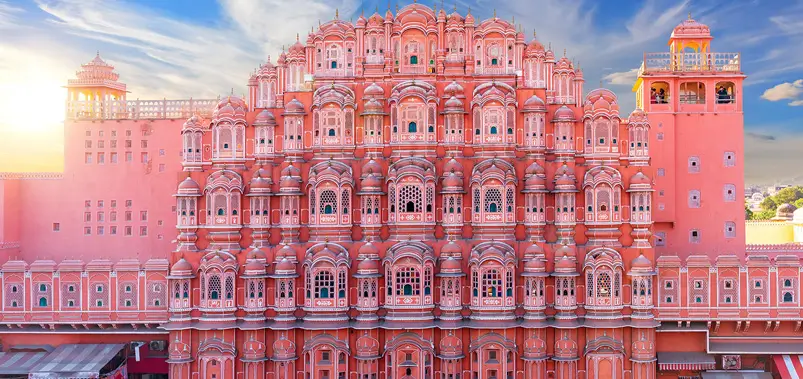
The five storey facade of Hawa Mahal becomes a backdrop for kite flying from the surrounding rooftops on this day. Several rooftop cafes along the Hawa Mahal road have terraces with unobstructed views. Arrive early — these seats are in high demand on festival mornings.
The old city markets take on a distinct personality in the days around Basant Panchami.
Kite stalls appear in the narrow lanes around Johari Bazaar, Bapu Bazaar, and behind Hawa Mahal starting two or three days before the festival. Simple small paper kites cost Rs. 5 to Rs. 20 each. Larger more decorative kites run Rs. 50 to Rs. 200. Rolls of string are sold alongside them. Buying a kite from one of these stalls, walking to an open area or rooftop, and attempting to fly it yourself is one of the most enjoyable things a foreign tourist can do on this day. Local people will help you if you struggle, and they will absolutely beat you in any kite battle — but that is entirely the point.
Yellow textiles flood the stalls. Dupattas, sarees, kurtas, and scarves in shades of mustard, saffron, and bright yellow are everywhere. If you have any interest in Rajasthani fabric and have not bought anything yet, this is a natural day to browse when the colour selection tilts toward warm and golden and the market energy is festive rather than transactional.
Marigold garlands are sold by the metre near temple entrances. Buying one and offering it at a Saraswati temple is a small act of participation that costs almost nothing and connects you to the day in a real way.
.webp)
Every festival in India has its food, and Basant Panchami is no different.
Kesari Halwa is the dish most closely associated with this day. It is a semolina based sweet pudding coloured and perfumed with saffron, dense and warm and faintly grainy in texture. It is sold outside temples, at sweet shops throughout the old city, and served in homes across Jaipur on this morning. Try it early, preferably still warm.
Saffron laddoos and barfis appear in every mithai shop window. The yellow colour is the saffron itself, used generously. The quality varies enormously between shops — the better sweet shops in Johari Bazaar area consistently produce the most flavourful versions.
Feeni with warm milk is a Rajasthani specialty worth seeking specifically on this day. Feeni looks like extremely fine, delicate vermicelli wound into a light, crispy ball. When placed in warm sweetened milk it softens slowly and absorbs the liquid into something rich and comforting that tastes unlike any sweet tradition most foreign tourists will have encountered. Ask for it at any traditional Rajasthani sweet shop.
Boondi — small fried chickpea flour droplets in sugar syrup — is another festival staple. It is simple, sweet, and eaten in handfuls by children and adults with equal enthusiasm throughout the day.
Masala chai from a street stall on a cool February morning, drunk while watching kites from a rooftop, is not a festival specific food but it is the single most appropriate beverage for the occasion.
Basant Panchami in Jaipur is one of those festivals that works extremely well for foreign tourists precisely because it asks nothing of you. You do not need to dress a particular way, book anything in advance, or know any rituals. You simply need to be in the right place at the right time.
The kite flying is genuinely spectacular in a way that photographs only partially capture. What the images cannot show is the sound — the collective hum of a city engaged in the same playful competition simultaneously — or the feeling of looking up and seeing a sky that has been completely taken over by colour and paper and string.
The yellow is real and unstaged. The women in yellow sarees walking to temples in the early morning are dressed that way because it is meaningful to them, not because anyone arranged it for tourist photographs. Walking through the old city at 8 AM on Basant Panchami and absorbing this colour shift as it happens organically is one of those genuine travel moments.
It is a family day, not a party. The atmosphere is celebratory but quiet compared to Holi. Families are on their rooftops. Children are learning to fly kites. Grandmothers are watching from chairs in the shade with cups of chai. There is music, but it comes from different rooftops and windows rather than any organised sound system. The overall feeling is joyful and relaxed simultaneously.
Participation is genuinely welcomed. If you find yourself on a rooftop where kite flying is happening — through your hotel, through a local contact, through a guided experience — you will almost certainly be invited to try. Accept it. You will not fly the kite well. You will probably lose it to a ten year old within three minutes. That is exactly the correct outcome.
Book a rooftop hotel in the old city in advance. Heritage havelis and hotels with terraces in the walled city area are in demand around Basant Panchami. A rooftop access on this specific day is worth more than almost any other hotel feature in Jaipur.
Start your day by 8 AM. The kite flying begins at sunrise and builds steadily. By 10 AM the sky is at maximum capacity. Arriving at a good viewpoint early gives you the best light and the build up rather than just the peak.
Wear something yellow if you have it. A yellow scarf or dupatta bought from the market that morning for Rs. 100 to Rs. 200 works perfectly and connects you naturally to the day's visual.
Watch out for falling kite string. Traditional manjha can be sharp and can cause cuts if it falls across your face or arms at speed. Be aware when walking through areas with heavy overhead kite flying. Cover bare arms if you are cautious.
February weather in Jaipur is nearly perfect. Temperatures sit at roughly 18 to 25 degrees Celsius during the day with clear skies and low humidity. Light layers in the morning, a single layer by midday. It is one of the most comfortable months of the year to be outdoors in Rajasthan.
Photography. The best light is morning and late afternoon. Afternoon gives you the fullest sky. Sunset is when some families begin flying illuminated lanterns alongside kites, and the combination of last light, lanterns, and kites creates extraordinary images. A polarising filter deepens the blue of the sky against the kite colours significantly.
We promise you a holiday where everything is taken care of from the moment you land. Trusted drivers waiting for you, handpicked hotels that fit your style, personalized itineraries designed just for your family, and a dedicated team on call 24/7. All you need to do is relax, explore, and create unforgettable memories, while we take care of every detail behind the scenes.
If you have any flexibility in your travel dates, yes. The combination of near-perfect February weather, the extraordinary visual of kite-filled skies, the organic yellow colour throughout the city, the accessible festival food, and the genuinely relaxed and welcoming atmosphere makes it one of the most rewarding days to be in Jaipur. It is less intense than Holi but significantly easier to navigate as a foreign tourist, and in many ways more memorable for exactly that reason.
Yes. Markets are active and often more energetic than usual on festival days. Sweet shops, kite stalls, textile vendors, and street food stalls are all operating. Most restaurants remain open, and many heritage hotels serve special Rajasthani festival menus.
Yes. Most Saraswati temples in Jaipur are open to all visitors on this day. Dress modestly, remove footwear before entering, observe rituals quietly, and ask before photographing. The morning hours from 7 to 9 AM are the most active for temple visits before the kite flying peaks.
Kesari Halwa is the most festival-specific sweet — try it warm from a temple stall in the morning. Feeni with warm sweetened milk is a Rajasthani specialty worth seeking at a traditional sweet shop. Saffron laddoos from a good mithai shop in Johari Bazaar are excellent. Masala chai from a rooftop while watching kites is non-negotiable.
The January kite festival around Makar Sankranti is a larger, more organised, internationally promoted event with formal venues and competitions. Basant Panchami kite flying is organic, neighbourhood-level, and family-focused with no formal organisation. It has a more intimate and unscripted quality that many visitors prefer.
It is one of the best festivals in Jaipur for families with children. Kite flying is inherently child-friendly, the atmosphere is safe and celebratory rather than intense, and watching children across the city doing the same thing creates an instant sense of connection.
Comfortable clothes for a warm clear February day. Something yellow, even just a scarf, is a natural fit with the day's energy. Modest dress is appropriate if you plan to visit temples as part of your morning.
Nahargarh Fort gives the best panoramic view of the city with kites everywhere. Old city rooftops give the most immersive and community-level experience. Jal Mahal waterfront gives the most photogenic backdrop. Rooftop cafes near Hawa Mahal offer a comfortable middle ground.
Kite stalls appear throughout the old city starting two to three days before the festival. The area around Johari Bazaar, Bapu Bazaar, and the lanes behind Hawa Mahal have the highest concentration of vendors. Small kites cost Rs. 5 to Rs. 20 and large decorative ones up to Rs. 200.
Absolutely. Kite flying is a public and communal activity with no restrictions on participation. Buying kites from market stalls and flying them from any open rooftop or ground is entirely welcomed. Most heritage hotels organise rooftop sessions specifically for this purpose.
Yes. It is a gazetted public holiday in Rajasthan. Government offices and schools are closed. Most tourist attractions, markets, and restaurants remain open. Festival days in Jaipur typically bring more activity to markets rather than less.
Basant Panchami in 2027 falls on February 11. The date changes every year according to the Hindu lunar calendar, so always verify the exact date for your travel year before booking flights or accommodation around the festival.