Khajuraho is one of those Indian destinations that many travelers think they understand before they arrive. The name is internationally associated with erotic sculpture, and that association has become so dominant that it often obscures the much larger achievement of the site. The Khajuraho Group of Monuments is not simply a collection of temples decorated with sensual imagery. It is one of the finest surviving expressions of medieval North Indian temple architecture, sculpture, court culture, religious thought, and artistic ambition.
UNESCO identifies the Khajuraho monuments as a major achievement of the Chandella dynasty, whose power reached its height between the tenth and eleventh centuries. The surviving temples belong to both Hindu and Jain traditions, and UNESCO emphasizes the extraordinary balance between architecture and sculpture across the site. The monumental towers, elevated platforms, carved exterior walls, sanctums, halls, processional paths, divine figures, musicians, dancers, warriors, household scenes, mythical creatures, and couples all belong to one integrated architectural language rather than existing as unrelated decoration.
For travelers from the United States, this distinction is important because Khajuraho is often marketed in a sensational way. The erotic carvings are real, important, and visually striking, but they form only a small portion of the sculptural program. Visitors who arrive expecting an ancient collection of explicit imagery usually leave surprised by how much of the site deals with religion, music, daily life, mythology, royal culture, ornament, and architectural symbolism.
The strongest Khajuraho temple tour therefore begins with the architecture, not the controversy.
A first visit should focus on the Western Group, where the most celebrated temples are concentrated within a landscaped archaeological complex. Important structures include Kandariya Mahadeva Temple, Lakshmana Temple, Vishvanatha Temple, Chitragupta Temple, Devi Jagdamba Temple, Varaha Temple, and other shrines. The Eastern Group adds important Jain monuments, while the Southern Group contains quieter temples that are often missed by rushed tours.
The site deserves at least one full day.
Two nights in Khajuraho are far more comfortable than a hurried same day excursion because they allow travelers to see the Western temples early, take a midday break, visit the Eastern and Southern groups later, and still have time for a museum, cultural program, or a carefully arranged excursion toward Panna if wildlife or landscape is part of the itinerary.
.webp)
The surviving monuments were created under the Chandella rulers, who controlled an important kingdom in central India. UNESCO states that the temples represent the culmination of northern Indian temple architecture during this period and identifies twenty three surviving temples and structures across the Western, Eastern, and Southern groups within the protected World Heritage property.
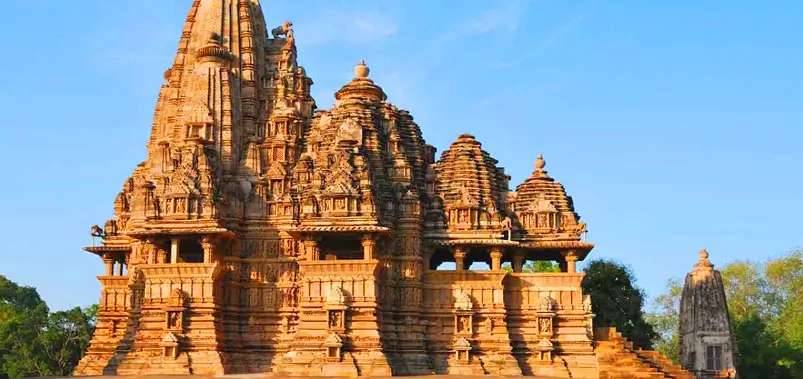
They are built primarily in sandstone and follow the Nagara tradition of North Indian temple architecture. Their most recognizable feature is the rising composition of multiple vertical towers culminating in a central shikhara over the sacred inner chamber. UNESCO describes this upward movement as symbolically connected with the sacred mountain form associated with the divine realm.
For a traveler without an architectural background, the easiest way to read the temples is from outside inward.
First comes the raised platform.
Then the entrance porch.
That leads into increasingly important interior halls.
Finally, the route reaches the sanctum at the spiritual center of the temple.
This gradual movement from the outer world toward the most sacred interior is essential to the building's meaning.
The exterior surfaces are extraordinarily active. Figures appear in horizontal bands, niches, projecting sections, and architectural frames. From a distance, the stone appears almost textile like because every surface seems carved. Move closer and individual scenes begin to separate from the pattern.
There are gods and goddesses.
There are celestial beings.
There are musicians.
There are dancers.
There are warriors, hunters, teachers, attendants, animals, domestic scenes, romantic couples, and figures performing ordinary acts of grooming or movement.
Incredible India's official Khajuraho guidance divides the sculptural themes into several broad groups including sacred figures, attendants, celestial women, scenes of ordinary life, and mithuna or erotic sculptures, noting that the erotic figures appear on the exterior walls rather than defining the entire temple interior.
This is a useful corrective to the way Khajuraho is often described internationally.
The temples are not buildings constructed for erotic worship.
They are monumental religious structures whose sculptural programs represent a broad conception of life.
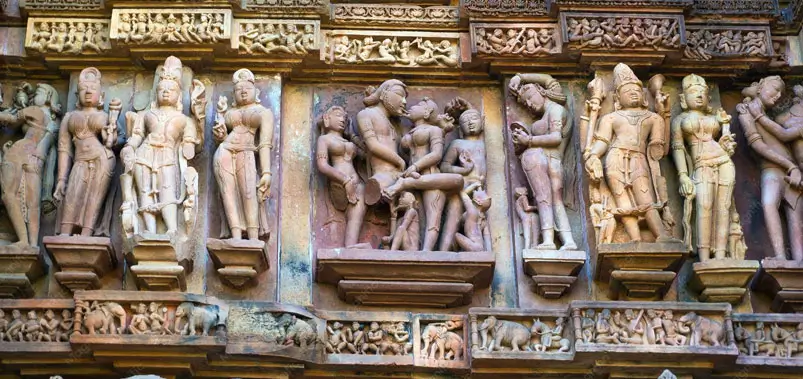
The erotic sculptures of Khajuraho have attracted more speculation than almost any other element of medieval Indian architecture.
There is no single scholarly explanation that settles every carving.
Some interpretations connect the imagery with tantric traditions.
Others see the figures as representations of fertility, auspiciousness, love, human desire, and the full range of worldly life.
Another interpretation places sensuality within a larger philosophical framework in which human life contains different legitimate aims, including moral duty, material life, desire, and spiritual liberation.
UNESCO itself is careful not to reduce the imagery to one explanation. Its description notes that the sculptural program includes sacred and secular subjects, scenes of worship, deities, domestic life, musicians, dancers, and couples in union, reflecting a broader belief system and social world.
That broader context matters more than any sensational headline.
At Lakshmana Temple, official tourism guidance specifically notes that the sculptural program includes figures connected with sensuality, fertility, love, and the wider experience of human life rather than existing merely for shock value.
The placement of the carvings is equally important.
Many of the best known intimate scenes appear on exterior walls and architectural junctions. The sacred core remains structurally and spiritually distinct.
For a thoughtful visitor, this raises a fascinating question: why would a sacred building include images of worldly desire on its exterior?
One interpretation is that the temple expresses a complete universe rather than separating religion from human life as sharply as some modern viewers might expect. Desire exists, daily life exists, family life exists, music exists, warfare exists, sensuality exists, devotion exists, and beyond them lies the sacred center.
Whether every medieval worshipper read the architecture in exactly that way cannot be proven.
What can be said confidently is that isolating several erotic panels from thousands of other figures badly misrepresents the site.
A good guide should explain this without embarrassment and without turning the visit into a series of jokes.
The sculptures are explicit in places, but the monument deserves adult historical interpretation rather than either moral panic or voyeurism.
American travelers visiting with teenagers should decide based on their own family's comfort level. The site itself is not presented as adult entertainment, and the carvings exist within a museum like archaeological environment. Mature historical explanation generally makes the experience far less awkward than allowing the subject to become a surprise.
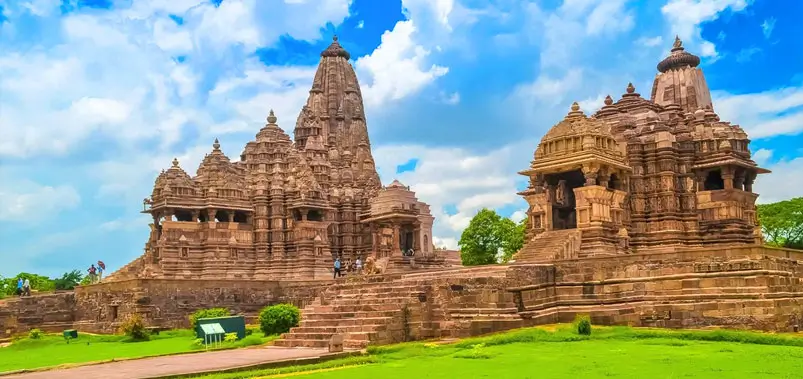
Kandariya Mahadeva Temple is the architectural centerpiece of Khajuraho.
UNESCO singles it out for the extraordinary richness of its sculptural decoration and describes its carvings as among the major masterpieces of Indian art.
The temple is dedicated to Shiva and represents the mature form of the Khajuraho architectural style at an extraordinary scale.
From a distance, the tower appears to rise in layers, with smaller spires clustering around the main vertical mass. The effect is almost geological, like a mountain rendered in carved sandstone.
This is not accidental.
The vertical composition is part of the temple's sacred symbolism.
From the platform, visitors can move around the exterior and inspect the sculptural bands at close range. This circumambulatory movement is one of the best ways to understand the building because the sculpture was designed to be encountered sequentially rather than viewed only from one frontal position.
Allow at least 45 minutes to one hour for Kandariya Mahadeva alone if architecture is a genuine interest.
A rushed group may stop for ten minutes, photograph the main facade, identify several famous erotic panels, and move on.
That misses most of the temple.
Look at how the figures fit the architectural projections.
Look at the changing scale of sculpture.
Look at the relationship between the lower walls and the rising tower.
Look at the contrast between the dense exterior and the darker sacred interior.
The temple rewards slow observation.
Morning is particularly good because the light reveals the relief carving more clearly before the strongest midday heat.
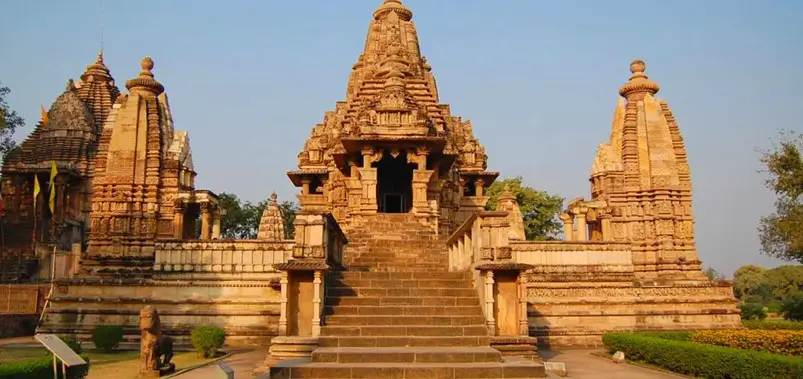
Lakshmana Temple is one of the most important monuments in the Western Group and should receive almost as much attention as Kandariya Mahadeva.
The temple is dedicated to Vishnu and is among the earlier major structures of the complex. Incredible India notes an inscription associated with the reign of King Dhanga and links the temple's construction to his father, Yashovarman.
Its exterior sculpture is extraordinarily rich.
Visitors can see divine figures, celestial women, social scenes, sensual imagery, and finely observed human gestures. One of the remarkable strengths of Khajuraho sculpture is its interest in small moments rather than only monumental divine poses.
A figure removes a thorn.
Another applies makeup.
A musician performs.
A couple embraces.
A warrior prepares for action.
These details make the stone feel unexpectedly alive.
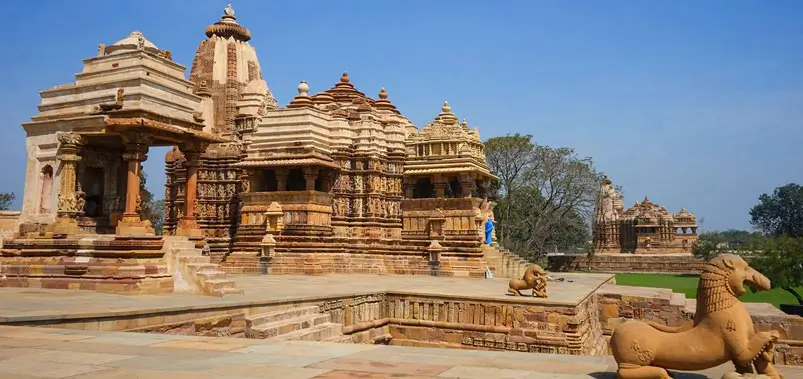
Vishvanatha Temple offers another excellent example of Shaiva architecture and is particularly useful for comparing how different temples within the Western Group repeat common forms while changing proportions and sculptural details.
Chitragupta Temple is dedicated to Surya, the sun god. Incredible India notes the important interior image of Surya and describes exterior scenes including processions, battles, hunting, dancing, and other aspects of courtly life.
This diversity demonstrates once again that Khajuraho is not defined by one category of sculpture.
For travelers moving quickly, the ideal approach is not to see every temple equally.
Spend the greatest amount of time at Kandariya Mahadeva and Lakshmana.
Then use Vishvanatha, Chitragupta, Devi Jagdamba, Varaha, and the smaller temples to deepen the architectural context.
The Western Group of Khajuraho temples is the priority for every first time visitor.
It contains the most monumental concentration of temples, the strongest museum style visitor infrastructure, and the architectural masterpieces most frequently associated with the UNESCO site.
Allow approximately three to four hours for a detailed Western Group visit.
Serious photographers or architecture enthusiasts may need longer.
The Eastern Group contains important Jain temples and provides a valuable contrast. These monuments show that Khajuraho's religious landscape was not exclusively Hindu. UNESCO specifically notes that the World Heritage group represents both Hinduism and Jainism.
Travelers should allow approximately one and a half to two hours for the Eastern temples, depending on guiding depth and transportation between sites.
The Southern Group is smaller and quieter. Important temples include Duladeo Temple and Chaturbhuj Temple. Incredible India's visitor guidance specifically recommends ending a full temple day toward the Southern Group, where Chaturbhuj can be particularly attractive later in the day.
The Southern sites receive fewer visitors than the Western Group, which can make them more atmospheric.
For a premium private itinerary, the strongest sequence is Western Group early in the morning, hotel break around midday, Eastern Group in the afternoon, and selected Southern temples toward late afternoon.
This avoids trying to absorb hours of sculpture without rest.
Temple fatigue is real.
After seeing several thousand carved figures, visitors begin to stop noticing details.
A two hour lunch and hotel break can restore attention far more effectively than forcing one continuous seven hour monument day.
Timings vary somewhat between individual monument listings and operational zones.
Current Incredible India listings show major Western Group temples operating broadly during daylight hours. For example, Lakshmana Temple is listed from 8:00 AM to 6:00 PM, while Chitragupta Temple is listed from 6:00 AM to 6:00 PM.
Because the protected complex is managed by the Archaeological Survey of India and schedules can change, visitors should verify the current opening time and ticket tariff immediately before travel.
For practical planning, 8:00 AM to 6:00 PM is a safe working framework for the principal Western Group experience, with early arrival strongly preferable.
Ticket prices for ASI monuments can be revised periodically, and foreign visitors should expect a separate international admission rate. Travelers should use the official ASI ticketing system or authorized ticket counter rather than buying from unofficial sellers.
For budgeting, the admission itself is modest relative to an international luxury trip.
The larger costs come from transportation, private guiding, hotel accommodation, domestic flights or train arrangements, and optional excursions.
Carry valid identification if required for any ticket category.
Large luggage should remain at the hotel or inside the private vehicle.
Comfortable shoes are essential.
The Western Group is landscaped and comparatively easy to walk, but visitors still cover substantial ground.
Stone surfaces become hot in strong sunlight.
Carry water where allowed.
A hat, sunglasses, and sunscreen are useful for most of the year.
The strongest daily visiting time is early morning.
The light is better for carved relief, temperatures are more comfortable, and the complex is generally easier to appreciate before the largest groups arrive.
By late morning, direct sunlight can become strong.
The sandstone temples remain beautiful, but the physical experience becomes more tiring.
In warmer months, a midday break is essential.
Return to the hotel.
Have lunch.
Rest.
Resume with the smaller temple groups later.
The cooler travel season provides the most comfortable conditions for a Khajuraho luxury tour, particularly for American visitors who intend to combine the temples with Panna, Orchha, Varanasi, or the Golden Triangle.
Peak summer heat can be severe.
Monsoon brings humidity and rain, but the surrounding landscape becomes greener.
Khajuraho is therefore visually attractive in different seasons, but comfortable walking conditions favor the cooler part of the year.
Yes, for most first time international travelers.
Khajuraho is one of the monuments where a licensed private guide adds real value because the sculptures are dense and the religious iconography is unfamiliar to many visitors.
Without interpretation, the visit can quickly turn into “another carved temple.”
A strong guide identifies major deities, explains temple architecture, points out court scenes, distinguishes religious figures from secular ones, gives context to the erotic panels, and helps travelers understand why certain images appear in particular locations.
The guide should not spend the entire visit making jokes about the erotic sculptures.
That is a common failure in superficial tours.
The best guiding treats the sensual imagery as one component of a much larger artistic program.
For premium travelers, a private English speaking guide is preferable to a large group tour because the pace can be adjusted.
Architecture enthusiasts can spend more time at Kandariya Mahadeva.
Photographers can pause for light.
Families can move faster through subjects that do not need extended discussion.
Older guests can take breaks.
That flexibility is worth far more than saving a small amount on a shared group.
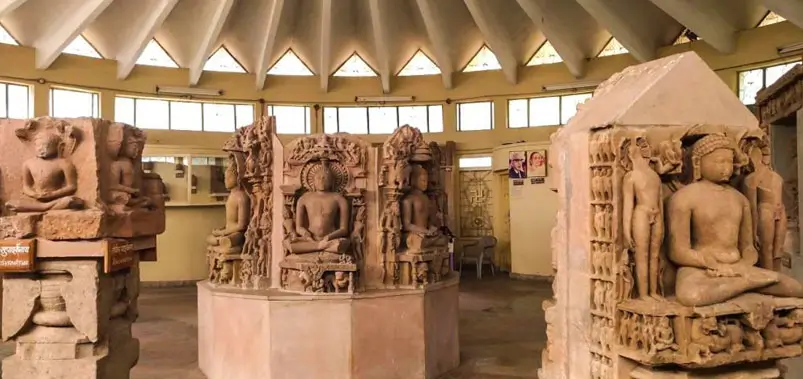
A museum visit can deepen the temple experience because sculpture removed from architectural context can be studied at eye level.
The local archaeological collections contain important fragments and works from the Khajuraho region, allowing visitors to examine artistic details that are harder to see high on exterior temple walls.
A museum works particularly well during the hotter part of the day.
Rather than remaining outdoors continuously, travelers can combine morning temples with an indoor cultural stop.
Khajuraho has also long been associated with an evening sound and light presentation near the Western Group. Operating schedules, languages, and seasonal timings can change, so travelers should verify the current performance before building dinner reservations around it.
Some visitors enjoy the presentation as a simple introduction to Chandella history.
Others prefer spending the evening at the hotel or arranging a quieter cultural experience.
It is optional rather than essential.
The temples themselves are the reason to come.

Khajuraho has its own airport, but international travelers should never assume flights operate every day throughout the year.
This is particularly important at present.
Recent reporting states that Khajuraho Airport has had periods with no commercial flight operations, including a pause during the monsoon period. At the same time, Air India has announced renewed Delhi and Varanasi connectivity for the later winter schedule, with daily Khajuraho services planned from late October.
This is exactly why an article claiming “simply fly from Delhi to Khajuraho” would be misleading.
Flight schedules are seasonal and can change.
Travelers need to check the actual travel date before finalizing the wider India itinerary.
When operating, Delhi–Khajuraho flights take approximately an hour and a half, while Khajuraho–Varanasi can be under an hour in the air. Current schedule sources show both routes appearing in seasonal airline planning.
If a convenient flight does not operate, rail and private road combinations become important.
Jhansi and Satna have historically been useful rail gateways depending on the route, while private vehicles can connect Khajuraho with Orchha, Panna, and other central Indian destinations.
A private tour operator should therefore design Khajuraho around live connectivity, not around an old itinerary template.
That is especially important for U.S. travelers with international flights and limited vacation days.
Khajuraho combines exceptionally well with Panna National Park.
The two destinations sit close enough that travelers can experience world class temple architecture and wildlife within the same short stay.
Panna is known for tiger habitat, river landscapes, and central Indian wildlife. Safari availability is seasonal and subject to park rules, permits, zone allocation, and closure periods.
A well paced itinerary can spend the first full day on Khajuraho's temples and the second on a morning or afternoon safari.
This combination is particularly attractive for American travelers who want more variety than an exclusively monument based trip.
The contrast is dramatic.
One morning is spent examining tenth century stone sculpture.
The next is spent driving through forest and river landscapes searching for wildlife.
That change of pace makes Khajuraho easier to justify within a longer India journey.
Two nights are ideal for most first time visitors.
One night can work when transportation aligns perfectly, but it leaves little margin for flight delays, heat, temple groups, or Panna.
Three nights are better when wildlife is included.
A comfortable two night stay might involve afternoon arrival, hotel check-in, a light orientation, full temple sightseeing the next day, and onward departure after breakfast.
A three night stay can add Panna without compressing the temples.
Luxury travelers should resist the temptation to fly in, rush through the Western Group, and leave immediately.
Khajuraho is not enormous, but the artistic density requires mental space.
The temples are better after a good night's sleep than immediately after a long road transfer.
Khajuraho works extremely well as an extension to a Golden Triangle Tour with Varanasi because it adds a major architectural tradition not represented by Delhi, Agra, or Jaipur.
Delhi and Agra introduce Islamic, Mughal, and colonial monuments.
Jaipur introduces Rajput palaces and forts.
Khajuraho introduces mature medieval Hindu and Jain temple architecture.
Varanasi then adds living riverfront religious traditions.
The combination creates a much broader picture of North Indian history than the standard Golden Triangle alone.
A possible luxury route can connect Delhi, Agra, Jaipur, Khajuraho, and Varanasi using a mixture of private road transfers and flights where current schedules operate.
The exact order should depend on live air connectivity.
Guests working with Golden Triangle Tours can have Khajuraho incorporated into a customized route with private vehicles, vetted English speaking guides, hotel arrangements, airport or rail assistance, and enough time to visit the Western, Eastern, and Southern temple groups without turning the destination into a hurried stop.
That slower approach matters here more than almost anywhere else.
Khajuraho has spent decades being reduced to a provocative travel headline.
The actual monuments are more intelligent than the headline.
The sensual figures belong to a larger artistic world that includes gods, families, music, warfare, courtly life, mythology, desire, ritual, and ordinary human gestures carved into stone with extraordinary technical control.
Visit for the famous sculptures if that is what first creates curiosity.
Stay long enough to see everything around them.
We promise you a holiday where everything is taken care of from the moment you land. Trusted drivers waiting for you, handpicked hotels that fit your style, personalized itineraries designed just for your family, and a dedicated team on call 24/7. All you need to do is relax, explore, and create unforgettable memories, while we take care of every detail behind the scenes.
Yes. Khajuraho is an excellent addition to a private Golden Triangle Tour with Varanasi, particularly for travelers interested in Indian art, temple architecture, sculpture, religion, and a broader historical journey beyond Delhi, Agra, and Jaipur.
Yes. Khajuraho and Panna National Park make an excellent combination, with temple sightseeing and wildlife experiences close enough to fit within the same multi-night stay.
Yes. The temples are historic and religious monuments rather than adult-entertainment sites. Families should simply be prepared to discuss explicit sculptures in a mature historical context where appropriate.
Yes. A knowledgeable private Khajuraho guide can explain the religious iconography, architecture, Chandella history, everyday scenes, and erotic sculptures in their proper context.
Current official tourism listings show major temples operating broadly during daylight hours, with examples ranging from 8:00 AM to 6:00 PM at Lakshmana Temple and 6:00 AM to 6:00 PM at Chitragupta Temple. Check current ASI operating hours before visiting.
Allow approximately three to four hours for a detailed first visit. Travelers seriously interested in sculpture, architecture, or photography may want even longer.
Kandariya Mahadeva Temple is generally regarded as the architectural masterpiece of the complex. UNESCO specifically highlights the exceptional quality of its sculpture.
The temples were constructed under the Chandella dynasty, particularly during its political and cultural high point in medieval central India. UNESCO identifies the site as an exceptional surviving testimony to Chandella culture.
No. Erotic carvings represent only a portion of the total sculptural program. UNESCO describes a much broader range of sacred and secular imagery across the monuments.
The Khajuraho temples are famous for their exceptional Nagara-style architecture and extraordinarily detailed sculpture. Erotic imagery is one component, but the temples also depict deities, musicians, dancers, warriors, household life, animals, mythology, and court culture.