North India can be seen through forts, palaces, Mughal architecture, royal residences, bazaars, and historic cities, but another route reveals a very different country. It begins beside sacred rivers before sunrise, moves through temple cities filled with pilgrims, follows religious traditions that have remained part of everyday life for generations, and reaches Amritsar, where the marble Golden Temple rises from the sacred Amrit Sarovar.
A journey connecting Varanasi, Haridwar, Ayodhya, and Amritsar should not be treated as a collection of unrelated religious attractions. Each city represents a different tradition, different geography, different form of worship, and different relationship between people and sacred space. Varanasi is inseparable from the Ganga and its ancient ghats. Haridwar marks the point where the Ganga reaches the North Indian plains and becomes the center of mass pilgrimage at Har Ki Pauri. Ayodhya is closely associated with Lord Ram and the Saryu River. Amritsar centers on Sikh faith, community service, the Harmandir Sahib, and the sacred pool surrounding the Golden Temple.
For American travelers, this route also provides something the standard monument circuit cannot. A palace can show how a ruler lived. A fort can explain military power. A museum can preserve objects from the past. These sacred cities show traditions that remain active today.
That difference changes the way they should be visited.
There are security procedures at temples, shoe removal requirements, head coverings at Sikh shrines, early morning rituals, evening Aarti schedules tied to sunset, crowded pedestrian zones, river safety considerations, and places where photography should be restrained even if technically possible.
Travel comfort matters as well. A premium private journey through these cities should include carefully selected hotels, chauffeur driven transportation where road travel makes sense, reliable airport and railway assistance, local guides with strong English, realistic rest periods, and enough nights that the trip does not become a sequence of dawn departures.
The most rewarding version of this route does not try to make every sacred place feel the same.
It allows Varanasi to remain intense.
It allows Haridwar to remain deeply pilgrimage oriented.
It allows Ayodhya to retain its devotional relationship with the Saryu.
And it allows the Golden Temple to speak through its remarkable combination of worship, architecture, equality, service, music, and hospitality.
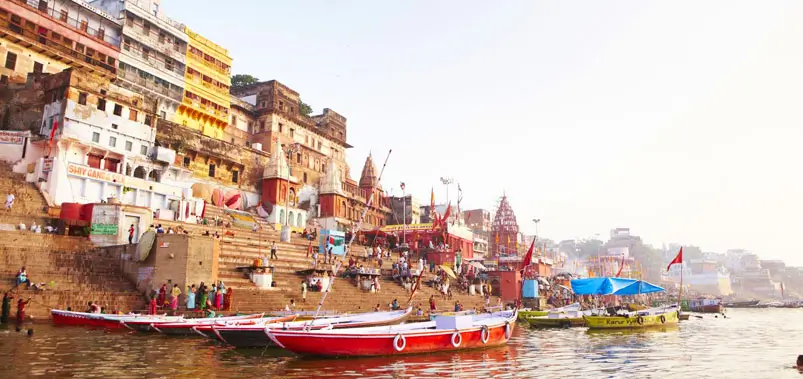
The Ganga connects Varanasi and Haridwar, but the two cities should never be treated as interchangeable stops on the same river.
Varanasi is best approached before sunrise.
A private sunrise boat ride in Varanasi allows visitors to see the ghats gradually become active as daylight reaches the river. Pilgrims descend to the water, prayers begin, boats move along the banks, and the architecture lining the river appears slowly through the morning light. For a first time international visitor, this early boat journey provides geographic context before entering the dense old city lanes.
Dashashwamedh Ghat becomes the center of attention again in the evening for the Varanasi Ganga Aarti. The principal ceremony takes place after sunset and lasts around 45 minutes. Seasonal schedules vary, so the exact time should be reconfirmed locally on the day. The practical rule is more useful than memorizing a permanent clock time: arrive roughly one hour before the ceremony.
Visitors can watch from the ghat or from a boat.
A position on the steps places the traveler directly inside the chanting, bells, incense, lamps, and crowd. A private boat provides a broader view of the ceremony and architecture from the river while creating some distance from the densest gathering.
Luxury travelers should arrange the boat in advance rather than negotiating at the river at the last moment. Private boat prices vary by vessel, demand, duration, festival dates, boarding point, and whether the journey also includes a river cruise before or after Aarti. Several thousand Indian rupees for a properly arranged private outing is a reasonable working expectation, with premium vessels and high demand dates costing more.
Varanasi deserves at least two nights, while three nights create a much better pace. The city contains much more than the evening ceremony. Kashi Vishwanath Temple, Sarnath, old city lanes, Assi Ghat, morning river activity, local cuisine, and quieter ghats all deserve time.
Haridwar feels different from the moment a traveler reaches the river.
The city sits where the Ganga enters the plains after descending from the Himalayan region, and Har Ki Pauri is one of India's major pilgrimage ghats. The atmosphere is less about monumental riverfront architecture and more about constant devotional activity. Pilgrims come to bathe, make offerings, pray, and attend the daily evening Haridwar Ganga Aarti.
The ceremony takes place at dusk, meaning the starting time changes according to season. During cooler periods it begins earlier; longer summer daylight moves it later. A traveler should again confirm the same day's timing rather than relying on an old timetable.
Arriving 60 to 90 minutes early is sensible.
Unlike a reserved luxury event, the best public positions at Har Ki Pauri cannot simply be assumed to remain empty until a traveler arrives. Weekends, religious holidays, pilgrimage periods, and festivals can produce enormous crowds.
The Ganga current at Har Ki Pauri also deserves respect. Chains are installed in sections used for bathing because the river can be strong. Foreign visitors should not interpret the large number of people entering the water as proof that every location is safe.
There is no requirement to bathe.
Watching the river, participating in a small flower lamp offering, and attending Aarti can provide a meaningful visit without entering the water.
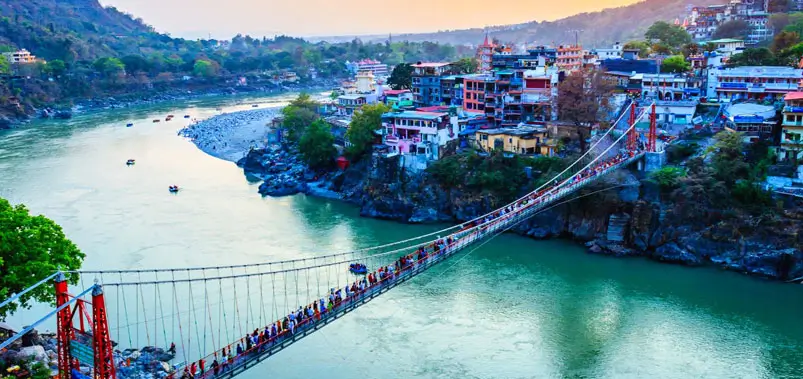
Haridwar also works naturally with Rishikesh, located a relatively short drive away. Premium travelers often prefer staying in a high quality resort near Rishikesh and making a private excursion to Har Ki Pauri, although one night in Haridwar can be worthwhile for travelers who want to remain close to the pilgrimage center.
The relationship between Varanasi and Haridwar is therefore not repetition.
Varanasi presents the Ganga as an ancient urban sacred landscape.
Haridwar presents the Ganga as a gateway to pilgrimage.
Seeing both gives international travelers a much fuller sense of how one river can carry different religious meanings in different places.
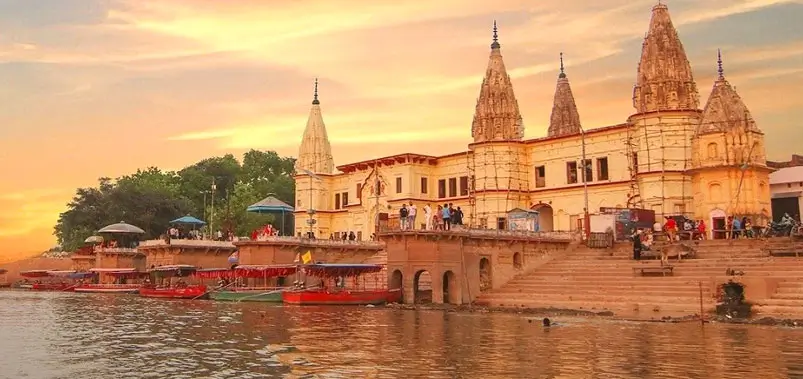
Ayodhya adds another river to the journey.
The Saryu River does not have the same global recognition as the Ganga, but within Ayodhya it is inseparable from the city's religious identity. The strongest itinerary therefore pairs the Ram Mandir with an evening beside the Saryu rather than treating the temple as the only reason to visit.
The Ram Temple should generally be visited early.
Public worship access begins in the morning and continues across different periods of the day, with pauses possible around temple rituals. Exact access hours should be verified shortly before arrival because religious schedules and crowd management procedures can change.
Travelers should allow two to three hours for the complete visit even when the actual time in the principal worship area is much shorter.
Security takes time.
Vehicle access may stop before the final approach.
Certain personal belongings and electronics are restricted.
Shoes need to be handled according to current temple procedures.
Queues can lengthen dramatically on weekends and religious dates.
The most important practical advice is to carry almost nothing.
A foreign traveler does not need a backpack, laptop, professional camera kit, several power banks, or shopping bags at a high security pilgrimage site. Leave nonessential belongings securely at the hotel or with the approved travel arrangement.
Modest clothing is appropriate.
Comfortable, easy to remove footwear is useful.
Senior travelers should inform the guide beforehand if they require mobility assistance.
After the morning temple visit, return to the hotel rather than forcing the day into one uninterrupted religious circuit. Have breakfast or lunch, rest, and resume later in the afternoon.
This break is especially important when temperatures rise.
Late afternoon belongs to the Saryu riverfront and Ram Ki Paidi.
Ram Ki Paidi consists of a series of ghats along the Saryu and becomes particularly attractive as daylight fades and the riverfront lights begin to appear. The evening ceremony is held around sunset, with earlier times during shorter winter days and later times when daylight extends into the evening.
Arrive roughly 45 to 60 minutes early.
That time allows visitors to settle into a comfortable location, see the riverfront before darkness, and avoid the frustration of entering a dense crowd after the ceremony has already begun.
A small flower and lamp offering is optional. Simple offerings are inexpensive by international standards, although prices vary according to decoration and seller. Confirm the amount before accepting one.
There is generally no ordinary public admission ticket required simply to stand at Ram Ki Paidi and witness the riverfront ceremony.
The difference between Ayodhya and Varanasi becomes particularly clear here.
Varanasi's major Aarti is larger and visually elaborate.
Ayodhya's Saryu Aarti is closely connected with a day centered on Lord Ram, temple worship, and the sacred geography of the city.
For travelers seeing several religious cities within the same trip, Ayodhya should receive two nights. That allows the Ram Temple, Saryu riverfront, Hanuman Garhi, selected additional religious sites, and proper rest without creating a rushed schedule.
The city can connect particularly well with Varanasi by private road when the larger route makes sense. Road distance is substantial enough that travelers should allow a generous transfer window rather than treating the cities as immediate neighbors.
The wider value comes from contrast.
A traveler can begin the day inside one of India's most important contemporary pilgrimage complexes and finish it beside an ancient sacred river under evening lamps.
That transition gives Ayodhya its strongest travel rhythm.
.webp)
Amritsar changes the religious language of the journey.
The Golden Temple, formally known as Harmandir Sahib or Sri Darbar Sahib, is the spiritual center most international visitors associate with Sikhism. It stands within the Amrit Sarovar, the sacred pool that gives Amritsar its name, and combines architecture, scripture, devotional music, community service, and a remarkable principle of openness.
For travelers arriving after Hindu pilgrimage cities, one of the first visible differences is etiquette.
Everyone entering the Golden Temple complex must cover the head.
Shoes are removed.
Feet are washed before proceeding into the sacred complex.
Smoking, tobacco, alcohol, and other prohibited items have no place within the shrine environment.
Modest clothing is appropriate.
Visitors do not need to be Sikh to enter.
That openness is one of the most memorable aspects of the Golden Temple visit. International travelers, families, local worshippers, Sikhs from across the world, and people from many different backgrounds move through the same complex.
The temple is particularly beautiful at early morning and after dark.
A premium itinerary should ideally include both.
Morning brings devotional music, softer light, and an atmosphere that can feel more contemplative before the busiest daytime period. Evening transforms the complex through reflections of the illuminated shrine across the Amrit Sarovar.
If staying two or three nights in Amritsar, there is little reason to force the entire Golden Temple visit into one hour.
Come once early.
Return at night.
The Langar, or community kitchen, is fundamental to the institution. Huge numbers of people are served free vegetarian meals without distinction of religion, nationality, income, caste, or social status. For foreign travelers, seeing how food is prepared and served on such a scale can be as meaningful as viewing the golden sanctum.
Visitors are welcome to eat.
The meal should be approached respectfully rather than as a free culinary attraction.
Guests sit together and are served a simple vegetarian meal. Donations and voluntary service are part of the culture, but no visitor should feel that an expensive contribution is required to justify entering.
The practical side requires preparation.
The complex can become extremely busy.
The queue to enter the central shrine itself can take considerable time, particularly during weekends and important Sikh dates.
A private guide can provide historical and religious context but cannot legitimately bypass official religious queues simply because a traveler booked a luxury tour.
This distinction matters across every sacred city in North India.
Luxury transportation can take you to the correct entrance.
A knowledgeable guide can explain what is happening.
A premium hotel can provide comfort before and after the visit.
None of these should be marketed as authority to ignore the rules of an active religious institution.
Amritsar deserves at least two nights.
A strong itinerary includes the Golden Temple, Jallianwala Bagh, the Partition Museum, local Punjabi dining, and the Attari Wagah Border Ceremony in the late afternoon on a separate or carefully arranged day.
The border ceremony is roughly an hour's drive from central Amritsar under normal conditions, although crowd traffic can materially increase travel time. Visitors should arrive well before the formal military ceremony begins because security screening and seating take time.
Three nights are particularly comfortable when travelers want both early morning and evening visits to the Golden Temple without compressing the city.
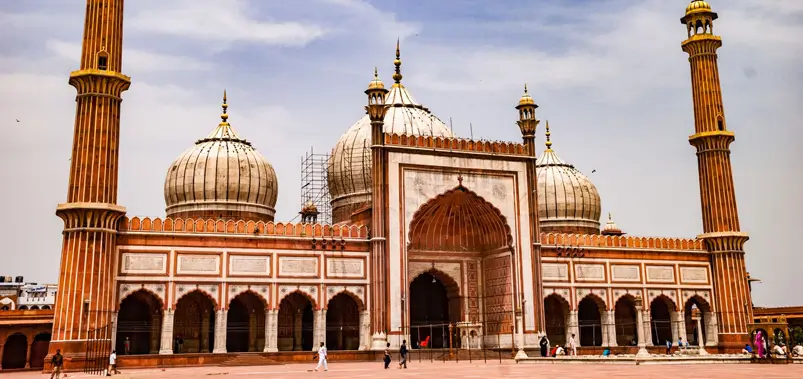
The practical challenge is not deciding whether these places are worthwhile. It is connecting them without creating an exhausting itinerary.
For American travelers beginning with the Golden Triangle Tour, Delhi provides the natural transportation hub.
One option is to place Haridwar and Rishikesh immediately after Delhi. Private road transportation works well because travelers can leave directly from their Delhi hotel and continue into Uttarakhand. Driving should generally be treated as a substantial half day transfer rather than a quick suburban journey.
After returning toward Delhi, the core Delhi–Agra–Jaipur circuit can continue by private chauffeur driven vehicle.
Ayodhya and Varanasi can then be connected using a combination of domestic flights, rail, and private road travel according to the live schedule available for the travel dates.
Amritsar can sit either near the beginning or end of the route because Delhi has strong transport connections with the city.
For premium travelers, there is no benefit in creating a zigzag route solely to include every destination in chronological religious order.
Geography matters.
The itinerary should minimize repeated backtracking.
A comfortable larger journey might allocate approximately:
Delhi: two to three nights.
Haridwar and Rishikesh: two to three nights.
Agra: one to two nights.
Jaipur: two to three nights.
Ayodhya: two nights.
Varanasi: two to three nights.
Amritsar: two to three nights.
That is already a substantial North India journey.
Trying to compress it into eight or nine nights would transform sacred cities into transfer stops.
Transportation standards also matter.
For road sectors, American travelers should use a private air conditioned vehicle with an experienced chauffeur. A couple with normal luggage may find a premium sedan sufficient for shorter journeys, but a spacious SUV or quality MPV is often more comfortable across a multi city route.
Higher end vehicles cost more but can materially improve several hours of daily travel.
Rail can be excellent on selected sectors, especially when premium seating or sleeping classes align with the schedule. A train should be chosen because it improves the route, not merely because travel in India is assumed to require one train journey.
Domestic flights are valuable for longer sectors but should include realistic airport buffers.
North Indian winter fog can affect both road and air operations. Tight same day connections with international flights should be avoided.
Hotels should also match the character of each destination.
Delhi and Jaipur offer some of India's finest international and palace style luxury hotels.
Agra has exceptional Taj Mahal view accommodation.
Haridwar and Ayodhya have a more limited ultra luxury inventory, so property selection should emphasize cleanliness, room quality, service, location, vehicle access, and reliability rather than brand prestige alone.
Varanasi offers distinctive high end options, including heritage properties near the river and refined modern hotels elsewhere in the city.
Amritsar has strong luxury accommodation choices within convenient driving distance of the Golden Temple.
Guests booking through Golden Triangle Tours can have these sacred destinations incorporated into one private itinerary, with chauffeur driven transportation, English speaking guides, selected domestic flights or trains, hotel arrangements, temple day logistics, and realistic buffers around evening ceremonies.
The purpose of premium service is not to turn pilgrimage cities into sanitized resorts.
It is to remove unnecessary friction so the traveler can pay attention to the places themselves.
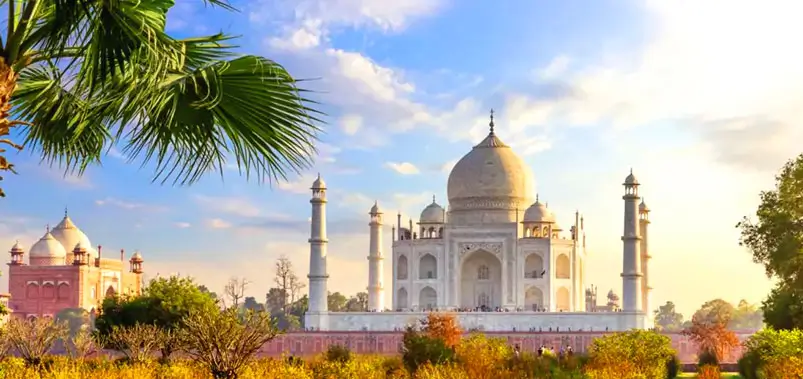
Sacred travel requires a different attitude from ordinary sightseeing.
At river ghats, private prayer and bathing should not automatically become photographic subjects.
At Hindu temples, shoes are commonly removed and clothing should remain modest.
At the Golden Temple, covering the head is mandatory and footwear is removed before entering the complex.
At heavily secured shrines such as the Ram Temple, electronics and personal belongings may be restricted.
Every site has its own instructions.
Follow them.
Photography rules should be treated seriously even when other visitors appear to ignore them.
A traveler does not gain anything by arguing with temple personnel over a camera restriction.
The same applies to donations.
Religious donations are voluntary unless a clearly defined paid service has been requested. Visitors should never feel pressured into handing over large amounts because someone claims a ritual is compulsory.
A reputable private guide can help distinguish normal religious customs from aggressive tourist solicitation.
The sacred rivers require physical caution as well.
The Ganga and Saryu are living rivers with currents, changing water levels, slippery steps, and seasonal conditions.
Do not enter the water simply because people around you are bathing.
Families should keep children close.
Senior travelers should prioritize stable viewing areas instead of trying to reach the closest river edge.
Health and physical energy matter throughout the journey.
Early morning worship followed by afternoon sightseeing and an evening Aarti can create a very long day.
Do not repeat that pattern every day for two weeks.
Use hotel breaks.
Have proper meals.
Stay hydrated.
Keep some mornings later.
Premium travel becomes noticeably better when the itinerary recognizes that travelers are human rather than treating every available hour as sightseeing inventory.
The same principle applies emotionally.
Varanasi, Haridwar, Ayodhya, and Amritsar are not simply locations where a guide delivers an explanation and moves on.
Sit for a while.
At the Golden Temple, watch the reflection on the water.
At Har Ki Pauri, arrive before the lamps.
At Ayodhya, remain beside the Saryu as the riverfront lights appear.
In Varanasi, take the sunrise boat before the city becomes fully awake.
Those quiet periods between formal attractions are often the moments international travelers remember longest.
We promise you a holiday where everything is taken care of from the moment you land. Trusted drivers waiting for you, handpicked hotels that fit your style, personalized itineraries designed just for your family, and a dedicated team on call 24/7. All you need to do is relax, explore, and create unforgettable memories, while we take care of every detail behind the scenes.
Yes. A Golden Triangle Tour with Varanasi, Ayodhya, Haridwar and Amritsar can create an exceptionally broad North India itinerary combining the Taj Mahal, Rajput palaces, sacred rivers, Hindu pilgrimage centers, Sikh heritage, historic cities, and major living religious traditions.
Yes, provided the pace is carefully managed. Use private vehicles, stay close to important sites where practical, allow midday breaks, avoid consecutive long sightseeing days, confirm accessibility, and arrive early at ceremonies to reduce crowd-related stress.
Varanasi generally deserves the most time, with two nights as a minimum and three nights preferable. Ayodhya and Amritsar each work well with two nights, while Haridwar can be paired with Rishikesh for a two- or three-night regional stay.
Yes. International visitors are welcome at the Golden Temple Langar, where a vegetarian meal is served without distinction of religion, nationality, or social background. The meal should be treated as part of a tradition of equality and community service.
Yes. There is generally no admission ticket to enter the Golden Temple complex. Visitors must follow religious etiquette, including covering the head, removing footwear, washing the feet, and respecting rules within the shrine.
Visitors generally attend the Saryu River Aarti around Ram Ki Paidi and nearby riverfront ghats. The ceremony takes place around sunset and should be paired with an early arrival rather than a last-minute transfer from Ram Mandir.
The Har Ki Pauri Ganga Aarti takes place at dusk every day. Winter ceremonies occur earlier than summer ceremonies because the schedule follows sunset. Arriving 60 to 90 minutes beforehand is sensible.
The Varanasi Ganga Aarti is held daily after sunset at Dashashwamedh Ghat. The exact starting time changes seasonally, so confirm it locally and arrive approximately one hour early for a better viewing position.
Allow at least 12 to 16 nights if the route also includes Delhi and selected Golden Triangle destinations. More time produces a significantly better journey because Varanasi, Ayodhya and Amritsar each deserve multiple nights.
Yes. Varanasi, Haridwar, Ayodhya and Amritsar can be combined within a longer private North India itinerary. The route works best with a mixture of private vehicles, domestic flights, and selected rail sectors rather than driving every long distance.