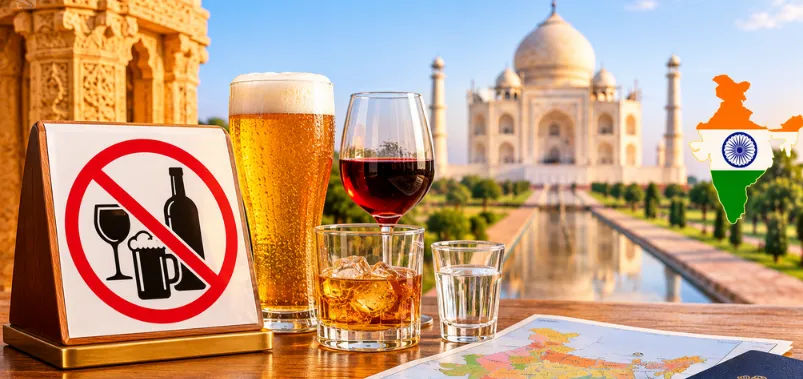
A couple from Manchester sit down at a rooftop bar in Jaipur on a warm October evening, ask for two gin and tonics, and are told politely that the bar cannot serve alcohol today. It is Gandhi Jayanti, a national dry day, and nobody mentioned it. The next week in Delhi, a 23 year old American is asked for her passport at a hotel bar and then refused, because the legal age in the capital is 25. Neither traveller did anything wrong. They simply did not know the rules.
Alcohol laws in India are set state by state, so the legal age, shop hours, dry days and even whether you can drink at all change as you cross a border. On a classic Delhi, Agra and Jaipur route you pass through three different systems in a week. This guide sets out what tourists actually need to know: drinking ages, the dry states, national and local dry days, where to buy, realistic prices in luxury hotels, Indian wine and craft beer, the law on public drinking and drink driving, what you can bring through customs, and how to behave around temples and holy towns.
There is no single national drinking age in India. Each state and union territory sets its own minimum through its excise laws, and the numbers range from 18 to 25. Bar staff in good hotels do check, and they will ask for a passport, not a driving licence from home, so carry a photocopy or a clear photo of your passport page and keep the original handy in the evening.
The legal drinking age in Delhi is 25, one of the highest in the country. This is the rule that catches out younger travellers most often. There has been repeated discussion in the Delhi government about lowering it, particularly for beer, and an earlier policy that briefly set it at 21 was withdrawn. At the time of writing, 25 remains the age that hotels and bars apply, so anyone under 25 should expect to be refused in Delhi even at an international chain hotel. Check the current position close to your travel date, as the excise policy is under review.
Just across the border, the rules relax. In Gurugram, which is in Haryana, and in Noida, which is in Uttar Pradesh, the minimum is 21. The drinking age in Uttar Pradesh is also 21, which covers Agra, Varanasi and Lucknow. So a 22 year old traveller could be refused a beer in central Delhi and then served one quite legally in an Agra hotel the following night.
Rajasthan is commonly listed with a minimum age of 18 under its state excise rules, which covers Jaipur, Udaipur, Jodhpur, Jaisalmer and Ranthambore. In practice, some upmarket bars and heritage hotels set a house rule of 21 or ask young-looking guests for ID, so do not be surprised if you are checked.
Further afield, Maharashtra sets 25 for spirits and 21 for beer and wine, which matters in Mumbai. Punjab uses 25, Kerala uses 23, and states such as Haryana, Madhya Pradesh, Tamil Nadu and West Bengal use 21. Himachal Pradesh, Sikkim and Puducherry use 18. Goa is famously relaxed about alcohol, but bars there still expect adults to carry ID.
Parents travelling with teenagers should note that hotels will not serve a glass of wine to a 17 year old at the table, even with a parent present. Staff can lose their licence over it, so do not put them in an awkward position by asking.
The simplest approach on a Golden Triangle route is to treat 25 as the safe age in Delhi and 21 everywhere else. If you are under that, enjoy fresh lime soda, mango and yoghurt smoothies, spiced lemonade and the excellent mocktails that most five-star bars now take seriously. Ask the bartender for a version of their signature cocktail without spirits; at palace hotel bars such as the Polo Bar at Rambagh Palace in Jaipur, a well made alcohol-free drink in those surroundings is a pleasure in its own right.
Every Indian state has different alcohol regulations. Let thoughtful trip planning help you navigate local customs, discover iconic destinations and enjoy a more informed Golden Triangle experience from start to finish.
A handful of Indian states ban alcohol entirely or almost entirely. The best known is Gujarat, which has been dry for decades. Visitors from outside the state, including foreign tourists, can apply for a short-term personal Gujarat liquor permit through the state's online E-Permit system at eps.gujarat.gov.in, paying a small fee and then having the printed permit verified with original passport and travel documents at a licensed liquor shop, usually attached to larger hotels, within a few days of arrival. Since late last year, foreign nationals and visitors from outside Gujarat can also drink at licensed hotels and restaurants inside GIFT City near Gandhinagar with valid photo ID and no permit. Everywhere else in Gujarat, you need the permit.
Bihar has a total ban with no tourist permit, and enforcement is strict. Travellers visiting Bodh Gaya should assume they will not find a drink anywhere, and must not carry alcohol into the state. Nagaland and Mizoram, in the north east, are also dry. Manipur has partial prohibition in some districts. Lakshadweep, the island territory off Kerala, repealed its long-standing prohibition law in June and replaced it with a new excise regulation, but the new licensing system depends on a further official notification, so check before you travel. Previously, alcohol was allowed only at Bangaram island resort and a few licensed places.
Dry days in India are a separate issue, and they apply even in states where alcohol is normally freely sold. Three national dry days are observed across the country: Republic Day on 26 January, Independence Day on 15 August and Gandhi Jayanti on 2 October. On these days liquor shops, bars and restaurants close their alcohol service.
States then add their own festival dry days. Delhi's excise department publishes a list each quarter, which this season has included days such as Maha Shivratri, Id-ul-Fitr, Ram Navami and Mahavir Jayanti, alongside festivals later in the year such as Janmashtami and Diwali. Holi was removed from Delhi's dry day list this year, which shows how much the lists change. Rajasthan and Uttar Pradesh publish their own lists, and they do not always match Delhi's.
Elections create the most unexpected election dry days. Alcohol sales stop in a constituency for about 48 hours before polls close, and on counting day. With Indian elections held in phases over several weeks, a dry period can hit your route with little notice.
There is one useful exception. In Delhi, hotels with the special L-15 hotel licence may continue serving alcohol on dry days, but only to resident guests, usually in the room or in a designated area. Other states have similar rules for top hotels. Ask your hotel in advance, and if a celebratory dinner falls on a dry day, either move it or arrange with your hotel. Your driver or guide will usually know local dry days a few days ahead.
Where you buy makes a huge difference to price and experience. Most travellers on a private tour drink at their hotel and in good restaurants, and only occasionally visit a shop for a bottle of wine for the room.
Liquor shops in India fall into two main types. In Delhi, retail is currently handled mainly through government corporation shops, while in Rajasthan and Uttar Pradesh it is mostly private licensed shops. Many are basic counters with a grille and a crowd of men, which can feel off-putting, but upmarket stores in malls and better neighbourhoods have shelves, air conditioning and a broader range of wine and imported spirits. Hours vary: Delhi shops usually trade from late morning until about 10pm, while Rajasthan has enforced an 8pm closing time for shops for several years. If you want a bottle for the evening in Jaipur, buy it in the afternoon.
Shop prices are low by Western standards. A 650 ml bottle of Kingfisher beer usually costs roughly INR 180 to 250, a bottle of Sula Sauvignon Blanc or Chenin Blanc about INR 900 to 1,300, and a bottle of an Indian single malt such as Amrut or Paul John several thousand rupees. Imported wine and spirits are heavily taxed and can cost two to three times their home price.
Restaurants need a bar licence to serve alcohol, and many smaller family places and vegetarian restaurants do not have one. Do not assume every restaurant offers wine with dinner; ask your guide which ones do.
Hotel bar prices in India at the luxury end are close to London or New York levels once tax is added. As a guide from one Taj group hotel bar menu in Delhi, domestic beers such as Kingfisher Ultra or Bira cost around INR 575 to 750 (about USD 7 to 9), imported Corona around INR 750, classic cocktails such as a negroni or margarita about INR 1,000 to 1,250, Sula wine around INR 850 to 1,250 a glass and INR 3,750 to 6,300 a bottle, and a 30 ml single malt such as Glenfiddich or Lagavulin about INR 875 to 1,250. All of those are before taxes. At flagship bars in palace and five-star hotels, cocktails often run INR 1,200 to 2,000 (roughly USD 14 to 24) or more, and a bottle of good imported wine can easily pass INR 10,000. Taxes on alcohol add noticeably to the final bill, and prices can change, so budget on the higher side.
Note that Indian bars usually pour spirits in 30 ml or 60 ml measures, and menus often price by the 30 ml peg. A "large" drink is 60 ml, double the price. Ask if unsure.
Room service minibar prices are higher still, and the beer in your room fridge may cost more than in the bar downstairs.
Planning ahead makes travelling through India easier. Discover the Golden Triangle with private transport, local guidance and practical support for navigating regional rules and unexpected changes during your journey with care.
India's drinks scene has changed enormously, and a holiday is a good chance to try local bottles you will rarely find at home.
Indian wine is centred on Nashik in Maharashtra, a few hours from Mumbai. Sula Vineyards is the largest and best known producer, and its Sauvignon Blanc, Chenin Blanc, Brut sparkling and the Rasa Cabernet Sauvignon appear on wine lists across the country. Sula's estate near Nashik has a tasting room, restaurant and resort, and it is a popular stop for travellers heading to Mumbai. Grover Zampa, from Nandi Hills near Bengaluru and Nashik, is another reliable name, as are Fratelli and York. Indian whites tend to be fresh and fruity, which suits spicy food better than heavy oaked reds, and a chilled Chenin Blanc with a Rajasthani lamb dish is a good pairing to try.
Beer drinkers will meet Kingfisher everywhere, usually in strong and lager styles. But craft beer in India has grown fast. Bira 91, with its monkey logo, is now on most hotel menus, and Simba and White Rhino are also widely available. Gurugram, on the edge of Delhi, has a cluster of microbreweries with house wheat beers, IPAs and stouts, and Bengaluru is known as the craft beer capital. Brewpubs make a relaxed evening out, though they tend to be loud and lively on weekends.
Whisky lovers have a real treat. Indian single malt whisky has won major international awards. Amrut, from Bengaluru, and Paul John, from Goa, are the pioneers, while Indri, from Haryana, has won a string of competitions. Hotel bars in Delhi and Jaipur usually stock at least one, and tasting a peg side by side with a familiar Scotch is a fun way to spend an hour. Bottles make good gifts to take home, within your home country's customs limits.
Gin has also become fashionable, with Indian craft brands such as Greater Than, Hapusa and Stranger and Sons using botanicals like Himalayan juniper, mango and Indian lemon. Ask the bartender for a gin and tonic with Indian gin and local tonic water.
Rum is cheap and popular, and Old Monk is a cult classic. You will find it in a lot of bars, mixed with cola, at very modest prices.
Remember that tap water is not safe to drink, so ice in roadside places is best avoided, but in luxury hotels and good restaurants ice is made from purified water and is perfectly fine.
Finally, many Indians do not drink at all, for religious or family reasons, and there is no social pressure on visitors to drink either. Hotels and good restaurants have extensive non-alcoholic menus. Some of the best drinks you will taste in India are fresh coconut water, sugarcane juice from a clean vendor, rose-flavoured milk and the spiced lemonade found at palace hotels across Rajasthan.
The legal rules on where you can drink are stricter than in much of Europe or Australia. Drinking in public in India is illegal in almost every state. That means no beer on the beach in most places, no bottle of wine at a picnic in Lodhi Garden and no can in the car. Penalties include fines and, in some states, possible arrest. Drinking is allowed only in licensed premises and in private places such as your hotel room.
Drink driving laws in India set the legal limit at 30 mg of alcohol per 100 ml of blood, lower than the limits in England or Scotland. Under the Motor Vehicles Act, a first offence can bring up to six months in prison and a fine of up to INR 10,000, with tougher penalties for a repeat offence. Police in Delhi and Gurugram set up breath test checkpoints on weekend nights. Most tourists use a private car with a driver, which avoids the issue completely. It is worth making clear to your driver, kindly, that you would like him to be completely sober during your trip, and good tour companies enforce this anyway.
Carrying alcohol between states is a common trap. Each state taxes alcohol differently, and taking a bottle bought in one state into another is often an offence, especially from Haryana or Uttar Pradesh into Delhi, where prices differ. Never carry alcohol into Gujarat without a permit or into Bihar at all. The safe approach is to buy alcohol in the state where you will drink it and finish it there.
Arriving by air, the India duty free alcohol allowance is 2 litres of alcoholic liquor or wine per adult passenger, confirmed in the new Baggage Rules that came into force in February. Under the same rules, foreign tourists can bring other goods worth up to INR 25,000 duty free. Delhi airport has a duty free shop in the arrivals hall before customs, which is handy for a bottle of wine for your hotel room. Anything above the allowance must be declared at the red channel and will attract duty.
Religious sites deserve particular care. Never bring alcohol into or near a temple, gurdwara, mosque or church, and do not visit a religious site after drinking. Pushkar in Rajasthan is a holy town where alcohol, meat and eggs are banned, and the rule is taken seriously, so time any drinks for your hotel outside town or for the next stop. Varanasi has strict rules near the ghats and temples, and alcohol sales are prohibited around the temple areas of Mathura and Vrindavan. Ayodhya and Haridwar have similar restrictions near their holy sites.
Even in Jaipur or Agra, avoid drinking in view of a temple or a family gathering, and keep photos of drinking off social media posts tagged at religious sites. If you are on one of our Golden Triangle tours, your guide can flag dry days, local rules and the best hotel bars as you travel, so you can enjoy a drink without any awkward surprises.
We promise you a holiday where everything is taken care of from the moment you land. Trusted drivers waiting for you, handpicked hotels that fit your style, personalized itineraries designed just for your family, and a dedicated team on call 24/7. All you need to do is relax, explore, and create unforgettable memories, while we take care of every detail behind the scenes.
There is no single national age, and tourists follow the same rules as residents. Delhi sets 25, Uttar Pradesh, Haryana and many other states set 21, and Rajasthan is commonly listed at 18. Carry your passport or a copy, because bars will check.
Not legally, because Delhi's drinking age is 25 and hotels apply it strictly. The government has discussed lowering it, but no change was in force at the time of writing. You can legally drink at 21 in nearby Gurugram, Noida and in Agra.
Republic Day on 26 January, Independence Day on 15 August and Gandhi Jayanti on 2 October are dry days across the country. States add festival dry days and polling days on top. Shops close and bars usually stop serving alcohol on these days.
In Delhi, hotels with an L-15 licence can serve alcohol to resident guests on dry days, but not to outside visitors. Other states have similar exceptions for top hotels. Ask your hotel in advance, as practice varies.
Yes, with a liquor permit applied for online at eps.gujarat.gov.in and verified at a licensed liquor shop with your passport within a few days of arrival. Foreign nationals can also drink at licensed hotels and restaurants inside GIFT City with photo ID and no permit. Elsewhere in Gujarat, drinking without a permit is illegal.
Bihar, Nagaland and Mizoram are dry, and Gujarat is dry except for permit holders. Lakshadweep has repealed its prohibition law, but the new licensing system is still being set up. Manipur has partial bans in some districts.
At five-star hotel bars in Delhi and Jaipur, classic cocktails usually cost INR 1,000 to 2,000 (about USD 12 to 24) before tax, and more at flagship bars. Domestic beer is around INR 575 to 750 and a glass of Sula wine around INR 850 to 1,250 plus taxes. Prices can change, so budget on the higher side.
Each adult passenger can bring 2 litres of alcoholic liquor or wine duty free. Foreign tourists also have a general allowance of up to INR 25,000 for other goods. Declare anything above the limit at the red channel.
Yes, drinking in public places such as streets, parks, beaches and cars is illegal in almost every state. You can drink only in licensed bars and restaurants or in private places like your hotel room. Fines and possible arrest apply.
It is risky and often illegal, because each state has its own excise rules and taxes. Never carry alcohol into Bihar or into Gujarat without a permit, and avoid taking bottles from Haryana or Uttar Pradesh into Delhi. Buy alcohol in the state where you will drink it.