The flight lands at Indira Gandhi International Airport at 1:40 in the morning. You have been awake for most of a day, the arrivals hall smells of floor polish and jasmine garlands, and your body is convinced it is mid afternoon somewhere over the Atlantic. This is the moment where an India holiday either starts well or slips into three days of foggy headaches and 4am wakeups in a beautiful hotel room you are too tired to enjoy.
The good news is that jet lag in India is very manageable if you treat the first 48 hours as part of the holiday rather than lost time. This guide works through the real numbers: how far ahead India is from New York, Los Angeles, London, Sydney and Perth, which flights land when, what to do on the plane, how to handle the arrival night, and how to shape a light first and second day in Delhi so that by the time you reach Agra and Jaipur you are sleeping through the night and properly awake for the sights.
India runs on a single time zone, Indian Standard Time, which is IST UTC+5:30. That half hour catches people out, so it is worth writing down. India does not use daylight saving, so the gap with your home city changes twice a year when your own clocks move, while Delhi stays put.
For North American travellers the numbers are large. New York, Boston and Washington are 9 hours 30 minutes behind India during US summer time and 10 hours 30 minutes behind in winter. Chicago adds one more hour. Los Angeles, San Francisco and Seattle sit 12 hours 30 minutes behind in summer and 13 hours 30 minutes behind in winter, which is almost a complete flip of day and night. When it is 8am in Delhi, it is 7:30pm the previous evening in California during the winter months.
From the UK the gap is much gentler. London is 4 hours 30 minutes behind India while British Summer Time is running and 5 hours 30 minutes behind once the clocks go back to GMT. Most UK visitors to the Golden Triangle travel between October and March, so the usual figure is five and a half hours. That is roughly the same shift as flying from London to New York, just in the other direction.
Australians face a different puzzle because India is behind them, not ahead. Sydney and Melbourne are 4 hours 30 minutes ahead of India on standard time and 5 hours 30 minutes ahead when Australian daylight saving runs from early October to early April, which is exactly the Indian peak season. Perth, which has no daylight saving, is a steady 2 hours 30 minutes ahead of India, so West Australians barely notice a change at all. Brisbane, also without daylight saving, sits 4 hours 30 minutes ahead all year.
A rough rule used by sleep doctors is that the body clock shifts by around one hour per day on its own. On that basis a Californian could take ten days or more to adjust fully, a New Yorker around a week, a Londoner four or five days and a Sydney traveller a few days. You can speed this up a great deal with light, meal timing and sleep discipline, which is what the rest of this guide is about.
Direction also matters. Travelling east, as you do from the US and UK, means your day is shortened and you must fall asleep earlier than your body wants. This is the harder direction for most people. Travelling west, as Australians do, means staying up later than usual, which most of us find easier. So a Sydney traveller with a five and a half hour gap often feels better on day two than a London traveller with exactly the same gap flying the other way.
Arriving in India after a long-haul flight? Give yourself time to adjust, enjoy comfortable transfers and explore at your own pace with a thoughtfully planned Golden Triangle holiday from arrival onwards.
Knowing your arrival time shapes everything that follows, and a surprising number of long-haul flights into Delhi land late at night or in the small hours. Airlines time them to suit departure slots in Europe, the Gulf and North America, not your sleep.
From the United States, Air India flies nonstop from New York JFK to Delhi, and United Airlines operates its Newark to Delhi service. These flights normally take around 14 to 16 hours eastbound, though routings have changed in recent seasons because of airspace closures, and some Air India services to San Francisco and other US cities have run with a stop or been suspended for periods. Check the current schedule carefully when you book, because a "direct" flight with a technical stop can add two or three hours. Many US travellers instead fly one stop via the Gulf: Emirates via Dubai or Qatar Airways via Doha, with Etihad via Abu Dhabi as another option. The final hop from the Gulf to Delhi is only about 3 to 4 hours, and a large share of these connections reach Delhi between midnight and 5am.
From London, the nonstop choice is wide. British Airways, Virgin Atlantic and Air India all fly Heathrow to Delhi, and the London to Delhi flight time is usually around 8 hours 30 minutes to 9 hours 30 minutes. Overnight departures from Heathrow typically land in Delhi in the late morning or around midday, while daytime departures arrive close to midnight. If you can choose, the overnight flight that lands mid morning is often kinder, because you step straight into daylight and only need to stay awake until about 9pm.
From Australia, Air India runs nonstop flights from Sydney and Melbourne to Delhi, taking roughly 12 hours 30 minutes to 13 hours. Qantas has operated a Melbourne to Delhi service on a seasonal basis, so check whether it is flying in your travel months. Perth travellers usually connect through Singapore, Kuala Lumpur or a Gulf hub. Flights from Australia often land in Delhi in the evening, which suits the westward direction because you simply have dinner, go to bed a little early by your home clock and wake up close to local morning.
When you compare fares, it is worth paying a little more for a flight that lands at a sensible hour. A 2am arrival means immigration, baggage, a drive of 30 to 45 minutes to central Delhi hotels and bed around 4am, which wrecks the following day. A slightly dearer flight that lands at 11am can save you an entire day of the holiday and the cost of an extra hotel night.
Immigration at Delhi Terminal 3 can be slow at peak arrival times, especially between 1am and 4am when several Gulf and European flights land together. Have your India e-Visa printout and hotel address ready, fill in any arrival form on the plane and keep a pen in your bag. Your driver will usually wait just outside the arrivals exit holding a name board. Having that person already booked is one of the simplest ways to reduce stress on a tired night, and it is something Golden Triangle Tours arranges as part of its private trips.
The work of beating jet lag starts the moment you board. The single most useful habit is to set your watch and phone to Delhi time as soon as the doors close, then behave as if you are already living on that clock. If it is night in Delhi, try to sleep. If it is day in Delhi, stay awake, read, watch a film and walk the aisle.
For US travellers on eastbound overnight flights, this usually means trying to sleep fairly soon after the first meal. Skip the second film. An eye mask, good earplugs or noise cancelling headphones and a neck pillow make a real difference in economy and premium economy. In business class on Air India, United, British Airways, Virgin Atlantic, Emirates or Qatar Airways you have a flat bed, so use it properly: change into loose clothes, brush your teeth and treat it like a short night at home.
Food timing helps your body clock as well as light does. Some long-haul crews will happily skip waking you for a meal if you ask, and many experienced travellers eat a light meal at the airport, then take only the breakfast service on board if it falls close to Delhi morning. Heavy, salty airline meals at what feels like 3am to your stomach tend to make the first day worse.
Hydration on long-haul flights matters more than most people realise. Cabin air is very dry, typically well under 20 percent humidity, and mild dehydration feels almost exactly like jet lag: headache, poor concentration, low mood. Aim for a glass of water every hour or so while awake, carry an empty bottle through security and ask crew to fill it. Go easy on wine and spirits. A gin and tonic at take-off is fine, but several drinks will give you broken, shallow sleep on the plane and leave you dehydrated on arrival.
Caffeine needs thought too. A coffee in the airport lounge at home before an evening departure can easily keep you awake through the part of the flight when you should be sleeping. If your flight is a daytime one, coffee and tea are your friends early on, then stop about six hours before you intend to sleep on board or in Delhi.
Movement keeps the legs and the mind fresher. Get up every couple of hours, stretch in the galley and do ankle circles in your seat. On flights over eight hours, compression socks are worth considering, particularly for older travellers or anyone with circulation concerns, and your own doctor can advise.
Finally, think about the last two hours before landing. If you are arriving in the morning, open the window blind when allowed, eat the breakfast and wash your face. If you are arriving at night, keep the lights low, avoid bright phone screens and use the time to rest so that you can go to sleep quickly at the hotel. The mindset to keep is simple: you are not on home time any more, you are on Delhi time.
Your India adventure deserves a refreshing beginning. Share your arrival schedule and travel preferences with our team to arrange comfortable transfers, relaxed sightseeing and a personalised holiday experience with care.
The arrival night decides how good the next day feels, and the biggest practical question is the hotel room. Standard check-in at most luxury hotels in Delhi is 2pm or 3pm. If you land at 2am, the hotel is under no obligation to have a room ready, and you could be sitting in the lobby for ten hours.
The way around this is to book the room from the previous night, which guarantees early check-in in Delhi the moment you arrive. At top hotels such as The Oberoi New Delhi, Taj Mahal New Delhi, The Leela Palace or the ITC Maurya, that extra night commonly costs around INR 20,000 to 45,000 (roughly USD 240 to 540) or more including taxes, depending on season and room type, and prices can change. Some hotels offer a half-day rate of about 50 percent for arrivals after midnight, so it is worth asking directly. For a morning arrival, a guaranteed early check-in from around 8am is sometimes possible for a similar half-day charge. Most travellers who pay it say it was the best money they spent on the trip.
When you reach the room, resist the urge to unpack everything, scroll your phone or order a big meal. Have a warm shower, drink a glass of water, eat something light if you are hungry, set the air conditioning to a cool temperature and close the blackout curtains fully. Delhi hotel rooms are usually well sealed against noise, but earplugs are still useful because horns and early morning prayer calls can carry.
Set an alarm, and set it for a reasonable local morning time, not noon. If you get to bed at 4am, an alarm at 9am or 10am gives you a solid five or six hours. It is tempting to sleep until mid afternoon, but that pushes your body clock in the wrong direction and makes the second night very difficult. A slightly short first night followed by a normal bedtime is far better than a long lie-in.
If you wake at 3am wide awake, which is very common for UK and US travellers on the second or third night, do not start working or watching television. Keep the lights off, stay in bed, do slow breathing and accept that rest without sleep still helps. Reaching for your phone exposes you to bright screen light, which tells your brain it is morning.
Travellers who land in the late morning on the London overnight flight have a different task: stay awake until local evening. Check in, shower and get outside. A short power nap after arrival of 20 to 30 minutes before 3pm is fine and can take the edge off, but set two alarms. A two hour afternoon sleep feels wonderful at the time and then leaves you staring at the ceiling at midnight. Aim for bed around 9pm or 10pm local time on that first night, even if you feel you could stay up.
The first full day in Delhi should be deliberately light. This is not the day for the Red Fort, Chandni Chowk lanes and a four hour drive. It is a day for daylight, gentle walking, good food at sensible times and one beautiful sight in the afternoon. You can see more of what the city offers on our Delhi destination page.
Start with morning daylight for jet lag. Bright outdoor light in the morning is the strongest signal your body clock receives, and for travellers who have flown east it helps pull the internal clock forward to local time. Even on a hazy day, outdoor light is many times brighter than a hotel room. Have breakfast near a window, then head out.
Lodhi Garden is the ideal first walk. It is a large, shaded public park in central New Delhi, free to enter and usually open from early morning until around 8pm, with timings varying by season. Paths loop between 15th and 16th century tombs of the Sayyid and Lodi rulers, including the domed tomb of Mohammed Shah and the Bara Gumbad, and you will share them with retired gentlemen in tracksuits, yoga groups, dog walkers and parrots. An easy 45 minute circuit is enough. Keep it slow, carry water and do not try to cover every corner.
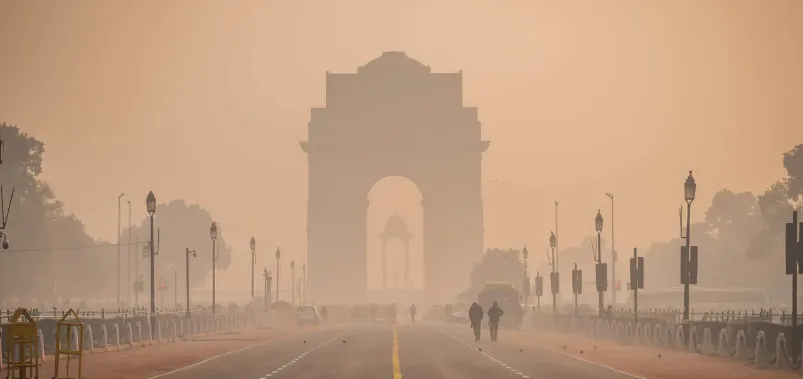
Between November and January, Delhi can suffer serious air pollution, especially in the mornings. Check the Air Quality Index on an app such as SAFAR or IQAir before you head out. On bad days, choose a shorter walk later in the morning when the haze lifts, consider a well-fitting N95 mask, and keep the rest of the day indoors in good air filtered spaces.
Eat lunch at a normal local time, roughly 1pm, even if you do not feel hungry. Meal timing helps reset the body clock. Keep it light: a salad and grilled fish at the hotel, or a simple lunch at one of the cafés near Khan Market. Avoid a large, rich curry lunch, which tends to send jet lagged travellers straight to sleep.
In the afternoon, visit Humayun's Tomb in Delhi, the 16th century Mughal garden tomb that is a UNESCO World Heritage Site and a clear forerunner of the Taj Mahal. It opens around 6am and closes around 6pm, and the foreigner ticket is INR 600 at the gate or about INR 550 online through the ASI booking portal (roughly USD 7), though fees can change. The late afternoon light on the red sandstone and white marble is lovely, the gardens are calm, and you can walk at your own pace. Allow about one and a half hours.
Back at the hotel, have an early dinner around 7:30pm, keep alcohol to one glass at most, dim the lights by 9pm and go to bed by 10pm. Avoid screens in the last hour. If you followed this pattern, most travellers find the second night far better than the first.
On day two you can step up the pace a little. A morning in Old Delhi with a guide, a cycle rickshaw ride through the lanes and lunch, followed by a quiet afternoon, works well. Keep getting morning light, keep meals at local times and keep the evening calm. By day three most UK and Australian travellers are close to normal, and US travellers are well on the way. That timing matters, because day three is often the drive to Agra or the early morning Taj Mahal visit at sunrise.
Coffee and tea help, but use them strategically. Drink them in the morning and up to early afternoon, then stop. A cup of strong Indian tea at 5pm can keep a jet lagged brain awake until 2am. Many luxury hotels serve excellent filter coffee at breakfast; enjoy it, then switch to water, coconut water or fresh lime soda in the afternoon. Caffeine and jet lag work against each other in the evening even if you think you are immune.
Melatonin is widely discussed for jet lag. It is a hormone, and some research suggests a small dose taken at local bedtime can help after eastward flights. However, rules on buying it differ between countries, it can interact with other medicines, and it is not suitable for everyone. Only take melatonin for jet lag on the advice of your own doctor before you travel, at the dose and timing they recommend. The same applies to prescription sleeping tablets, which can leave you groggy and unsteady, which is not ideal on uneven monument steps.
Hydration in Delhi deserves the same care as on the plane. The winter air is dry and the days are surprisingly warm in the sun. Drink sealed bottled water or filtered water provided by the hotel, keep a bottle in the car, and add oral rehydration salts if you feel drained. Dehydration makes every jet lag symptom worse.
Exercise helps too. A swim in the hotel pool or 20 minutes in the gym in late afternoon can lift your mood and help you sleep, but avoid hard exercise within two hours of bedtime.
Then there is the return flight. Reverse jet lag after India surprises many travellers. For US and UK travellers, flying home means travelling west, which is usually easier, and most people adjust in a few days. For Australians, home is east, so the return is the harder direction and can take longer than the outbound trip. The same tools apply: switch your watch to home time when you board, sleep or stay awake according to that clock, drink plenty of water, get morning daylight at home and avoid long naps.
Book your return flight with sleep in mind if you can. A London overnight flight from Delhi that lands early morning means a long first day back, while an afternoon departure landing in the evening lets you go straight to bed. For US travellers, a Gulf stopover of a night in Dubai or Doha can break the trip into two easier halves. Give yourself one quiet day at home before returning to work, and the memories of the Taj Mahal at dawn will not be blurred by exhaustion.

We promise you a holiday where everything is taken care of from the moment you land. Trusted drivers waiting for you, handpicked hotels that fit your style, personalized itineraries designed just for your family, and a dedicated team on call 24/7. All you need to do is relax, explore, and create unforgettable memories, while we take care of every detail behind the scenes.
India is 9 hours 30 minutes ahead of New York during US summer time and 10 hours 30 minutes ahead in winter. Los Angeles is 12 hours 30 minutes behind India in summer and 13 hours 30 minutes behind in winter. India does not change its clocks, so the gap shifts only when US clocks change.
India is 5 hours 30 minutes ahead of the UK during GMT, which covers most of the Indian peak season from late October to late March. During British Summer Time the gap narrows to 4 hours 30 minutes. The half hour is easy to forget, so set your phone to Delhi time on boarding.
A common rule of thumb is about one day per hour of time difference without any help. With morning daylight, local meal times and controlled naps, UK and Australian travellers usually feel normal by day two or three. US travellers, especially from the West Coast, often need three to five days to feel fully settled.
A late morning or midday arrival is usually easier because you step into daylight and only need to stay awake until about 9pm. A 2am landing means bed around 4am and a tired first day. If you must arrive at night, book the hotel from the previous night so your room is ready immediately.
Guaranteeing a room for a 2am arrival usually means paying for the previous night, often around INR 20,000 to 45,000 (USD 240 to 540) or more at hotels like The Oberoi, Taj Mahal New Delhi or The Leela Palace. Some hotels offer about 50 percent for a late night or early morning check-in. Rates vary by season and can change, so ask the hotel directly.
A short nap of 20 to 30 minutes before 3pm is fine and can help you stay alert. Avoid long afternoon sleeps, because they make it very hard to sleep at night. Always set two alarms when you lie down on day one.
Keep it light: a morning walk in Lodhi Garden for daylight, a simple lunch around 1pm and a relaxed afternoon visit to Humayun's Tomb. Leave Old Delhi, Chandni Chowk and long drives for day two or later. Have an early dinner and aim for bed by 10pm.
Only take melatonin on the advice of your own doctor before you travel. It can help some people after eastward flights, but it is not suitable for everyone and may interact with other medicines. Your doctor can advise on dose and timing.
For US and UK travellers, flying to India is eastward and usually harder, while the trip home is westward and easier. For Australians it is the reverse, because India is behind Australia, so the outbound trip is easier and the return feels heavier. Use the same habits in both directions.
Poor air quality between November and January can cause headaches, sore throats and tiredness, which add to jet lag symptoms. Check the AQI each morning, take outdoor walks later in the morning on hazy days and consider an N95 mask. Hotels with good air purification make the recovery days more comfortable.