Anyone who flew into India a few years ago remembers the small paper card handed out by the cabin crew somewhere over the Arabian Sea. Passport number, flight number, address in India, all scribbled with a borrowed pen on a tray table. That card has now gone. India replaced it with a digital form called the India e-Arrival Card, which you complete online on the days before you land.
It is free, it takes about ten minutes, and it is now the only accepted method for foreign visitors. It is also a different thing from your visa: the visa gives you permission to come, while the arrival card simply tells the immigration officers who is landing, on which flight and where they are staying. This article explains who has to file it, when the window opens, how to fill each section, what happens at the immigration desks in Delhi, and the small mistakes that cost travellers time in the queue.
For decades every foreign passenger arriving in India filled in a paper disembarkation card. Officers at the immigration desk then had to read the handwriting, check it against the passport and pass the cards on for manual data entry. On a busy night at Delhi, with three wide-body flights from Europe and the Gulf landing within an hour, those cards were one reason the queue moved so slowly.
The Bureau of Immigration, which runs passport control at Indian airports and seaports under the Ministry of Home Affairs, introduced the digital replacement on 1 October as an optional alternative. For six months both systems ran side by side: you could fill in the online version before travelling, or take a paper card on the plane as before. From 1 April the paper cards were withdrawn, and the digital disembarkation card became the only accepted way to declare your arrival details. Airports such as Bengaluru announced the change ahead of time, and airlines stopped carrying the old forms.
It is worth being clear about what the card does and does not do. It is a data collection form. It does not grant entry, it does not replace a visa or an OCI card, and it is not checked by a computer to approve or refuse you in advance. You can hold a perfectly valid e-Visa and still need to file the arrival card, and you can file the arrival card and still be turned back if you have no valid visa. The two are separate steps with separate purposes.
The benefit for the traveller is speed at the desk. Because your details are already in the system when you walk up, the officer only has to match your passport, take your biometrics and stamp you in. Officials reported that waiting times fell by up to 40 percent in the early months when most passengers used the online form. Anyone who has stood in the Terminal 3 immigration hall at two in the morning will appreciate every minute of that.
There is no fee. The official form is free on every government channel, and you do not upload any documents: no passport scan, no photo, no ticket. That point matters, because a number of commercial websites have appeared offering to "process" the card for a charge per person. They are simply typing your details into the free government form. Some are worse and use the passport details for other purposes.
The official channels are three: the Indian Visa Online portal at indianvisaonline.gov.in (the arrival card section sits at indianvisaonline.gov.in/earrival), the Bureau of Immigration website at boi.gov.in, and the government mobile app called Indian Visa Su-Swagatam, available on the Apple App Store and Google Play. Delhi Airport's own website also links through to the official form. If a site does not end in gov.in, or is not the official app, do not use it.
The short answer on who needs the e-Arrival Card is every traveller entering India on a foreign passport. That covers tourists on an e-Visa, people holding a regular paper visa issued by an embassy, business visitors, students and conference delegates. It applies at airports and also to cruise passengers arriving by sea at ports with immigration counters.
OCI cardholders have caused the most confusion. When the system first launched, some reports and an airport announcement said Overseas Citizens of India were exempt. Within a few days the Bureau of Immigration clarified that this was not the case, and the current position, repeated in later official notices and by Indian missions abroad, is that OCI cardholders must also file the card because they travel on a foreign passport. If you are British, American or Canadian with an OCI card, treat yourself like any other foreign visitor for this step.
Indian citizens travelling on an Indian passport do not need it. Airline crew on duty are also outside the scheme. If a family includes an Indian passport holder and a foreign spouse or child, only the foreign passport holders file.
Every foreign traveller needs to be covered, including babies and children. Parents fill the details in for minors. The online form allows a group submission for a family or small group travelling together, which saves typing the same flight and hotel information several times, but each person still has their own entry with their own passport details. Make sure every name in the group appears before you submit.
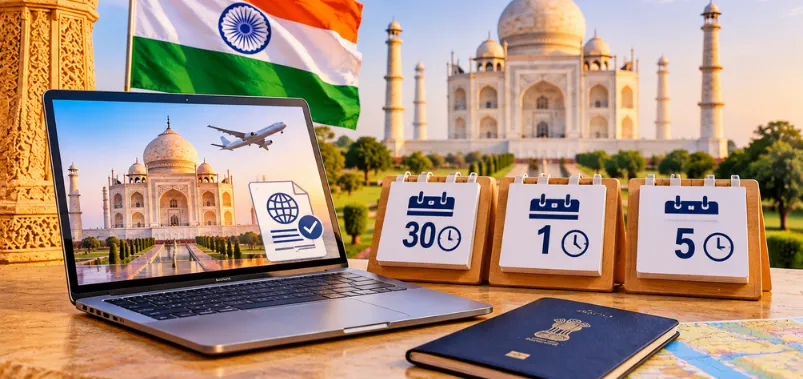
Timing is the part people miss. The e-Arrival Card 72 hours rule means you can only submit within the three days before your scheduled arrival in India. If you try earlier, the form will not accept your arrival date. For a Friday morning landing in Delhi, the window opens on Tuesday morning. Most travellers find the easiest moment is the evening before departure, once the airline has confirmed the flight number and their first hotel is fixed.
A few timing scenes we see often:
Officials recommend submitting before you board. Travellers who arrive without a submission are not refused entry on that ground alone, but they may be asked to complete it on their phone or at a help desk in the arrivals hall, which means stepping out of the queue and joining it again. Filing in advance, from your sofa, is far more pleasant.
Open the official portal or the Su-Swagatam app and choose the option for the e-Arrival Card for foreigners. The form loads as a short series of screens. Have your passport, your flight booking and your first hotel's address open in front of you before you start, because the session can time out if you leave it idle while hunting for a booking email.
The first section is your personal and passport information. You will type:
Copy the passport number from the machine readable lines at the bottom of the photo page, where it is easiest to read accurately. A common slip is mixing up the letter O and the number zero, or the letter I and the number one. The visa number for e-Visa holders is shown on the approval document.
The second section covers your travel details. Enter the airline, the flight number, the date of arrival and the port of entry, which for most of our guests is Indira Gandhi International Airport, New Delhi. If you are flying into Mumbai or Jaipur first, choose that airport instead. You will also be asked for the purpose of your visit; for a holiday choose tourism.
The third section asks which countries you have visited in the six days before arriving in India. This is the question people rush. List every country where you have spent time, including a transit stopover where you left the airport. Six days is the window India uses for health screening, particularly for yellow fever: travellers who have been in a country with yellow fever risk need a vaccination certificate on arrival. A short health declaration is part of this section, asking whether you have any symptoms.
The fourth section is your address in India. Enter the full name and address of your first hotel, including the city and the postal code. A complete line reads like a postal address: hotel name, street, area, city, state, and the six-digit PIN code. If you are on a private tour and are not sure of the hotel's exact address, ask your tour operator for the confirmation voucher, which always includes it. A vague entry such as "Delhi hotel" or "tour group" helps nobody and can lead to questions at the desk.
The last section is your contact details: an email address and a mobile number. Use an email you can open on your phone when you land, because that is where the confirmation arrives.
Review the summary screen carefully, then submit. The confirmation, with a reference and a QR code, arrives by email, often within a few minutes. Save the email, take a screenshot of the QR code so you can show it without data roaming, and print one copy for your hand luggage. Officials say a digital copy is acceptable, but a printout is a useful backup if your phone runs flat on a long flight.
Most of our guests land at Terminal 3 of Indira Gandhi International Airport, the main international terminal in New Delhi. The walk from the aircraft door to the immigration hall can take 10 to 15 minutes along long corridors with moving walkways, past the duty free shops and the large hand sculptures on the wall that every first-time visitor photographs.
The immigration hall is divided into lanes. Indian passport holders go one way. Foreign nationals with an e-Visa have their own dedicated counters, and holders of regular visas and OCI cards use the general foreign passport counters. Look for the overhead signs and the staff at the head of the queue, who will direct you if you are unsure. On a busy late-night bank of arrivals, the e-Visa queue is often the longest, so walk briskly from the plane rather than lingering at the toilets.
At the desk, hand over your passport and have your e-Arrival Card confirmation ready on your phone or on paper. In practice, many officers pull up your submission from the passport scan, but keep the QR code ready in case they ask. Then come the immigration biometrics: fingerprints from both hands on a small glass scanner, and a photograph taken by a camera on the desk. You may be asked how long you are staying, where you are staying first and whether you have a return ticket. A copy of your itinerary on your phone answers all three questions at once. Then the officer stamps your passport and you are through.
You may notice automated gates on the far side of the hall. These belong to the Fast Track Immigration and Trusted Traveller Programme, which uses facial recognition and passport scanning instead of an officer. They are open only to Indian citizens and OCI cardholders who have registered and enrolled their biometrics in advance. Foreign tourists on a visa cannot use them yet, so do not join that line by mistake. Registered OCI cardholders can use the gates, though the arrival card still has to be filed.
After immigration, collect your luggage from the belts, then pass through customs. Most tourists with personal belongings walk through the green channel. If you are carrying goods above the duty free allowance, or foreign currency above the declared limits, use the red channel; the customs department also runs an app called Atithi for making that declaration in advance.
Then you are out into the arrivals hall, where drivers hold up name boards behind a barrier. If you have booked a private car with us, the driver will be waiting there with your name, and your first evening can be as calm as a short drive to the hotel and an early dinner. Our page on Delhi has ideas for that first full day in the city, once you have slept off the flight.
The most expensive mistake is paying for something free. Search for "India arrival card" on any search engine and you will usually see adverts above the official result. Some of these sites look convincingly governmental, with the Indian flag, Ashoka emblem style graphics and words like "official application" in the heading. They charge a fee per person, sometimes presented as a "service" or "express" charge, and then type your details into the same free government form. Before typing a single detail, look at the web address: the official one ends in gov.in. Spotting fake e-Arrival Card websites is that simple, and it protects your passport data as well as your money.
The second mistake is filing too early. People keen to tick things off their list try to submit a week ahead, get an error, and assume the system is broken. It is not. The window only opens 72 hours before your landing time, so put a reminder in your phone for three days before arrival.
Third, filing with the wrong flight. If your flight is changed, retimed to the next day or rerouted via a different hub, your card may no longer match. Submit a new one with the correct flight details. It takes a few minutes and avoids a puzzled officer at the desk.
Fourth, leaving people out. A family of four needs four entries. Parents sometimes complete their own forms and forget the children, or assume a teenager on a separate passport is covered by a parent's submission. Check the confirmation email lists every name.
Fifth, typing errors on the passport number or expiry date. These are the details the officer checks first. Read them back slowly on the summary screen before submitting, character by character against the passport.
Sixth, a vague address. "Staying with friends" or "touring Rajasthan" is not an address. Give the full address of the first hotel or the home where you will spend your first night, and if your tour starts in Delhi, use the Delhi hotel even if you leave for Agra the next morning.
Seventh, confusing this card with the visa. Every season we hear from someone who filed the arrival card and believed that counted as permission to travel. It does not. You still need an approved e-Visa, a regular visa or an OCI card, and the airline will check that at the departure gate.
Finally, relying on mobile data at the desk. Many phones have no signal or no roaming package for the first minutes after landing. Keep a screenshot of the QR code and the confirmation email offline, and a paper copy in your bag. When the officer asks, you can hand it over in seconds and move on.

We promise you a holiday where everything is taken care of from the moment you land. Trusted drivers waiting for you, handpicked hotels that fit your style, personalized itineraries designed just for your family, and a dedicated team on call 24/7. All you need to do is relax, explore, and create unforgettable memories, while we take care of every detail behind the scenes.
Yes, OCI cardholders travel on a foreign passport, so they must file the e-Arrival Card. An early report of an exemption was corrected by the Bureau of Immigration within days. Enter your OCI card number in the visa section of the form.
Yes, since 1 April the paper disembarkation card has been withdrawn and the online e-Arrival Card is the only accepted method. Every foreign passport holder entering India needs one. Travellers without it are not refused entry on that ground alone, but they face extra checks and a longer wait.
No, Indian citizens travelling on an Indian passport are exempt. Only foreign passport holders, including OCI cardholders, file it. In a mixed family, only the members on foreign passports need an entry.
You can submit it only within 72 hours before your scheduled arrival in India. The form will not accept an arrival date further away than that. Many travellers file it the evening before departure.
No, the official e-Arrival Card is completely free. Any website asking for a payment is a private agent, not the government. Use indianvisaonline.gov.in, boi.gov.in or the Indian Visa Su-Swagatam app.
No, the form asks you to type details but does not require any document uploads. You enter passport details, flight information, travel history and your address in India. The confirmation with a QR code comes by email.
Give the full address of the hotel or home where you will spend your first night in India, including city and PIN code. Your tour operator's hotel voucher shows the exact address. Avoid vague entries like "touring" or "with friends".
Submit a fresh card with the new flight number and arrival date. It only takes a few minutes and keeps your record accurate. Make sure the new submission still falls within the 72-hour window.
Not yet. The automated gates belong to the Fast Track Immigration and Trusted Traveller Programme, which is open only to registered Indian citizens and OCI cardholders. Foreign tourists use the e-Visa or regular visa counters with an officer.
The official app is Indian Visa Su-Swagatam, available on the Apple App Store and Google Play. It offers the same free form as the Indian Visa Online and Bureau of Immigration websites. Avoid other apps that charge for the service.