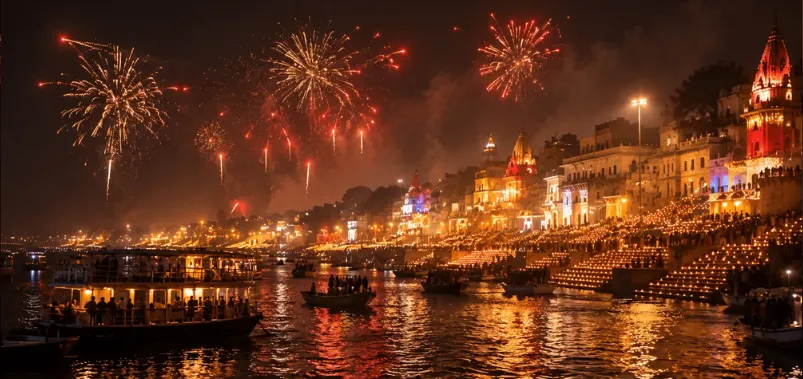
Picture the crescent of Varanasi's riverfront at dusk, seven kilometres of stone steps, temples and old palaces, and then picture every step lit by small clay lamps until the whole bank glows orange and doubles itself in the river. That is Dev Deepawali in Varanasi, often called the Diwali of the Gods, and for one night each year it turns the oldest living city in India into a river of light. This season it falls on Tuesday 24 November, the full moon of Kartik Purnima, about fifteen days after Diwali.
It is also one of the most crowded evenings in the country. Hundreds of thousands of pilgrims and visitors converge on the ghats, roads close by mid afternoon, and boat prices multiply. Travellers who arrive with a booked boat, a hotel near the river and a clear idea of where to stand have a wonderful time. Those who turn up hoping to sort it out on the day often spend the evening stuck in traffic. This guide covers the best ghats, the laser and lamp shows, boat booking, crowd management, hotels and getting there from Delhi.
Dev Deepawali is celebrated on Kartik Purnima, the full moon of the Hindu month of Kartik, which usually lands in November. The belief is that on this night the gods descend to earth to bathe in the Ganges at Varanasi, and the city lights lamps along the river to welcome them. It is also linked to the story of Shiva defeating the demon Tripurasura, which is why the day is sometimes called Tripura Purnima. For local families it is a time to bathe in the river at dawn, offer lamps on the water at dusk, and visit temples across the old city.
The festival is the climax of a five day period that runs from Prabodhini Ekadashi to the full moon. Over those days, the riverfront fills with pilgrims taking an early morning bath, and preparations build steadily. Volunteers, schools, residents' groups and temple committees spend the afternoon of the full moon laying out lamps in rows and patterns on the steps. In recent seasons the state government and local organisers have lit well over a million clay lamps along both banks, some of them made from cow dung as an eco friendly option.
The timing on the day matters. Sunset in Varanasi in late November is around 5.15pm, and lamp lighting begins as dusk falls, spreading from ghat to ghat over roughly the next hour. By about 6pm the full length of the riverfront, from Ravidas Ghat and Assi Ghat in the south to Rajghat in the north, is lit. The famous Ganga Aarti on Dev Deepawali at Dashashwamedh Ghat is a larger, longer version of the nightly ceremony, usually running from around 6.30pm to 7.15pm and ending close to 7.45pm. It includes a tribute to soldiers who died serving the country, with wreaths laid at a replica of the Amar Jawan Jyoti memorial and a last post played by the armed forces.
Around this time, a laser and 3D projection show plays on the walls of the riverfront, fireworks light the sky over the water, and boats drift past the ghats in their thousands. The Ganga Mahotsav, a cultural festival organised for visitors, often runs over the same days with classical music, dance and crafts.
What a visitor actually experiences depends heavily on where they are. On a boat, you see the whole sweep of the lit riverfront and the reflections, but you also share the water with an enormous number of other vessels. On the ghats, you feel the energy of the crowd up close and smell the incense, but you see only your own stretch. Many travellers do both across two evenings: the ghats on the evening before, when lamps are already being tested and crowds are lighter, and the river on the night itself.
One point people often get wrong: Dev Deepawali is not the same night as Diwali. Diwali this season was 8 November. If you see older guides with different dates, check the current Kartik Purnima date before booking.
Experience Varanasi's spectacular Dev Deepawali celebrations with illuminated ghats, sacred Ganga Aarti and unforgettable river views. Plan your visit with comfortable stays and personalised travel arrangements throughout your Indian holiday experience.
Varanasi has more than 80 ghats, and on Dev Deepawali nearly every one is lit. Choosing your base for the evening is the most important decision you will make, because once the crowds build, moving between ghats on foot becomes very slow.
Dashashwamedh Ghat is the heart of the evening and the site of the grand Ganga Aarti. Priests in matching robes perform the ceremony with large brass lamps, conch shells and bells, and the stands, steps and rooftops around them are packed. If you want to watch from the ghat itself, arrive by 4pm at the latest, ideally earlier, and expect to stay in place until it ends. Some hotels and rooftop cafes around the ghat sell seats with a view for the evening; these are worth the money if you can find one. The ghat next door, Rajendra Prasad Ghat, gives a slightly less crushed view of the same ceremony.
Chet Singh Ghat, with its fortified 18th century palace above the river, is where the laser and 3D projection show has been staged in recent seasons. Images telling the story of the Ganges descending to earth and the history of Kashi Vishwanath are projected on the palace walls, usually starting around 6pm and repeating until about 7.15pm. The best view is from a boat directly in front of the palace or from the neighbouring ghats.
Assi Ghat, at the southern end of the main riverfront, holds its own aarti, often a little later than Dashashwamedh, and the crowd here is younger and somewhat less dense. It has good road access, a wide open platform, and plenty of cafes, which makes it a sensible choice for families or anyone nervous about crowds.
Rajghat, at the northern end near the Malviya Bridge, and the newer Namo Ghat beside it, are often where cultural programmes linked to the Ganga Mahotsav are held. The views back along the curve of the river toward the central ghats are very fine, and the area is more spacious than the old centre.
Panchganga Ghat, north of Manikarnika, is where a tall stone lamp stand with a thousand wicks is traditionally lit, one of the oldest rituals of the festival. Manikarnika Ghat itself, the main cremation ground, continues its work through the night. It is fine to see it from a boat, but photographing the cremations is strongly discouraged and often stopped by locals.
The best ghats for Dev Deepawali depend on what you value. For the aarti, choose Dashashwamedh or Rajendra Prasad. For the laser show, Chet Singh. For calmer viewing, Assi or Rajghat. From the water you see all of them, which is why boats are so popular.
A tip from local guides: the lamps look best in the first hour after they are lit, before wind and burn out make gaps in the rows. If you are on a ghat, walk slowly in one direction from about 5.15pm rather than staying put, then settle somewhere with a view for the aarti and fireworks.
Seeing the lit riverfront from the water is the classic way to experience the night, and it is the part that needs the most advance work. On ordinary days you can walk down to almost any ghat and hire a rowing boat for INR 500 to 1,000 an hour, or a small motorboat for a few thousand rupees. On Dev Deepawali that market changes completely. Demand outstrips supply by a wide margin, prices spike several times over, and the better boats are booked weeks in advance.
You have two broad choices. A shared boat for Dev Deepawali gives you a seat on a larger motorboat or double decker barge with other travellers, usually with life jackets, drinking water and light snacks included. This is the most economical option and works well for couples or solo travellers. Recent prices from established operators look roughly like this, leaning to the higher side:
Prices can change, and walk up quotes on the evening itself are often far higher, with less choice and no guarantee of safety equipment.
Book early. Good operators suggest reserving 15 to 30 days ahead at a minimum, and the premium boats often sell out several weeks before. Ask clearly about the boarding ghat, because many operators board well away from Dashashwamedh at places such as Gaay Ghat, Samne Ghat or Pandey Ghat, which can still be reached by road. Ask what time you must report, usually around 4pm for a 5pm departure, and how long the boat stays out, which can be two to three hours or until the fireworks end. Get the cancellation terms in writing. A common policy gives a full refund three weeks ahead and no refund within two weeks.
Safety on the water deserves real attention. On the night, thousands of boats crowd a narrow channel, and slow moving traffic between 6pm and 7pm is normal. Choose an operator that provides life jackets for every passenger and confirm that your boat will not be loaded beyond its licensed capacity. Wear the life jacket, even if locals do not. Stay seated while the boat moves, keep children within arm's reach, and do not lean out over the side for photographs. The National Disaster Response Force and river police patrol the water, and boat ambulances have been deployed in recent seasons, but the best safety measure is a sensible operator.
Finally, think about photography. A moving boat at night is hard on cameras, so raise your ISO, use a fast lens, and accept a little blur as part of the mood. Phones with night mode do surprisingly well.
Combine Dev Deepawali celebrations with comfortable accommodation, private transfers and guided sightseeing. Discover Varanasi's sacred heritage at your own pace with a thoughtfully arranged personalised holiday for a seamless festival getaway.
The single biggest mistake visitors make on Dev Deepawali is underestimating the crowd and the traffic restrictions. Varanasi's old city is a maze of narrow lanes even on a quiet day. On the night of the full moon, police seal the approaches to the main ghats, divert vehicles, and in practice turn a large part of the riverfront area into a walking zone.
The pattern in recent seasons has been consistent. Dev Deepawali road closures start in early afternoon. Godowlia Chowk, the junction above Dashashwamedh, has been closed to vehicles from around 2pm, with roads within roughly a kilometre of the main ghats sealed from about 2.30pm. Madanpura and the Luxa Road junction become the last drop points for Dashashwamedh, meaning a walk of about 700 to 800 metres through dense crowds. For Assi, cars usually stop around Ravidas Park or Durga Mandir crossing. For Chet Singh Ghat, the drop is near the Shivala crossing. By 5pm the area within two kilometres of the river is gridlocked, and walking is faster than any car.
Taxis are not allowed to wait near the ghats, so your driver will need to park at a designated area and meet you later at an agreed point. Confirm this point in daylight and save it on your phone map, as it looks very different in the dark with crowds pressing in. Mobile networks often struggle around the ghats on peak evenings, so a fixed meeting time is more reliable than a phone call.
The Dev Deepawali crowd is dense but generally good humoured, made up of local families, pilgrims from across North India and a growing number of foreign visitors. That does not mean it is comfortable. On the main steps around Dashashwamedh people press shoulder to shoulder, and moving against the flow can be impossible for long stretches. Leaving after the aarti takes 60 to 90 minutes from the central ghats.
A few habits make a real difference. Arrive early and stay put rather than trying to see several ghats in the peak hour. Carry very little and keep your phone, cash and passport copy in a zipped bag worn in front of you, because pickpockets work the crowds. Agree a meeting point with your group in case you get separated, and give each child a card with your hotel name and your phone number. If you feel the crowd surging, move sideways toward the edges rather than pushing forward. The national emergency number is 112, and police booths and medical tents are set up along the main ghats.
Older travellers and anyone with mobility problems should think carefully about the central ghats. A boat that boards from a ghat with road access, or a riverfront hotel room with a terrace, gives the full spectacle without the crush. Wheelchair access to the ghats is very limited because of the steep stone steps.
If you prefer to have every piece of transport and timing handled, Golden Triangle Tours can arrange a private car, a local guide who knows the closure points and a reserved boat as part of a wider trip, and the Varanasi destination page has more on the city.
Staying close to the river transforms the night. A riverfront hotel in Varanasi lets you walk out of the door onto the ghats, avoids the road closures entirely, and often gives you a terrace view of the lamps and fireworks without fighting the crowds. The trade off is price and availability, both of which are extreme on this date.
The best known heritage option is BrijRama Palace on Darbhanga Ghat, a restored 19th century palace right on the steps a short walk from Dashashwamedh. In an ordinary week its rooms typically sell for around USD 150 to 350 a night, and on Dev Deepawali they climb far higher and sell out months ahead. Suryauday Haveli by Amritara sits on Shivala Ghat in the southern half of the riverfront, a quieter heritage property with river facing rooms. Around Assi Ghat, Palace on Ganges and Hotel Ganges View are smaller heritage buildings with rooftop views. Many simpler guesthouses on the ghats also offer river views at lower rates.
For the night of the festival, riverfront prices commonly run two to four times normal rates, and minimum stays of two or three nights are common. As a rough guide, leaning high, expect INR 15,000 to 30,000 for a good river view room in a smaller heritage hotel, and INR 40,000 or more at the top properties, with prices subject to change. Book by July or August if you can.
If the river hotels are full, larger modern hotels in the cantonment area, such as Taj Ganges, offer comfort and pools, but you will rely on a car and a walk through the closure zone, so build in at least two hours to reach the ghats.
Reaching Varanasi from Delhi is straightforward. Lal Bahadur Shastri International Airport sits about 25 km from the old city, and flights from Delhi to Varanasi take around one hour twenty to one hour thirty five minutes, with frequent daily departures on IndiGo, Air India and other carriers. Fares rise in festival week, so book early. The airport road can take 45 minutes to over an hour normally, and longer on the afternoon of the full moon, so aim to land by late morning.
By rail, the Delhi to Varanasi Vande Bharat Express is the fastest train, leaving New Delhi at 6am and reaching Varanasi Junction around 2pm, about eight hours, six days a week except Thursday. It has air conditioned chair car and executive class seats with meals included. Overnight trains such as the Shiv Ganga Express and other services from New Delhi take around 11 to 13 hours in sleeper or air conditioned berths. Book on the IRCTC website, where foreign tourists can register using a passport, or through an agent, and do so as soon as bookings open about 60 days ahead.
Varanasi also links easily with Agra and the wider Golden Triangle by air via Delhi, which makes it a natural extension for travellers already in the north.
Late November is one of the most pleasant times to be in Varanasi. Days are usually around 26 to 28 degrees Celsius, but the temperature falls quickly after sunset to about 14 to 17 degrees, and on the open river with a breeze it feels cooler still. If you are out on a boat for three hours, you will be glad of a warm layer.
Dress for a religious event and a crowd at the same time. Loose trousers or a long skirt, a top that covers the shoulders, and a light jacket or shawl are ideal. Women often find a large scarf useful for covering the head at temples and for warmth later. Avoid anything you will mind getting brushed with oil, wax or ash, because lamps and incense are everywhere on the steps. Choose closed, flat, grippy shoes. The stone ghats are steep, uneven and can be slippery with oil and water, and in the crush people will step on your feet. Leave expensive jewellery and watches at the hotel.
Pack a small, light daypack with only what you need. Our checklist for the night:
Cash for Dev Deepawali night is important because card machines rarely work in the crowds and digital payment apps often need an Indian bank account. Withdraw cash a day earlier from ATMs in the cantonment area, as machines near the old city run low.
A few behaviour notes help you fit in. Remove your shoes if you step into a temple, and ask before photographing priests, pilgrims or anyone performing a ritual. Do not photograph cremations at Manikarnika or Harishchandra Ghat. If you would like to float a lamp on the river, small leaf boats with a candle and flowers are sold on every ghat for a few rupees, and the sellers will happily show you how. It is a simple, quiet moment amid the noise, and many visitors say it is the part of the night they remember most.
Finally, pace yourself. The festival week includes early morning bathing at dawn, the lamp lighting at dusk and late night crowds. Taking a rest in the afternoon of the 24th and eating early means you are fresh for the evening, rather than flagging just as the fireworks start.
We promise you a holiday where everything is taken care of from the moment you land. Trusted drivers waiting for you, handpicked hotels that fit your style, personalized itineraries designed just for your family, and a dedicated team on call 24/7. All you need to do is relax, explore, and create unforgettable memories, while we take care of every detail behind the scenes.
Dev Deepawali falls on Tuesday 24 November this season, on Kartik Purnima. It comes about fifteen days after Diwali, which was on 8 November. Lamp lighting starts at dusk, around 5.15pm.
The grand aarti at Dashashwamedh Ghat usually runs from around 6.30pm to 7.15pm and finishes close to 7.45pm. To watch from the ghat itself, arrive by 4pm at the latest. Boats position themselves in front of the ghat from about 6.15pm.
In recent seasons, the laser and 3D projection show has been staged on the palace walls at Chet Singh Ghat, usually from about 6pm to 7.15pm. The clearest view is from a boat in front of the palace or the neighbouring ghats.
Shared seats usually cost INR 2,000 to 9,000 per person depending on the boat, with premium cruises around INR 12,000 to 14,000. A private boat for a small group can cost INR 25,000 to 55,000 or more. Prices can change and walk up rates on the night are much higher.
Book at least 15 to 30 days ahead, and earlier for premium or private boats, which often sell out several weeks before. Confirm the boarding ghat, reporting time and cancellation policy in writing.
Reputable operators provide life jackets for every passenger and do not overload boats. Wear the life jacket, stay seated and keep children close. Disaster response teams and river police patrol the water.
Roads within about a kilometre of the main ghats are usually sealed from around 2pm to 2.30pm, including Godowlia Chowk. Madanpura and Luxa Road become drop points for Dashashwamedh. Expect to walk the last 500 to 800 metres.
BrijRama Palace on Darbhanga Ghat, Suryauday Haveli on Shivala Ghat, and Palace on Ganges or Hotel Ganges View at Assi Ghat are popular choices. Rates rise sharply for the festival and rooms sell out months ahead. Book by July or August if possible.
Flights from Delhi take about one hour twenty to one hour thirty five minutes to Lal Bahadur Shastri International Airport. The Vande Bharat Express leaves New Delhi at 6am and reaches Varanasi around 2pm, except on Thursdays. Overnight trains take around 11 to 13 hours.
Wear modest, covering clothes, flat closed shoes with good grip, and bring a warm layer for the evening and the boat. Nights in late November drop to around 14 to 17 degrees Celsius. Leave valuables at your hotel.