How to Choose the Best India Tour Company: 15 Questions to Ask Before You Book
16 Sep 2026

Travelers booking a private holiday in India often face an important decision before they compare hotels, vehicles or sightseeing routes: should they book through a local India tour operator based in India or purchase the trip through an international travel agency in their home country?
Both models can work well, but they operate very differently.
An international agency may provide the comfort of dealing with a company in the traveler’s own country, paying through familiar channels and speaking with an advisor who already understands the expectations of customers from that market. A local operator, on the other hand, works directly with the hotels, drivers, guides and regional suppliers that actually deliver the journey after the traveler lands in India.
The difference becomes important on routes such as Delhi, Agra, Jaipur, Rajasthan, Varanasi, Udaipur, Jodhpur or other multi city private journeys where the quality of daily ground coordination matters as much as the original booking.
A traveler may see two itineraries that appear almost identical. Both include Delhi, Agra and Jaipur. Both mention private transportation, hotels and guided sightseeing. Yet the final price can differ by hundreds or even thousands of dollars because the booking chain behind each package is different.
An international India travel agency may sell the holiday directly to the customer and then appoint an Indian destination management company or local operator to deliver the ground services. The traveler therefore pays not only for hotels and transport but also for additional sales, administration and distribution layers. A direct local operator can often remove some of those layers because the traveler communicates with the company arranging the actual vehicle, driver, hotels and guides.
That does not mean the local company should automatically be chosen because it is cheaper. The right decision depends on the operator’s reputation, financial transparency, communication quality, payment arrangements, support and ability to deliver the exact trip being sold.
Golden Triangle Tours represents the local private tour model, arranging ground journeys across Delhi, Agra, Jaipur, Rajasthan and other Indian destinations. Mr. Nand Singh Rathore and his team work directly with international travelers who want private hotels, vehicles, drivers and local guides arranged within one India itinerary.
The strongest booking decision comes from comparing what each business model actually provides rather than assuming that “international” automatically means safer or “local” automatically means cheaper.

The difference between a local Indian tour operator and international travel agency begins with who controls the ground services after the traveler arrives.
A local operator is physically based in the destination country and normally works directly with hotel reservation teams, transportation companies, private drivers, professional guides and local attraction services. When a traveler requests a change, the operator can often contact the driver, hotel or local guide directly because those suppliers are part of the same operational network.
An international agency usually operates from the traveler’s home market. It may specialize in India and have excellent destination knowledge, but many international agencies do not own vehicles or employ guides in India directly. The agency therefore appoints another company inside India to deliver all or part of the holiday.
This creates a chain that may look like:
traveler → international agency → Indian ground operator → hotel, driver and local guides.
With a direct private tour operator in India, the chain can be much shorter:
traveler → Indian operator → hotel, driver and local guides.
The shorter chain can make communication faster when an operational change is required.
Imagine a traveler arrives in Delhi six hours later than expected because an international flight has been delayed. Under the direct local model, the traveler or representative can contact the Indian operator, who communicates directly with the airport driver and hotel.
Under a multi layer model, the traveler may contact the overseas agency, which then contacts its Indian ground partner, which then contacts the driver. A good international agency can still manage the situation efficiently, but there are simply more communication steps involved.
The difference is even more visible during private road trips.
A traveler may decide after reaching Jaipur that they want to stay an additional night and remove another destination. A local operator who controls the vehicle and has relationships with hotels can often check availability and calculate the ground service change quickly.
An international agency may also handle the amendment professionally, but it may need confirmation from its Indian supplier before issuing a revised cost.
Neither system is inherently wrong. The traveler simply needs to know who is actually delivering the service.
One of the most useful questions to ask an international agency is:
“Who will operate my tour after I arrive in India?”
If the agency works with a long established Indian partner, that can be completely acceptable. If the agency cannot explain who handles the vehicle, guide services or emergency support on the ground, the traveler has less visibility into the actual product being purchased.
Price is one of the main reasons travelers compare a local India travel company with an overseas agency.
A private India holiday contains several core cost components: hotel rooms, private vehicle, driver allowance, fuel, tolls, parking, guides, airport transfers, monument tickets, meals and operational support.
A local operator purchases or negotiates these services inside India.
An international travel agency usually adds its own commercial margin for sales, staff, marketing, financial processing, customer service and administration. If it also purchases the Indian ground arrangements through another company, that ground operator needs its own margin as well.
This can create a noticeable final price difference.
Suppose an Indian ground itinerary covering Delhi, Agra and Jaipur costs approximately US$3,500 for two travelers with strong hotels, private transportation and guides.
A local operator may add its operating margin and sell the complete land service directly to the traveler.
An international company purchasing the same ground arrangement may need to add additional margin on top of the Indian supplier’s rate. The traveler could therefore receive a quotation of US$4,500, US$5,000 or more even though the hotels and vehicle ultimately come from the same local supply network.
That higher price is not automatically unreasonable.
The international agency may provide additional services such as airfare coordination, insurance assistance, local country consumer protections, dedicated pre-departure consultation or a highly developed concierge operation. Some travelers are happy to pay more for these services.
The important point is to understand what the additional money is buying.
A direct India tour operator price can often be more competitive because fewer businesses sit between the traveler and the actual suppliers. This is especially noticeable for private tours where the services are individually arranged rather than purchased as part of a mass market group contract.
Travelers should also compare prices carefully because a lower quote may contain fewer services.
One operator may include a sedan while another includes an Innova Crysta. One may use standard four star hotels while another uses premium five star properties. One may include entrance tickets, guides, tolls and parking while another leaves them outside the package.
The correct comparison is therefore not local price versus international price alone. It is like for like India tour pricing.
Hotel names, room categories, vehicle type, guide services, airport transfers, meals and entrance fees should all be compared before deciding which quotation offers better value.

Hotels are one of the biggest reasons two India private tour packages can have very different prices.
The term “five star hotel” does not identify a specific product.
A premium five star property in central Delhi may cost considerably more than a large business hotel on the outskirts. A palace style hotel in Jaipur can carry a very different nightly rate from a conventional international brand property. A room overlooking the Taj Mahal in Agra may cost significantly more than another room in the same hotel.
A local operator with strong hotel relationships can sometimes obtain contracted rates or negotiated prices that are not available to the public. An international agency may also benefit from contracted inventory, but it often obtains those rates through an Indian partner.
Travelers should therefore request hotel names.
A quotation stating “five star hotels throughout” is not detailed enough for an expensive private holiday.
The room category should also be specified. Standard room, premium room, club room, suite and view specific room categories can have substantial price differences.
A local India tour company with hotels may be able to suggest alternatives quickly if the traveler wants to reduce the price without reducing the overall quality too severely.
For example, the traveler may receive three choices in Jaipur:
a respected four star heritage hotel,
a modern five star hotel,
or a high end palace property.
The difference between the three could be several hundred dollars over multiple nights.
A knowledgeable ground operator can explain where paying more is likely to improve the journey and where it may have less impact.
An international agency can provide the same advice if its consultants know India well. The key difference is how close the advisor is to the actual hotel market and how quickly current alternatives can be checked.
Travelers should also examine hotel location.
A remote luxury resort may be excellent for a slow Rajasthan holiday but inconvenient for a short Golden Triangle trip where the guest is sightseeing every day. Spending an extra hour in traffic each morning can reduce the benefit of staying in a more impressive property.
The strongest hotel selection therefore balances service level, room quality, location and price.
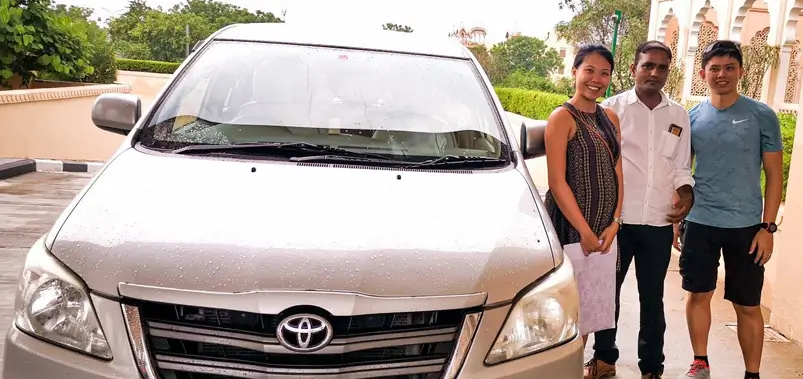
Transportation is one of the areas where the difference between a direct India tour operator and an international booking company becomes especially clear.
The vehicle physically exists in India. The driver lives and works in India. Fuel, tolls, parking and interstate road costs are paid locally. Daily pickup timing is coordinated locally.
Even when the traveler books through an international agency, the actual vehicle will almost always be arranged through a local Indian supplier.
This is why travelers should ask what vehicle has been confirmed rather than relying only on the phrase “private car.”
A sedan can work for one or two passengers with limited baggage. International travelers carrying two large suitcases and cabin bags may be more comfortable in an Innova Crysta or similar SUV.
Families may require a Tempo Traveller, while larger private groups can need a coach.
The India private driver cost should also be considered as a complete operational amount rather than only a daily vehicle rental.
Fuel, tolls, parking, driver allowance and interstate taxes can form part of the total trip cost. A very low transport quote may exclude several of these items.
The driver should be experienced with tourist routes, hotel access, airports and long distance road sectors.
On a Rajasthan journey covering Jaipur, Jodhpur, Udaipur and Jaisalmer, for example, the traveler may spend many hours with the same driver. Professional conduct, safe driving, vehicle cleanliness and punctuality can have a greater effect on the holiday than a small difference in hotel price.
A strong local operator often has direct feedback about specific drivers because it works with them repeatedly.
An international agency may receive this information through its ground partner.
The traveler should therefore ask whether the vehicle remains private for the complete itinerary and who should be contacted if there is a vehicle problem during the trip.
A professional private guide in India can significantly improve visits to historical and cultural attractions.
Delhi, Agra, Jaipur, Varanasi, Jodhpur and other destinations have guides who specialize in their local areas. These professionals understand monument procedures, local routes and the history of the sites they explain.
A direct local operator can arrange these guides city by city.
An international travel agency generally requests the same guide service through its Indian supplier.
For English speaking travelers, guide availability is usually easier. Spanish, French and German speaking guides should be requested earlier because specialist language availability may be more limited.
The quotation should state whether guide services are included in every destination or only at selected monuments.
Travelers should also understand the difference between a local guide and a full time escort.
A local guide usually joins for sightseeing in one city.
A private India tour escort can travel with the guest across several cities and assist throughout the trip.
The escort service costs more because accommodation, meals, transportation and daily professional charges may need to be covered for the entire journey.
International agencies sometimes include escort services in premium packages, while direct local operators can arrange them when requested.
Travelers should compare the actual guide service rather than assuming one model automatically provides stronger guiding.
One of the strongest arguments for using an international agency is communication familiarity.
A traveler may prefer speaking with an advisor in London, New York, Toronto, Sydney or another home market. The advisor may work in the same time zone, understand local payment expectations and communicate in the traveler’s preferred style.
This can provide reassurance, especially for someone taking their first long haul trip to India.
A professional local India tour operator for international travelers, however, should also provide clear English communication and respond to detailed questions about hotels, transport, sightseeing and payment conditions.
The traveler should judge the actual communication rather than the company’s location.
A local operator that responds clearly, provides detailed written quotations and answers difficult questions directly may inspire more confidence than an international agency providing generic sales responses.
The reverse can also be true.
An experienced international India specialist may provide excellent destination advice, while a weak local company may respond poorly and offer vague information.
Location is therefore not a substitute for professionalism.
Travelers should pay attention to whether their questions receive direct answers.
If they ask which hotels are included, do they receive actual names?
If they ask which vehicle will be used, do they receive a vehicle category?
If they ask whether entrance tickets are included, does the answer clearly state yes or no?
Good communication reduces uncertainty.
On tour support is where the local operator can have a structural advantage.
If a traveler is already in Jaipur and needs the hotel pickup moved by one hour, the local coordinator may be able to contact the driver immediately.
If the guest wants to add an additional night in Udaipur, the local team can check hotel and vehicle availability.
If a flight changes, the airport transfer can be adjusted locally.
A local India travel company with on ground support is physically operating in the same country and generally works in the same time zone as the traveler.
An international agency can still provide excellent emergency support, but it may rely on its Indian partner for the actual operational change.
The quality of that partner therefore matters enormously.
Travelers booking through an overseas agency should ask whether they receive the local contact details before arrival.
A good international agency should not leave the traveler dependent solely on contacting an office thousands of miles away while standing at Delhi Airport.
The itinerary should provide a practical local support channel.
This is particularly important for private road trips because changes can occur outside standard office hours.
International agencies can have an advantage in familiar payment methods.
A traveler in the United States may pay an American company in US dollars. A British traveler may pay in pounds. A European traveler may pay in euros.
This can simplify the transaction and reduce uncertainty about exchange rates.
A local India tour operator payment may be accepted in INR or an agreed foreign currency depending on the company and payment method.
The traveler should ask about card fees, bank transfer charges and currency conversion before paying.
A direct international bank transfer may carry fees from both sending and receiving banks. Card payments can include processing costs or foreign transaction charges depending on the traveler’s bank.
The quotation should make the accepted currency clear.
Travelers should also receive an invoice or booking confirmation showing the amount paid and the remaining balance.
Payment should be treated professionally regardless of whether the company is local or international.
The traveler should avoid making a major payment when the company cannot provide clear written confirmation of the trip details.
An international agency may provide consumer protections governed by the traveler’s home jurisdiction, depending on how the trip is sold and the laws that apply.
This can be valuable.
Some travelers prefer the reassurance of purchasing from a business registered in their own country because dispute procedures, card protections or package travel regulations may feel easier to navigate.
A local Indian operator operates under Indian business and tax requirements rather than the traveler’s home country regulatory framework.
This does not make direct booking unsafe, but it changes the legal relationship.
Travelers using a trusted India tour company should therefore perform sensible due diligence.
Check whether the business has a genuine operating presence.
Read detailed traveler reviews.
Ask for written payment terms.
Check cancellation conditions.
Confirm the hotels and vehicle.
Keep invoices and payment records.
Travel insurance is also important regardless of how the tour is booked.
International agencies do not eliminate the need for appropriate insurance, and a local operator should not be expected to absorb every loss created by airline disruption, illness or personal cancellation.
Cancellation terms should be compared carefully before booking.
A traveler may find that an international agency and local operator offer very different cancellation structures even when the itineraries look similar.
This can happen because hotels and suppliers impose their own deadlines.
A luxury hotel may require a non-refundable deposit during peak dates. A special room category may have stricter conditions. A group vehicle or escort service may need an advance commitment.
A private India tour cancellation policy should identify the amount that becomes non-refundable at different stages.
Travelers should not assume that dealing with an international agency guarantees a full refund.
The agency may still be bound by the Indian supplier’s hotel and transport conditions.
Similarly, direct local booking does not necessarily mean harsh cancellation terms. A well-managed operator can explain which elements are refundable and which supplier costs have already been committed.
The key is receiving those terms before paying.
Private travelers often change their minds.
A couple may decide to skip a Delhi monument because they are tired.
A family may want another hour at the Taj Mahal.
Senior travelers may want to return to the hotel after lunch.
A Rajasthan traveler may decide that they prefer an extra night in Udaipur instead of another long road sector.
A tailor made India tour operator should allow reasonable daily flexibility where confirmed supplier commitments permit it.
Direct local communication can make these small changes easier.
The driver can be told directly.
The guide can be informed.
The hotel can be contacted.
This does not mean every itinerary change can be made without cost. Changing cities, adding nights or upgrading hotels can affect confirmed reservations.
But small daily adjustments are one of the main reasons travelers pay for private travel instead of a shared coach tour.
An overseas agency working with a strong Indian partner can provide the same flexibility, but travelers should verify that the trip is genuinely private and not part of a fixed operational series.
Luxury travelers should be particularly careful because expensive packages can contain substantial markups.
A luxury India tour company should provide more than expensive hotel names.
Premium ground travel should include an appropriate vehicle, strong guides, responsive coordination, sensible hotel locations and enough time in each destination.
Booking directly with a high quality local operator can allow more of the traveler’s budget to go toward actual services.
For example, the price difference created by an additional distribution margin could instead fund a better room in Agra, a superior palace hotel in Jaipur, a larger private vehicle or additional nights.
An international luxury agency can justify its higher price when it provides significant additional value through concierge support, high touch consultation, global assistance, exclusive supplier relationships or comprehensive trip management beyond the Indian ground portion.
The traveler should therefore ask where the premium is going.
If both quotations use the same hotels, vehicle and local services, the higher agency price may primarily reflect the additional booking layer.
If the international agency provides genuinely different services, the premium may be worthwhile.
First time visitors often assume an international agency is automatically easier because India feels unfamiliar.
For some travelers, that is true.
Someone who wants one advisor to arrange international flights, insurance, India ground services and other countries within the same trip may prefer an established international agency.
Other travelers may feel perfectly comfortable dealing directly with a professional Indian operator.
A private India tour for first time visitors can actually benefit from direct local contact because the traveler can ask precise questions about airport pickup, road travel, guide services, hotel location, tickets and daily schedules.
The decision should depend on the quality of the company rather than the country where its office is located.
A strong local operator can provide an extremely smooth first India journey.
A strong international specialist can do the same.
A weak company in either category can create problems.
Direct booking often makes particular sense for travelers whose trip is concentrated inside India.
A couple taking a Golden Triangle holiday, a Rajasthan road journey, a Varanasi extension or a private North India trip may not need an additional overseas booking layer if they are comfortable dealing directly with the operator delivering the ground services.
A direct India tour booking can offer stronger price transparency, faster access to local operational information and more flexibility with vehicles and hotels.
It can also be particularly attractive for repeat India visitors who already understand the destination and know the type of service they want.
Travelers should still check the company carefully before payment.
Direct does not mean automatic trust.
It simply means the traveler is purchasing closer to the supplier delivering the journey.
An overseas agency may be the better choice when the traveler wants broader trip management.
Someone combining India with several other countries may prefer one international advisor handling the complete journey.
A traveler who strongly values home country consumer protections may also prefer dealing with a local market agency.
Some travelers simply feel more comfortable paying a company in their own country.
That comfort has real value.
The question is whether the traveler understands what premium is being paid for that additional layer.
A good international travel agency for India tours should clearly explain the value it adds rather than presenting itself as inherently safer simply because it operates outside India.
The final decision should be made using the actual written quotations.
Compare hotel names and room categories.
Compare private vehicle type and luggage capacity.
Compare driver related inclusions.
Compare guides in each city.
Compare airport pickup and departure transfers.
Compare monument tickets.
Compare meals.
Compare taxes.
Compare payment currency and processing charges.
Compare cancellation terms.
Compare on tour support.
Compare the itinerary itself.
A cheaper local India tour package can be excellent value when the service components are strong. A more expensive international package can also be worthwhile when the traveler receives substantial additional support and protection.
The strongest option is the company that provides the clearest relationship between price and actual service.
Golden Triangle Tours operates through the direct local model, with Mr. Nand Singh Rathore and his team coordinating private Indian ground services for international travelers. For travelers comparing local and international businesses, the most useful question is not “Which type of company is always better?” It is “Which company gives me the clearest services, strongest support and most sensible value for the exact trip I am buying?”
Post Date : 📅 16 Sep 2026
We promise you a holiday where everything is taken care of from the moment you land. Trusted drivers waiting for you, handpicked hotels that fit your style, personalized itineraries designed just for your family, and a dedicated team on call 24/7. All you need to do is relax, explore, and create unforgettable memories, while we take care of every detail behind the scenes.
The strongest advantage is direct access to the company coordinating the actual ground journey. This can provide faster local communication, clearer supplier information and greater flexibility when the operator is experienced and professionally managed.
Not necessarily. Both international agencies and Indian operators depend on hotel, vehicle and supplier cancellation conditions. Travelers should read the written policy before payment.
Either can work depending on the company and payment method. Travelers should compare exchange rates, card fees, transfer charges and the amount shown on the final invoice before deciding.
The international agency may handle communication, but the actual solution will often involve its Indian ground partner. Travelers should request a local emergency or operational contact before arrival.
Yes. A professional luxury India tour operator can arrange premium five-star hotels, heritage properties, palace accommodation and upgraded room categories according to availability and budget.
It can offer strong value because the traveler communicates directly with the company arranging Delhi, Agra and Jaipur ground services. The operator should still have clear reviews, payment conditions and written inclusions.
Differences can come from hotel quality, room category, vehicle type, guide services, entrance tickets, taxes, meals and the number of commercial layers between the traveler and local suppliers.
Many international agencies appoint an Indian ground operator or destination management company to deliver hotels, transport, drivers and guide services. Travelers can ask the agency who handles the tour after arrival.
Not automatically. International agencies may offer familiar payment arrangements or home-country consumer protections, while established Indian operators can provide strong local support and direct ground-service control. The individual company should be evaluated carefully.
It often can be because direct booking may remove an additional sales or distribution layer. However, travelers should compare the same hotels, vehicle, guides and inclusions before deciding whether the local India tour price genuinely represents better value.