Most first-time visitors to India worry about the wrong things. They fret over spicy food and traffic, then find themselves standing awkwardly at a temple door with their shoes still on, or holding out a left hand to pass money to a shopkeeper who politely pretends not to notice. None of this is a disaster. Indians are famously forgiving of foreigners, and a smile covers a lot of small slips. Still, a little knowledge of Indian etiquette for first-time visitors turns polite tolerance into genuine warmth, and that warmth is what makes a trip memorable.
This guide covers the everyday customs you will actually meet on a tour of Delhi, Agra, Jaipur and beyond: how to greet people, which hand to use, when to take off your shoes, what the famous head wobble means, how to dress at major religious sites, and how to photograph people without causing offence. It also touches on tipping, affection in public, eating as a guest and the topics best left alone at the dinner table. Nothing here is a strict law for visitors, but every point comes from situations travellers run into again and again.
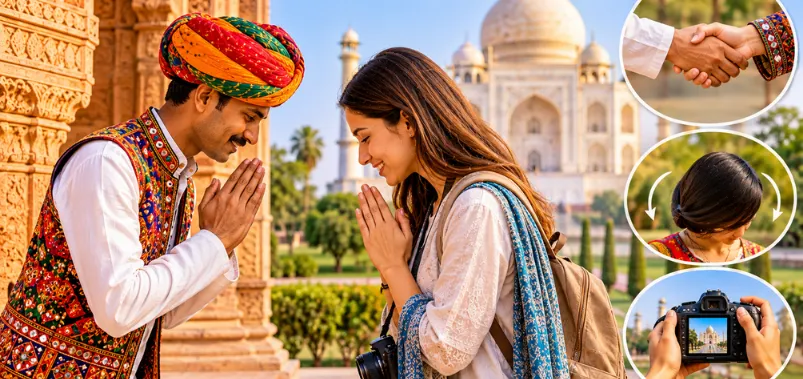
The most widely used greeting in India is simple and graceful. You press your palms together in front of your chest, fingers pointing upwards, and give a small nod or slight bow of the head. Many people say a word of greeting at the same time, but the gesture alone is perfectly polite and understood everywhere from a Delhi hotel lobby to a village in rural Rajasthan. The palms-together greeting works with anyone: an elderly priest, a hotel manager, a woman selling flowers, a child who waves at your car. It is also the safest choice when you are unsure whether a handshake is welcome, because it involves no physical contact at all.
Handshakes are normal in business settings and in cities, especially between men. Your driver, guide and hotel staff will usually offer a hand, and you can return a firm but not crushing grip. Shaking hands in India becomes more delicate across genders. Many Indian women, particularly older women and those in smaller towns, do not shake hands with men outside the family. The kind approach for a male traveller is simple: wait. If a woman extends her hand, shake it. If she does not, offer the palms-together greeting and a smile. Female travellers can offer a hand to men in professional settings, though some conservative men may hesitate, and again the palms-together greeting smooths things over instantly.
Respect for age runs deep. When you meet a family, greet the eldest person first. You may see younger Indians bend down and touch the feet of their parents or grandparents. This is a gesture of deep respect within families, and nobody expects a visitor to copy it, but noticing it tells you a lot about how much weight elders carry in conversation and decision making. Standing up when an older person enters a room is always appreciated.
Names and titles matter too. Indians often address strangers as "uncle" or "aunty" when speaking English, even if they are not related, and it is meant affectionately. Using "Sir" and "Madam" is completely normal in hotels and shops and does not sound stiff here. With a new acquaintance, use a title and surname until you are invited to use a first name. If you are greeted with a garland of marigolds at a hotel or at someone's home, accept it with a smile and a nod of thanks; you can remove it after a few minutes and set it down respectfully rather than tossing it aside.
A practical tip from guides in Jaipur: smile first and speak second. A warm face, a slight bow of the head and the palms-together greeting will open more doors than perfect phrases ever could. People notice when a visitor makes the effort, and you will often get a beaming greeting straight back.
First time in India? Enjoy a thoughtfully planned journey with local insights, comfortable private transfers and engaging cultural experiences across Delhi, Agra and Jaipur at your own pace.
Traditionally in India the left hand is associated with personal hygiene, and the right hand is used for eating, giving and receiving. This custom still shapes daily life, and following the right hand rule in India is one of the easiest ways to show good manners. Use your right hand to pass money to a shopkeeper, hand a tip to a porter, accept a cup of tea from your host or take a blessed sweet offering at a temple. If you are passing something heavy, you can use both hands, which is seen as extra polite. Left-handed travellers needn't panic. People understand, and nobody will be upset if you write or hold a phone with your left hand. Just try to make the right hand your giving and eating hand.
When eating with your fingers, which is common with breads and rice dishes, use only the right hand to bring food to your mouth. You can use the left hand to pass a serving bowl or hold a glass of water. In restaurants with cutlery there is no issue at all, and you will see Indian diners switch comfortably between fingers and forks.
Shoes are the next big one. Removing shoes in temples is non-negotiable, and the same applies to mosques, Sikh temples, Jain temples and most private homes. Look for a pile of footwear by the door, which is your clearest signal. Larger sites have a shoe deposit counter, often free or for a small tip of around INR 10 to 20, and you collect a token. At Hindu temples in summer the marble or stone floors can be scorching by midday, so many travellers carry a pair of thin cotton socks. Socks are allowed at many sites, though some temples ask for bare feet in the inner areas. When visiting an Indian home, glance at your host's feet. If they are barefoot or wearing indoor slippers, leave your shoes at the door.
Feet themselves carry meaning. The feet are considered the lowest and least clean part of the body, so avoid pointing the soles of your feet at people, at a shrine or at religious images. When sitting on the floor at a temple or a home, tuck your feet beneath you or to the side rather than stretching them out towards anyone. Never put your feet up on a table or chair in someone's home.
If you accidentally touch someone with your foot or step on a book or a bag, you may see Indians quickly touch the object or person with their hand and then touch their own chest or forehead. This is a small apology. As a visitor, a quick "sorry" with a hand gesture is more than enough, and people will appreciate that you noticed. Books, paper and anything bearing writing are treated with respect too, so do not step over them or use them to prop open a door.
Sooner or later you will ask a question and receive a gentle side-to-side tilt of the head in reply. The Indian head wobble confuses almost every visitor at first because it looks like something between a nod and a shake. In most situations it means "yes", "okay", "I understand" or "carry on". A quick, light wobble while you are speaking usually means the listener is following you. A slower, longer wobble with a warm smile can mean "of course" or "no problem". Context helps: if you ask your driver whether you can stop for lunch at the next town and he wobbles while starting the engine, he has agreed.
The trickier part is that the wobble can also be a polite way of avoiding a direct "no". Indians often find a flat refusal rude, so a vague wobble combined with "let me see" or "maybe" can mean the answer is unlikely. If something genuinely matters, such as whether a road is open or whether a shop accepts cards, ask an open question instead of a yes or no question. "What time does the fort close?" gets a clearer answer than "Does the fort close at five?" This trick alone will save you a lot of confusion.
Personal space works differently in a country of more than 1.4 billion people. In markets, train stations and temple courtyards, people stand closer than you may be used to, and a gentle brush of shoulders in a crowd is not considered rude. Personal space in India shrinks in busy places and expands again in homes, offices and hotels, where people are generally reserved. Strangers may ask questions that feel personal: where you are from, if you are married, how many children you have, what you do for a living. This is friendly curiosity rather than intrusion. You can answer as much or as little as you like and turn the question back with a smile.
Queues are an area where visitors often get frustrated. At some ticket counters and bank windows, lines are orderly. At others, people press forward and a gap of more than a few centimetres is treated as an invitation. Stand close behind the person in front, keep your place calmly and, if someone cuts in, a polite but firm "excuse me, the line is here" usually works. Many monuments, including the Taj Mahal and Amber Fort, have separate entry lines for foreign ticket holders or for men and women at security checks, so check the signs. Women often have their own security line, which is usually shorter.
One more note on space: same-sex friends in India often hold hands or walk with arms linked. This is simple friendship and carries no other meaning. Equally, a male stranger standing very close to a woman in a crowd is not acceptable, and women travellers can move away, use the women-only coaches on the Delhi Metro or ask a guide or staff member for help.
Go beyond famous monuments and discover the customs, traditions and everyday experiences that make India unique. Enjoy meaningful cultural encounters with knowledgeable local guides throughout your Golden Triangle holiday.
For everyday sightseeing, loose cotton clothes that cover the shoulders and knees are comfortable and respectful. At religious sites the rules become firmer, and each major site has its own approach. Following the temple dress code in India is easy once you know what to expect, and many places lend or rent cover-ups at the gate.
The dress code at Jama Masjid in Old Delhi follows general mosque etiquette. Shoulders, arms and legs should be covered for everyone, and women are often asked to cover their hair. If staff feel your clothes are too short, they will offer a long robe to wear over them, available near the gates. Shoes come off before you step onto the vast courtyard, which can be very hot in the afternoon. Delhi Tourism states that foreign visitors can enter from 8am until sunset and lists a fee of INR 400 (about USD 5) for foreign tourists; fees can change, and the mosque closes to visitors during prayer times, with Friday midday prayers being the busiest. Go in the morning for softer light and a calmer courtyard.
The Golden Temple in Amritsar is open around the clock and welcomes visitors of every faith free of charge. The Golden Temple head covering rule applies to everyone, men and women alike. Free scarves are available at the entrances, and you can also buy one for a few rupees outside. You leave your shoes at the footwear counter and walk through a shallow pool to wash your feet before entering. Tobacco, alcohol and chewing gum are not allowed. Photography is allowed on the outer walkway around the holy pool, but not inside the inner shrine, and the volunteers in blue robes will politely stop you if you go too far. Do sit down for a meal at the free community kitchen; eating side by side on the floor with thousands of others is one of the most moving experiences in India.
Jain temples have the strictest rules. At Ranakpur, near Udaipur, and at the Dilwara Temples on Mount Abu, leather items such as belts, wallets, handbags and watch straps are not permitted inside, so leave them in the car or at the counter. Non-Jain visitors are usually allowed at Ranakpur from about noon to 5pm, and covering shoulders and legs is expected, with cover-ups available at the ticket desk. Jain custom also asks women not to enter during menstruation, and visitors are expected to respect this quietly. Photography of the main images of worship is not allowed.
Swaminarayan Akshardham rules in Delhi surprise many visitors. Mobile phones, cameras, smartwatches and all other electronics are banned, so you must leave them at the free cloakroom before the security line. Shoulders, upper arms and legs below the knee must be covered, and a sarong can be bought at the gate for around INR 100. The complex is closed on Mondays. Entry is free, though the exhibitions and the water show have separate tickets.
India is a joy to photograph, and many people are happy to pose. The golden rule of photographing people in India is the same as anywhere: ask first. Lift your camera slightly, point at it, raise your eyebrows with a smile and wait for a nod or a head wobble. If the person turns away or waves a hand, lower the camera and move on. Shopkeepers, rickshaw drivers and children often love having their picture taken and will crowd round to see the result on your screen. Showing them the photo is a lovely way to say thank you.
Some photographs come with a price. In Jaipur, men dressed in bright turbans with snake baskets or musical instruments near Hawa Mahal and the approach to Amber Fort, and costumed performers at popular viewpoints, pose for tourists and expect a small payment, usually around INR 50 to 100 (roughly USD 1). The same applies to the wandering holy men in saffron robes and painted faces in Pushkar and Varanasi, many of whom will ask for money after a photo. This is a fair arrangement, so agree to it before you shoot or simply do not take the picture. Never sneak a photo and then refuse to pay.
At Pushkar, the bathing steps around the sacred lake are a place of prayer, and photographing people bathing is strongly discouraged; local priests may stop you. During the Pushkar Camel Fair, herders are often happy to be photographed with their animals, but asking first remains good manners, and a small payment or buying a cup of tea from a nearby stall is a kind gesture.
Be especially careful when photographing women. Many women in rural Rajasthan and in conservative communities do not want their picture taken by a stranger, particularly a man. If a woman covers her face or turns away, take that as a clear no. Female travellers often have more success, and asking a guide to help with an introduction makes a big difference. Never photograph people at a cremation ground, such as the riverside cremation grounds in Varanasi, and avoid photographing anyone in distress or poverty without permission. Think about how the image would feel if it were your own family.
Some places are off-limits entirely. Photography at airports, military areas, army cantonments and some bridges and dams is prohibited by law, and security staff do act on it. Do not photograph soldiers or police checkpoints. Drones require official permission across India and are banned near airports and many monuments, so leave them at home unless your tour operator has arranged a permit.
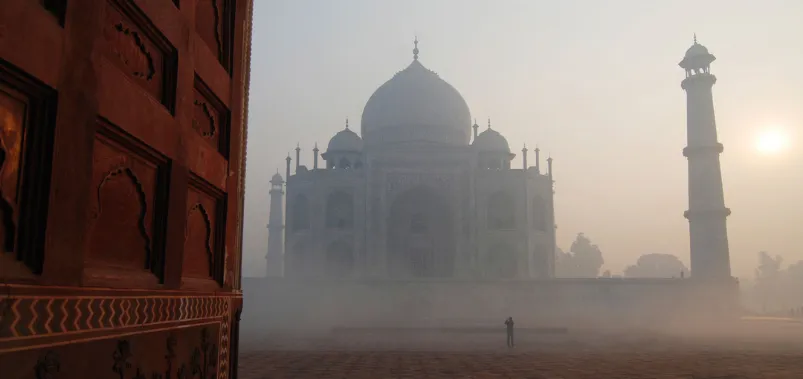
Inside monuments, look for signs. The Taj Mahal allows photography in the gardens but not inside the main tomb, and many temples ban photographs of the main image of worship. When in doubt, ask a guard or your guide. Your guide from Golden Triangle Tours can help with introductions in villages and markets, which often leads to warmer and more natural portraits than a lens pointed from across the street.
Tipping is customary but modest. Tipping in India usually looks like this, and amounts can change with the level of service and the city:
Hand tips over discreetly with your right hand, ideally in an envelope for drivers and guides at the end of a multi-day tour.
Public displays of affection in India are more restrained than in Europe, North America or Australia. Holding hands as a couple is fine in cities, but kissing and close embracing in public can draw stares and, in religious places or small towns, disapproval. Indian law includes provisions against obscene acts in public, and although tourists are rarely troubled, a quiet approach is simply more respectful. Save the romance for your hotel room or a private dinner terrace.
If you are invited into a home, consider it an honour. Bring a small gift such as a box of sweets from a good shop, fruit or something from your home country; avoid alcohol unless you know the family drinks, and avoid leather gifts for Hindu or Jain families. When eating as a guest in an Indian home, wash your hands before the meal, wait to be shown where to sit, and let the host serve you. Your host will likely press second and third helpings on you, which is a sign of care. Leaving a little food on your plate signals that you are full; an empty plate can mean you want more. Many Hindu and Jain families are vegetarian, and some Jain families avoid onions, garlic and root vegetables, so never ask for meat or bring it into a home. Do not touch food on a shared serving dish with fingers you have been eating with.
Conversation is lively and warm, and Indians enjoy talking about cricket, family, food, films and your own country. Religion and politics are more sensitive. India is home to Hindus, Muslims, Sikhs, Christians, Jains, Buddhists and many others, and opinions run deep. It is fine to ask respectful questions about a festival or a temple, but avoid debating faith, comparing religions or offering opinions on national politics, caste or relations with neighbouring countries. If a host raises these topics, listen with interest rather than arguing. Avoid criticising India even jokingly; Indians may complain about traffic or bureaucracy themselves, but the same words from a visitor can sting.
Finally, patience is its own form of courtesy. Things may run late, a shop may close for a family function, a waiter may take a while. A calm smile achieves more than raised voices, and following these cultural do's and don'ts in India will help you leave every place on good terms.
We promise you a holiday where everything is taken care of from the moment you land. Trusted drivers waiting for you, handpicked hotels that fit your style, personalized itineraries designed just for your family, and a dedicated team on call 24/7. All you need to do is relax, explore, and create unforgettable memories, while we take care of every detail behind the scenes.
Press your palms together in front of your chest, fingers pointing up, and give a small nod. This greeting works with people of any age, gender or faith and involves no physical contact. Handshakes are also common in business and between men.
Only if she offers her hand first. Many Indian women, especially in smaller towns, prefer not to shake hands with men outside the family. If she does not extend her hand, use the palms-together greeting with a smile.
The left hand is traditionally linked with personal hygiene, so the right hand is used for eating, giving and receiving. Pass money, gifts and food with your right hand, or with both hands for heavier items. Left-handed people are understood, so there is no need to worry about writing or using a phone.
Shoes must come off at temples, mosques, Sikh temples, Jain temples and most private homes. Shops, restaurants, hotels and monuments such as forts generally do not require it. A pile of footwear at the door is the clearest sign.
Usually it means yes, okay or I understand. A slower wobble with a smile can mean of course, while a vague wobble with "maybe" can be a polite way to avoid saying no. Ask open questions when you need a precise answer.
Cover your shoulders, arms and legs, and women should carry a scarf to cover their hair. If your clothing is too short, robes are available near the gates. Shoes are removed before entering the courtyard, and foreign visitors pay a fee at the gate.
No. Mobile phones, cameras, smartwatches and all electronics are prohibited, and you must leave them at the free cloakroom before security. The complex is closed on Mondays, and entry to the temple itself is free.
Costumed performers, snake charmers and wandering holy men usually expect around INR 50 to 100 for a photo. Agree before you take the picture, or do not take it. Ordinary people on the street generally do not expect payment, but you should always ask permission.
Airports, military areas, army cantonments, police checkpoints and some bridges and dams are off-limits by law. Many temples ban photographs of the main image of worship, the Taj Mahal bans photography inside the main tomb, and cremation grounds should never be photographed. Drones need official permission.
Holding hands is fine in cities, but kissing and close embracing in public can attract disapproval, especially near religious sites and in small towns. A discreet approach is more respectful. Save affectionate moments for your hotel or a private setting.