In a city full of extraordinary architecture and living heritage, Govind Dev Ji Temple occupies a category entirely its own. It is not a monument. It is not a tourist attraction in any conventional sense. It is one of the most actively worshipped Krishna temples in northern India a place where tens of thousands of devotees come every single day, not to look at something old and beautiful, but to be in the presence of a deity they consider genuinely alive.
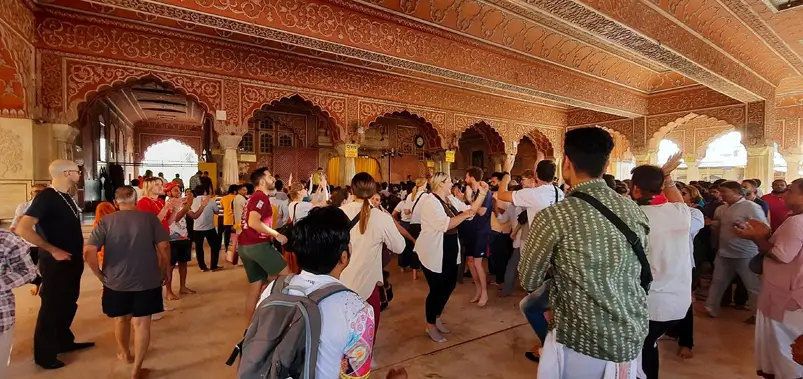
For a foreign visitor, walking into Govind Dev Ji Temple Jaipur during one of its daily aartis is one of the most viscerally powerful experiences available in Rajasthan. The temple fills with sound bells, conch shells, devotional singing, the collective energy of thousands of people in a state of focused spiritual attention in a way that is almost physical in its intensity. It does not matter whether you share the faith. The experience registers on a level that is entirely independent of belief.
This guide covers everything you need to know before you visit: the full Govind Dev Ji aarti timings schedule, the history of the temple and its deity, how to conduct yourself as a respectful foreign visitor, what to expect at each aarti, and practical information that will make your visit smooth and meaningful rather than confusing and rushed.
Experience the Divine Beauty of Govind Dev Ji Temple
Make your Jaipur visit more meaningful with a comfortable private sightseeing tour. Visit the sacred Govind Dev Ji Temple, witness the soulful aarti, and explore nearby attractions with a professional driver for a smooth and memorable travel experience.
The story of Govind Dev Ji Temple history begins not in Jaipur but in Vrindavan, the sacred city in Uttar Pradesh associated with the childhood of Lord Krishna. The original Govind Dev Ji idol was installed in Vrindavan in the sixteenth century during the reign of Emperor Akbar, commissioned by the great Vaishnava saint Rupa Goswami one of the principal disciples of Sri Chaitanya Mahaprabhu, the Bengali mystic who transformed Krishna devotion across northern India.
The idol itself is considered by devotees to be a svayambhu murti a self manifested image that was not carved by human hands but revealed from the earth. This belief places it in an entirely different category from even the finest commissioned religious art, and it is the foundation of the deity's extraordinary spiritual significance.
When the Mughal emperor Aurangzeb began his campaign of temple destruction in the late seventeenth century, the priests of the Vrindavan temple transported the Govind Dev Ji idol out of the city to protect it. After a series of locations, it eventually came to Jaipur under the protection of Maharaja Sawai Jai Singh II, who was a devoted worshipper of Krishna and who had begun building his new capital city at almost exactly the same time.
Jai Singh II installed Govind Dev Ji in the Surya Mahal a pavilion within the grounds of the City Palace complex in 1735. This location was chosen with deliberate symbolic intention: the temple faces east toward Vrindavan, maintaining the deity's connection to its original home. Jai Singh II formally declared Govind Dev Ji the ruling deity of Jaipur, meaning that in the spiritual and political understanding of the Jaipur kingdom, it was the god and not the maharaja who truly ruled the city.
This declaration had practical implications that have persisted into the present day. The maharaja's palace was oriented to face the temple, so that the king was always in a position of facing his deity. The revenues of the kingdom were formally dedicated to the temple's maintenance and worship. And the city's relationship with Govind Dev Ji as its presiding deity has remained a living cultural and religious reality rather than a historical footnote.
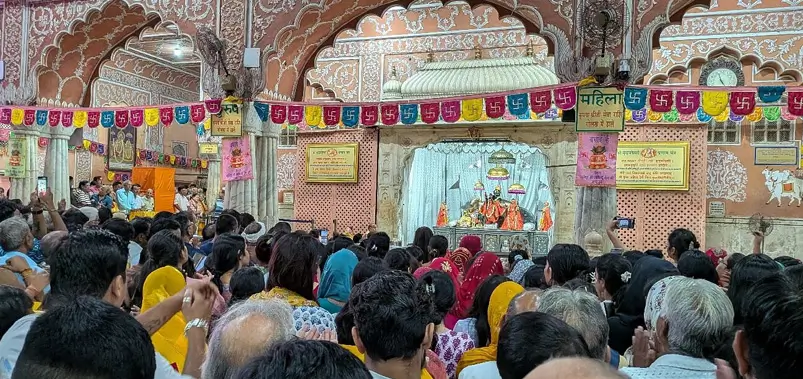
Govind Dev Ji darshan is not simply a religious activity for the people of Jaipur. It is a civic and cultural act that has been woven into the identity of the city for nearly three hundred years. For many Jaipur families, visiting the temple for the morning aarti is as much a part of the daily rhythm as breakfast. The temple's festivals draw hundreds of thousands of people. Its schedule organizes the devotional life of an entire city.
For foreign visitors, understanding this depth of significance transforms the temple experience. You are not walking into a historical site. You are walking into the living center of a religious community that has maintained an unbroken tradition of daily worship for centuries. The crowds are not inconvenient they are the point. The intensity of the atmosphere is not manufactured for visitors it is the genuine expression of a living devotional culture.
Krishna temple Jaipur visits of this depth are rare even within India, and Govind Dev Ji Temple Jaipur represents a level of active, continuous religious life that very few temple sites anywhere in the world can match.
Read More: Explore Jaipur's Most Authentic Cultural Experience
A visit to Govind Dev Ji Temple offers a glimpse into Jaipur's living spiritual traditions, but Rajasthan's cultural experiences extend far beyond temple walls. If you want to experience folk music, traditional Rajasthani cuisine, village arts, and local performances in one place, explore our detailed guide to Chokhi Dhani Jaipur. It helps first time visitors understand what is genuinely worth experiencing and how to make the most of an evening in Rajasthan's most famous cultural village.
The temple operates on a schedule of seven daily aartis, each of which marks a different moment in the deity's symbolic daily life. The curtain before the idol called the parda opens for each aarti and closes between them, and the opening of the parda is itself one of the most anticipated moments of each session.
Below is the standard Govind Dev Ji temple timings schedule. Note that timings shift slightly between summer and winter the schedule below reflects the approximate winter timings, and summer timings run approximately thirty to sixty minutes earlier for the morning sessions.
Mangala Aarti - 4:30 AM (Winter) / 4:00 AM (Summer)
The Mangala aarti is the first and earliest of the day the symbolic awakening of the deity. The temple opens before dawn, and the devotees who gather for Mangala are among the most deeply committed in the city. The atmosphere at this hour is intimate and intense, with far smaller crowds than the later aartis and a quality of stillness that is absent from the busier sessions.
For foreign visitors willing to wake at 3:30 AM and make the journey to the temple before sunrise, the Mangala aarti offers an experience of the temple that is entirely different from any other time of day. The pre dawn quiet, the oil lamps, and the small crowd of devotees create an atmosphere of concentrated devotion that the larger aartis cannot replicate.
Dhoop Aarti - 7:30 AM (Winter) / 7:00 AM (Summer)
The Dhoop aarti marks the symbolic morning meal of the deity and is the first of the longer, more elaborate aartis. By this hour the crowd has grown considerably from the Mangala session, and the energy of the temple is distinctly more communal and celebratory.
Shringar Aarti - 9:30 AM (Winter) / 8:30 AM (Summer)
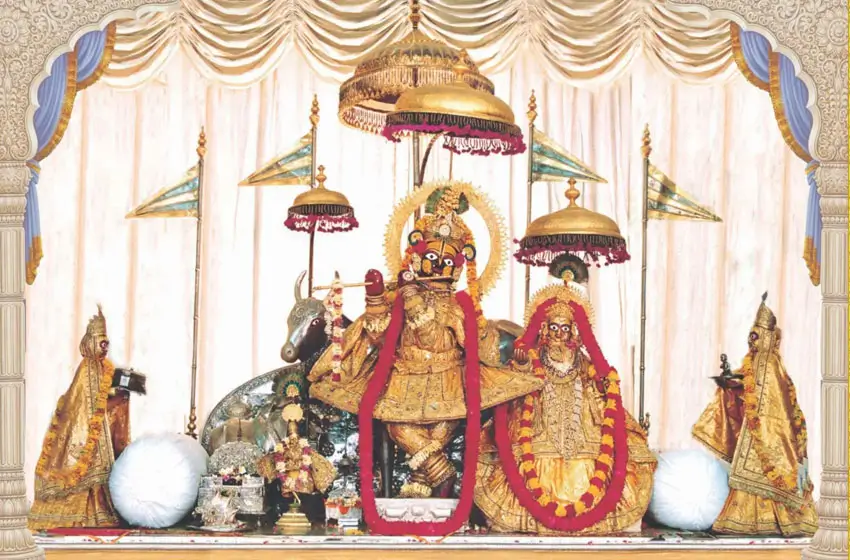
The Shringar aarti the adornment aarti marks the moment when the deity is symbolically dressed and adorned for the day. This is one of the most visually beautiful of the daily sessions, and the elaborateness of the idol's decoration at this aarti is exceptional. The crowds here are significant and the energy is high.
Rajbhog Aarti - 11:30 AM (Winter) / 10:30 AM (Summer)
The Rajbhog aarti marks the deity's midday meal symbolically the most elaborate meal of the day and is one of the most attended of the daily aartis. After the Rajbhog, the temple closes for several hours while the deity symbolically rests. This midday closure is one of the most important structural features of the temple's schedule and catches many visitors off guard.
The temple remains closed from approximately 12:00 PM to 5:30 PM (winter) or 11:30 AM to 5:00 PM (summer). Plan your visit around this closure arriving at 2:00 PM expecting an open temple is one of the most common mistakes foreign visitors make.
Read More: Discover More Sacred Places Around Jaipur
After experiencing the spiritual atmosphere of Govind Dev Ji Temple, many travelers look for other heritage, religious, and cultural destinations near Jaipur. From ancient stepwells and pilgrimage centers to royal towns and wildlife reserves, Rajasthan offers countless rewarding day trips. Explore our guide to the best places to visit around Jaipur for inspiration on extending your journey beyond the Pink City.
Utthapan Aarti - 5:45 PM (Winter) / 5:15 PM (Summer)
The Utthapan aarti marks the symbolic awakening of the deity from the midday rest. The temple reopens to large crowds for this session, and the energy of the early evening with the day's heat beginning to soften and the devotional music filling the courtyard is entirely different from the morning aartis.
Sandhya Aarti - 6:45 PM (Winter) / 6:15 PM (Summer)
The Sandhya aarti the twilight aarti is one of the most beautiful of the day. The natural light is fading, lamps are being lit throughout the temple, and the visual effect of the illuminated idol against the darkening sky is genuinely striking. This is one of the most recommended sessions for first time visitors who are not willing or able to wake for the Mangala.
Shayan Aarti - 8:30 PM (Winter) / 7:45 PM (Summer)
The Shayan aarti is the final aarti of the day the symbolic preparation of the deity for sleep. The curtain that closes after this aarti will not open again until the Mangala the following morning. The Shayan aarti has a quality of tender finality that is quite distinct from the celebratory energy of the daytime sessions.
For visitors experiencing a Jaipur aarti experience for the first time, knowing what to expect helps enormously in receiving the experience fully rather than spending it in confusion about what is happening.
Each aarti follows a broadly similar structure. The priests prepare the worship materials lamps, incense, flowers, food offerings in the inner sanctum while the crowd gathers in the outer hall and courtyard. The anticipation before the opening of the parda is palpable and builds progressively as the aarti time approaches.
When the curtain opens, the assembled crowd responds with an audible collective reaction a sound that is part gasp, part exclamation of joy, and part prayer that is one of the most distinctively powerful sounds in Indian religious life. The idol is revealed in its full decorated glory, and the priests begin the formal aarti ceremony, circling lamps of different sizes before the deity in a specific sequence while the temple musicians play and the crowd sings along with devotional hymns.
The aarti lasts between fifteen and forty minutes depending on the session. After the conclusion of the formal worship, the priests distribute prasad the food or sweets that have been offered to the deity and are now considered blessed to the assembled devotees. Receiving prasad is an important part of the temple visit and is offered to all visitors regardless of their faith background.
After the parda closes, the crowd disperses gradually. Some devotees remain for personal prayer. Others move to the outer courtyard areas for conversation and community. The transition from the intensity of the aarti to the quiet aftermath is itself a distinct atmospheric experience.
Read More: First Time in Jaipur? Start Here
Govind Dev Ji Temple is one of Jaipur's most important spiritual landmarks, but it is only one chapter in the city's remarkable story. Jaipur combines magnificent forts, royal palaces, colorful bazaars, architectural wonders, and centuries old traditions. Our complete Jaipur destination guide helps visitors plan a well rounded itinerary covering the city's most iconic attractions and cultural experiences.
Dress Code
The how to visit Govind Dev Ji temple question begins with dress, because the temple's requirements are non-negotiable and enforced at the entry.
Both men and women must cover their shoulders and knees completely. Sleeveless tops, shorts, short skirts, and low cut clothing are not permitted. Women should ideally carry a dupatta or light scarf to cover their head inside the temple this is not strictly required for foreign visitors but is deeply appreciated and will be noticed with warmth by temple staff and devotees.
Remove your shoes before entering the temple. Shoe storage is available at the entrance and is free of charge. Keep a pair of socks with you if you are sensitive about walking on stone floors that have been walked on by many thousands of people.
Photography
Photography is not permitted inside the inner sanctum of the temple. This restriction is enforced and should be respected without exception. Photography in the outer courtyard areas is generally tolerated, but be observant of the atmosphere a devotee in the middle of personal prayer is not a subject for a travel photograph regardless of how compelling the image might be.
Phones should be kept out of sight inside the main worship hall during aarti sessions. The energy of the space and the experience of the aarti are better received without a screen between you and them.
Read More: Experience Jaipur with a Private Golden Triangle Tour
Many international travelers visit Govind Dev Ji Temple as part of a larger Golden Triangle journey. Combining Delhi, Agra, and Jaipur, this route introduces visitors to India's most celebrated heritage sites, including the Taj Mahal, Amber Fort, and the spiritual heart of Jaipur. A private Golden Triangle tour provides flexibility, expert local guidance, and a deeper understanding of India's cultural diversity.
Timing Your Visit
The single most important practical advice for a Jaipur temple visit guide of any temple and particularly Govind Dev Ji is to verify the current day's timings before you leave your hotel. The schedule shifts between summer and winter, and on major Hindu festival days, special extended schedules apply that are entirely different from the standard daily timetable.
Arrive at least twenty to thirty minutes before the aarti you want to attend. The crowds build rapidly in the final minutes before the parda opens, and arriving late means joining a very dense crowd from the back rather than finding a comfortable position with a clear view.
Navigating the Crowds
Govind Dev Ji Temple Jaipur draws enormous crowds, particularly at the Shringar, Rajbhog, Sandhya, and Shayan aartis. During festival periods Janmashtami, Holi, Diwali the crowds exceed anything that a first time visitor is likely to have encountered in any religious setting.
Move with the crowd rather than against it. Keep your group close together and agree on a meeting point outside the temple in case you become separated. Keep your belongings secured against your body rather than in a backpack. And be prepared for a level of physical proximity with strangers that is greater than most Western visitors are accustomed to this is not threatening, it is simply the reality of a genuinely popular pilgrimage site.
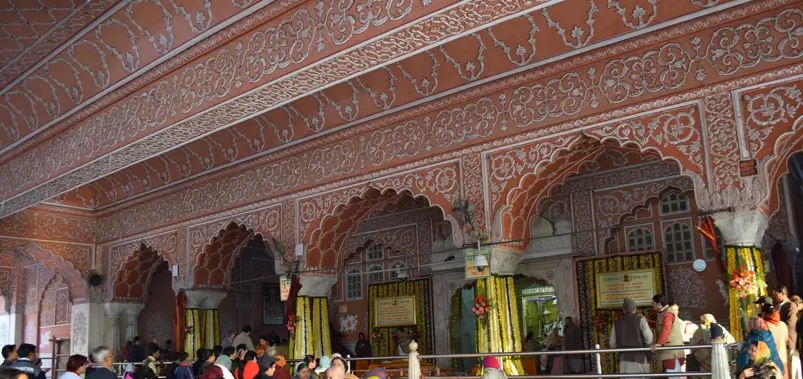
The physical structure of Govind Dev Ji Temple Jaipur is worth examining even by visitors whose primary interest is the devotional rather than the architectural experience.
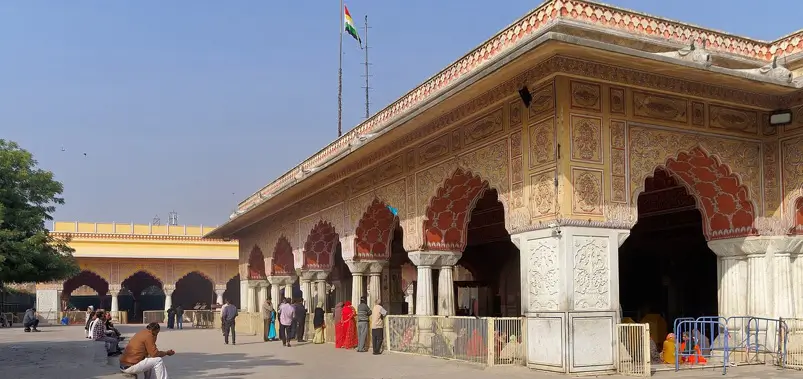
The temple is housed in what was originally the Surya Mahal a garden pavilion within the City Palace complex built by Jai Singh II in the seventeenth century, predating the construction of Jaipur itself. The structure is a blend of Rajput and Mughal architectural traditions open arched halls, carved stone columns, and a series of interconnected spaces that move from the public courtyard through progressively more sacred zones to the inner sanctum where the idol is housed.
The open, airy quality of the architecture unusual for temple design in northern India, which typically features more enclosed and cave like inner sanctums was specifically intended to allow the maximum number of devotees to have simultaneous sight of the deity. Jai Singh II, as a monarch responsible for an entire city of devotees, designed the temple space to be as democratically accessible as possible, which explains its unusual openness.
The garden surrounding the temple known as the Jai Niwas garden is one of the most beautiful enclosed garden spaces in Jaipur and provides a quiet contrast to the intensity of the temple interior. Walking through it before or after an aarti is a genuinely restorative experience.
Read More: Add Rajasthan's Royal Heritage to Your Journey
If the devotion and history of Govind Dev Ji Temple inspire you to explore more of Rajasthan, consider extending your itinerary beyond Jaipur. Udaipur's lakes, Jodhpur's blue streets, Jaisalmer's desert forts, and Ranthambore's wildlife create an unforgettable introduction to royal India. A Golden Triangle Tour with Rajasthan allows travelers to combine India's iconic landmarks with the state's most celebrated cultural destinations.
The best temples in Jaipur experience their most extraordinary moments during major Hindu festivals, and Govind Dev Ji is no exception.
Janmashtami - the birthday of Lord Krishna, falling in August is the most significant festival in the Govind Dev Ji calendar. The celebrations begin in the evening and reach their climax at midnight, the traditional hour of Krishna's birth. Hundreds of thousands of devotees fill every available space in and around the temple, and the midnight moment of the Janmashtami aarti is one of the most intensely devotional experiences in all of Indian religious life. Foreign visitors who are in Jaipur during Janmashtami and who are willing to navigate the crowds should not miss it.
Holi at Govind Dev Ji has its own specific tradition the temple's Holi celebration includes a ritual in which flowers rather than colored powder are thrown, maintaining the festival's joyful spirit in a specifically temple appropriate form. The flower Holi at Govind Dev Ji is one of Jaipur's most photographically beautiful festival moments and draws visitors from across India.
Radhashtami - celebrating the birth of Radha, Krishna's divine consort and Ekadashi - the eleventh day of each lunar fortnight, which is especially sacred to Vaishnavas bring additional intensity to the temple's regular schedule and are worth knowing about when planning your visit dates.
Explore Jaipur's Spiritual & Royal Heritage
Enhance your Jaipur journey with a private guided tour covering the revered Govind Dev Ji Temple along with the city's magnificent forts, palaces, vibrant markets, and cultural landmarks. Travel comfortably with an experienced chauffeur and enjoy a personalized sightseeing experience.
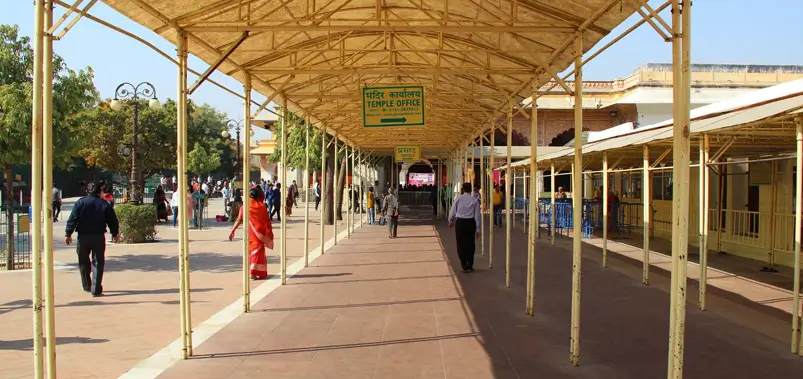
The temple is located within the City Palace complex in the heart of Jaipur's old city, making it accessible from most visitor accommodation areas.
From hotels in the Bani Park, Civil Lines, or C-Scheme areas, the temple is approximately fifteen to twenty minutes by auto rickshaw. From hotels within or immediately adjacent to the old city, it is often walkable in ten to fifteen minutes.
Auto rickshaws are the most practical form of transport for most visitors. Agree on the fare before boarding and confirm that the driver knows the temple entrance rather than the City Palace tourist entrance the two are adjacent but distinct, and arriving at the wrong gate costs time, particularly important if you are trying to reach the temple before an aarti begins.
Parking for private vehicles is available in the City Palace area, but traffic in the old city during aarti times particularly evening aartis can be significantly congested. If you are arriving by private car, build additional time into your journey and confirm with your driver about the best approach route given current traffic conditions.
Read More: Planning a Spiritual and Cultural Journey Through India
Travelers interested in temples, living traditions, architecture, and authentic local experiences often find Jaipur to be one of the most rewarding destinations in India. From the devotional atmosphere of Govind Dev Ji Temple to royal palaces, heritage neighborhoods, and cultural performances, Jaipur represents the perfect balance of spirituality and history. Explore more travel stories, destination guides, and expert planning resources to create a meaningful India itinerary.
Go for more than one aarti if your itinerary allows. The Mangala and the Sandhya offer entirely different experiences of the same space and the same deity, and experiencing both gives you a much fuller understanding of the temple's rhythm and character.
Spend time in the courtyard before and after the aarti rather than arriving at the last minute and leaving immediately. The peripheral spaces of the temple the areas where devotees sit, pray, and converse are where much of the genuine texture of the place becomes accessible.
If you are visiting with a knowledgeable local guide, ask them to explain the specific iconography of the Govind Dev Ji idol and its decorations. The deity is dressed differently for each aarti and for each season, and understanding what the different adornments signify adds a significant layer of meaning to the visual experience.
Do not attempt to rush through the temple experience. Govind Dev Ji darshan is not an item on a checklist. Give yourself at minimum ninety minutes for the full experience of an aarti time to arrive, to settle, to receive the aarti, to collect prasad, and to sit quietly afterward before returning to the pace of the city outside.
Read More: Arrange a Private Car and Driver in Jaipur
While Jaipur's iconic attractions are relatively spread out, the city is best experienced without rushing from one site to another. From early morning temple visits to sunset views at Amber Fort, having dedicated transportation allows travelers to enjoy the city's heritage, architecture, and culture with greater comfort and convenience.
Travelers interested in temples, living traditions, architecture, and authentic local experiences often find Jaipur to be one of the most rewarding destinations in India. From the devotional atmosphere of Govind Dev Ji Temple to royal palaces, heritage neighborhoods, and cultural performances, Jaipur represents the perfect balance of spirituality and history. Explore more travel stories, destination guides, and expert planning resources to create a meaningful India itinerary.
For travelers exploring Jaipur at their own pace, experiences like Govind Dev Ji Temple are best enjoyed as part of a thoughtfully planned day that may also include the City Palace, Jantar Mantar, local markets, and nearby heritage attractions. Having reliable local transportation allows the flexibility to discover these places comfortably while gaining a deeper appreciation of the city's rich history and traditions.
Whether you are visiting Jaipur for a day or as part of a longer journey through Rajasthan and the Golden Triangle, taking time to explore its spiritual and cultural landmarks often leads to the most memorable travel experiences.
Planning your time in Jaipur? Explore our private car rental services or share your travel plans through our booking form to create a personalized sightseeing experience tailored to your interests and schedule.

We promise you a holiday where everything is taken care of from the moment you land. Trusted drivers waiting for you, handpicked hotels that fit your style, personalized itineraries designed just for your family, and a dedicated team on call 24/7. All you need to do is relax, explore, and create unforgettable memories, while we take care of every detail behind the scenes.
The parda represents the boundary between the ordinary world and the sacred presence of the deity. When it is closed, the deity is understood to be resting, eating, or otherwise engaged in private activities. When it opens for an aarti, it is the moment of darshan - sacred sight - in which devotee and deity are understood to see each other simultaneously. The opening of the parda is among the most emotionally significant moments of any aarti, which explains the collective reaction of the assembled devotees at that instant.
Govind Dev Ji stands apart from most Krishna temples in India primarily because of the deity's history - its origins in Vrindavan, its status as a svayambhu murti, and its three-century-long association with the royal house of Jaipur give it a level of devotional significance that very few temples can match. In terms of the quality and continuity of daily worship, the sophistication of the musical tradition, and the depth of community engagement, it is considered among the foremost Krishna temples in northern India.
Yes, and a knowledgeable guide significantly enriches the experience. A guide who understands the temple's history, the iconography of the deity, and the meaning of the aarti rituals can transform a visit from a sensory experience into a deeply informed one. Through Golden Triangle Tours, guides with specific knowledge of Jaipur's Vaishnava traditions and temple culture can be arranged for this visit.
Move quietly and respectfully through the inner spaces. Do not turn your back on the deity in the inner sanctum - step backward when moving away from the idol. Do not eat or drink inside the temple. Do not use your phone during active worship. Speak softly and be conscious of the devotional atmosphere around you. Following the lead of the devotees around you is almost always the best guide to appropriate behavior.
The temple is worth visiting at any time of year, but the major festival periods - Janmashtami in August, Holi in March, and Diwali in October or November - offer an intensity of experience that is not available on ordinary days. For visitors who want a meaningful experience without extreme crowds, the regular October to March tourist season provides excellent conditions for an unhurried and immersive visit.
Yes, absolutely. Govind Dev Ji Temple welcomes visitors of all faiths and backgrounds. The only requirements are appropriate dress and respectful conduct. Many of the most meaningful experiences at the temple are had by visitors who come with genuine curiosity and openness rather than prior familiarity with the tradition.
Prasad is distributed by temple priests after the conclusion of each aarti. Position yourself near the distribution area as the aarti concludes and extend your hands in a cupped position - the priests will place the prasad directly into your hands. Receive it with both hands as a gesture of respect.
Photography is not permitted inside the inner sanctum or during aarti sessions. Respectful photography in the outer courtyard areas is generally tolerated. Keep your phone and camera out of sight inside the main worship hall and during any moment of active worship.
Both men and women must cover their shoulders and knees. Light cotton clothing is comfortable given Jaipur's climate. Women may wish to carry a dupatta or scarf for head covering. Remove shoes before entering - socks are recommended for comfort on the stone floors.
Yes. The temple closes after the Rajbhog aarti - approximately noon in winter and 11:30 AM in summer - and reopens for the Utthapan aarti in the late afternoon. The midday closure lasts approximately five to six hours. This is one of the most important practical facts for planning your visit.
Yes. The Mangala aarti is open to all visitors. The pre-dawn timing is demanding, but the experience of the temple at this hour - intimate, quiet, and deeply devotional - is unlike anything available at the later sessions. Arrange your transport in advance, as auto-rickshaws may be less readily available before sunrise.
Aarti duration varies between sessions. Shorter aartis like Mangala and Utthapan last approximately fifteen to twenty minutes. The major aartis - Shringar, Rajbhog, and Sandhya - typically run thirty to forty minutes. Allow additional time before and after for the crowd management at entry and exit.
The Sandhya aarti - the early evening session - is generally recommended for first-time visitors. The light at this hour is beautiful, the crowds are significant but manageable, and the atmosphere of the temple transitioning from day to evening is particularly evocative. The Shringar aarti is also excellent for those who prefer a morning visit and want to see the deity in its most elaborately decorated form.
No. Entry to the temple is free for all visitors. Donations are welcome but entirely voluntary. Shoe storage at the entrance is also free of charge.
Yes, the temple is open to all visitors regardless of nationality or faith. There are no restrictions on foreign visitors attending any of the daily aartis. The only requirements are appropriate dress and respectful conduct.
The standard timings are: Mangala at 4:30 AM (winter) / 4:00 AM (summer), Dhoop at 7:30 AM / 7:00 AM, Shringar at 9:30 AM / 8:30 AM, Rajbhog at 11:30 AM / 10:30 AM, Utthapan at 5:45 PM / 5:15 PM, Sandhya at 6:45 PM / 6:15 PM, and Shayan at 8:30 PM / 7:45 PM. Always confirm current timings with your hotel or the temple directly before visiting, as festival schedules may differ.