Golden Triangle Tour for Large Groups: Coach, Hotels & Group Package Pricing
14 Sep 2026

For many travelers, Agra begins and ends with the Taj Mahal. While the white marble mausoleum rightly earns worldwide admiration, another UNESCO World Heritage Site located just a few kilometres away tells the story of the Mughal Empire's rise, power, and eventual decline. That monument is Agra Fort, one of the largest and most historically significant forts ever built in India.
Unlike many forts that now stand in ruins, Agra Fort remains remarkably well preserved. Massive red sandstone walls rise nearly 21 metres (70 feet) above the surrounding city, enclosing an impressive collection of royal palaces, audience halls, mosques, gardens, courtyards, and defensive structures. Walking through its gates feels less like entering a military fortress and more like stepping into a royal city where emperors once ruled one of the richest empires in the world.
The fort served as the principal residence of the Mughal emperors for nearly a century before the capital shifted to Delhi. Some of the most important decisions in Indian history were made inside these walls. Emperor Akbar transformed the fort into his imperial headquarters, Jahangir expanded its palaces, and Shah Jahan replaced many red sandstone buildings with elegant white marble structures that reflected his passion for architecture.
The fort also witnessed one of the most emotional chapters in Mughal history. After being overthrown by his son Aurangzeb, Shah Jahan spent the final years of his life confined inside Agra Fort. From a marble pavilion overlooking the Yamuna River, he is believed to have spent his remaining days gazing toward the Taj Mahal, where his beloved wife Mumtaz Mahal rested.
Today, Agra Fort welcomes visitors from across the world who come not only to admire its impressive architecture but also to understand the political and cultural history behind the Mughal Empire. Its blend of military engineering, Persian design, Islamic architecture, and Indian craftsmanship makes it one of the most fascinating monuments in the country.
Whether you are travelling independently or as part of a luxury Golden Triangle Tour, Agra Fort deserves far more than a quick stop between the Taj Mahal and Jaipur. With the right planning, visitors can spend several hours exploring magnificent palaces, hidden courtyards, marble balconies, and spectacular viewpoints overlooking one of the world's most famous monuments.
Long before the magnificent red sandstone walls dominated the Agra skyline, the site was occupied by an older brick fortress known as Badalgarh. Historical records suggest that this earlier fort existed centuries before the Mughal Empire arrived, although little of its original structure survives today.
The transformation of the site began in 1565, when Emperor Akbar ordered the construction of a completely new imperial fortress. At the time, Agra occupied a strategic position along important trade routes connecting northern India with central and western regions. Akbar recognised that controlling Agra meant controlling both commerce and administration across much of the empire.
Construction continued for approximately eight years, employing thousands of skilled craftsmen, stone masons, engineers, and labourers from across the Mughal Empire. Massive blocks of red sandstone were transported primarily from the quarries around Fatehpur Sikri and neighbouring regions of Rajasthan.
The result was extraordinary.
Stretching nearly 2.5 kilometres around its perimeter, the completed fort combined military strength with imperial luxury. High defensive walls, deep moats, powerful bastions, and carefully designed gateways protected the royal residence while elegant palaces, audience halls, gardens, and private apartments provided comfort worthy of an emperor.
Akbar himself preferred bold red sandstone architecture, which explains why much of the earlier construction inside the fort displays robust geometric forms and richly carved Hindu and Islamic decorative elements blended together. This architectural fusion reflected Akbar's broader policy of encouraging cultural cooperation across his diverse empire.
When Jahangir succeeded his father, the fort continued to evolve. New residential buildings were added, and several palace complexes received decorative improvements. Jahangir also welcomed foreign ambassadors, merchants, and travellers inside the fort, helping establish Agra as one of the world's most prosperous imperial capitals during the early seventeenth century.
The most dramatic architectural transformation occurred during the reign of Shah Jahan.
Unlike Akbar, Shah Jahan preferred elegant white marble over red sandstone. Inspired by symmetry and refined craftsmanship, he ordered the replacement of several earlier buildings with luxurious marble palaces featuring intricate floral carvings, delicate lattice screens, precious stone inlay work, graceful arches, and spacious courtyards.
Many of the structures visitors admire today—including the Khas Mahal, Musamman Burj, and sections of the Diwan-i-Khas—owe their appearance to Shah Jahan's extensive renovations.
Ironically, these magnificent additions later became the setting for one of the Mughal Empire's greatest tragedies.
In 1658, Shah Jahan's son Aurangzeb seized power after a bitter struggle for succession. The emperor was confined within Agra Fort under house arrest. Although treated with royal dignity, he was not permitted to leave the fortress.
According to historical accounts, Shah Jahan spent nearly eight years living in the marble palace known as Musamman Burj, from where he could see the distant white dome of the Taj Mahal across the Yamuna River.
Whether viewed as historical fact or symbolic legend, the image of an ageing emperor looking toward the mausoleum of his beloved wife has become one of the most enduring stories associated with Agra Fort.
Following the decline of Mughal power, the fort passed through the hands of the Marathas, the Jats, and eventually the British East India Company after the early nineteenth century. British occupation resulted in significant alterations, with many original Mughal buildings demolished to create military barracks and administrative facilities.
Historians estimate that only about 30 percent of the original Mughal palace complex survives today. Even so, what remains represents one of the finest surviving examples of Mughal architecture anywhere in the world.
Recognising its outstanding historical importance, UNESCO designated Agra Fort as a World Heritage Site in 1983. Today it stands alongside the Taj Mahal and Fatehpur Sikri as one of India's most celebrated historical monuments.
Walking through Agra Fort is therefore not simply a sightseeing experience—it is a journey through nearly five centuries of political ambition, architectural brilliance, royal luxury, family conflict, and imperial history that shaped much of the Indian subcontinent.
.webp)
Before visiting Agra Fort, it is useful to understand its operating hours, ticket system, and the best times of day to avoid crowds. Although the fort attracts fewer visitors than the Taj Mahal, arriving at the right time still makes a noticeable difference, particularly during the peak tourist season.
Agra Fort is generally open every day of the week, unlike the Taj Mahal, which remains closed on Fridays.
Typical visiting hours are:
|
Information |
Details |
|---|---|
|
Opening Time |
6:00 AM |
|
Closing Time |
6:00 PM |
|
Closed Day |
Open All Seven Days |
|
Recommended Visit Duration |
2–3 Hours |
Most visitors spend between two and three hours exploring the accessible sections of the fort. History enthusiasts or photography lovers may wish to allow additional time.
Approximate ticket prices are:
|
Visitor Category |
Ticket Price |
|---|---|
|
Indian Citizens |
₹50–₹60 |
|
Foreign Tourists |
₹650 |
|
Children (within applicable government age limits) |
Generally Free |
Tickets can be purchased both online and at the entrance. Booking online is particularly useful during busy holiday periods because it reduces waiting time at the ticket counter.
The best visiting hours are between 8:00 AM and 10:00 AM, when temperatures remain comfortable and the morning sunlight beautifully illuminates the red sandstone walls. Another excellent option is visiting after 3:30 PM, when the afternoon heat begins to decrease and many organised tour groups have already departed.
Unlike the Taj Mahal, Agra Fort contains numerous covered palace areas, making it a more comfortable sightseeing destination during warmer months.
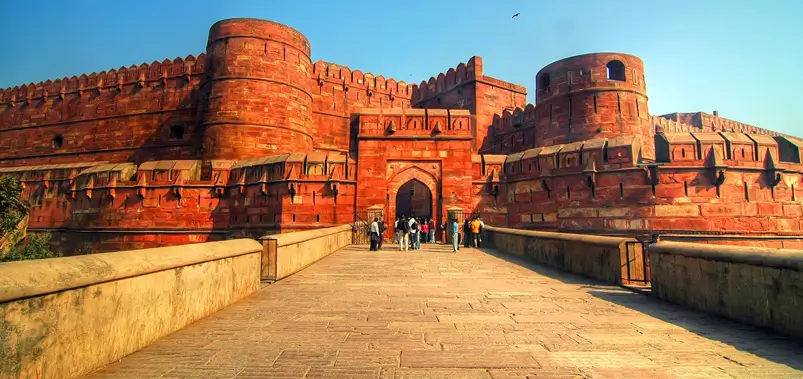
Unlike many historic forts that have multiple entrances open to visitors, Agra Fort currently welcomes tourists through a single public entrance known as Amar Singh Gate. This massive gateway immediately gives an impression of the fort's military strength. High red sandstone walls, defensive towers, and sharply angled passageways demonstrate that the fort was designed not only as a royal residence but also as one of the most secure military strongholds of the Mughal Empire.
The original ceremonial entrance, Delhi Gate, is considered one of the finest examples of Mughal military architecture. However, it is generally not open to regular tourists because it lies within a protected military area. Visitors therefore begin their journey through Amar Singh Gate, which itself offers an impressive introduction to the scale of the monument.
As you walk through the entrance passage, you will notice that the pathway bends rather than continuing in a straight line. This was an intentional defensive feature. Enemy armies could not charge directly through the gateway because the sharp turns slowed both soldiers and war elephants, giving defenders an important tactical advantage.
Security screening at Agra Fort is generally faster than at the Taj Mahal. Visitors pass through metal detectors and baggage checks before entering the complex.
Items normally allowed include:
Large luggage, drones, and prohibited items should be left at your hotel whenever possible.
Once inside, wide open courtyards replace the narrow entrance passages. The contrast between the heavily fortified exterior and the elegant palace complex immediately demonstrates the dual purpose of Agra Fort: it was both an impregnable fortress and one of the grandest royal residences in Asia.
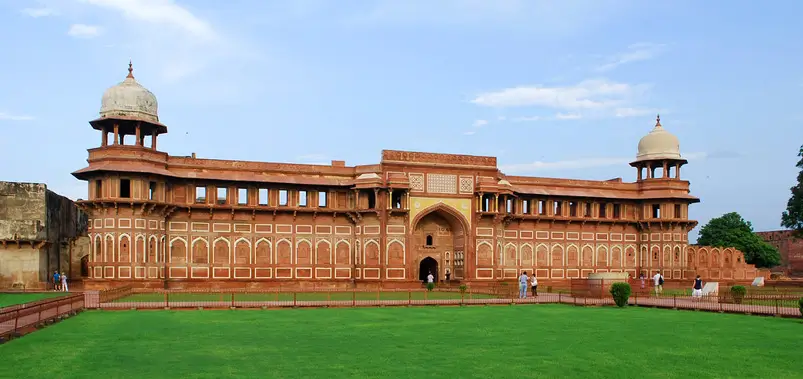
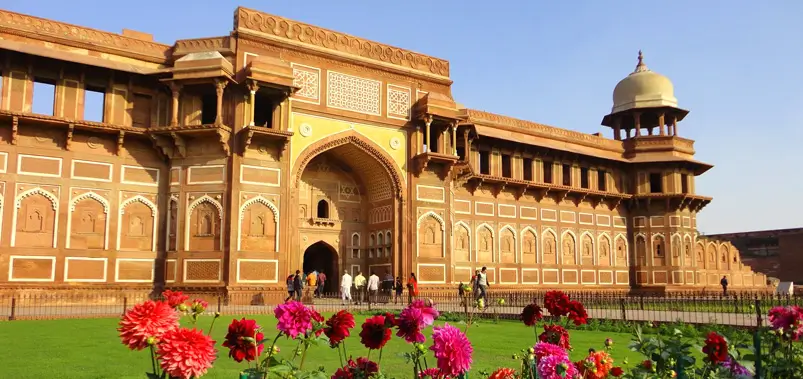
One of the first major buildings visitors encounter is the magnificent Jahangiri Mahal, often regarded as the oldest surviving palace inside Agra Fort.
Despite its name, historians believe this palace was actually commissioned by Emperor Akbar and later used by his son Jahangir, from whom it eventually received its present name.
Built almost entirely from rich red sandstone, the palace reflects Akbar's distinctive architectural style. Rather than relying solely on Persian influences, the design incorporates decorative elements inspired by Hindu, Rajput, Central Asian, and Islamic traditions. This combination reflects Akbar's policy of cultural integration throughout his empire.
Walking through Jahangiri Mahal reveals enormous courtyards surrounded by beautifully carved pillars, balconies, decorative brackets, and finely detailed stone screens. Every section demonstrates the remarkable craftsmanship of sixteenth century stone masons.
One particularly interesting feature is the massive carved stone bowl located within the palace grounds. Historians believe it may have been used for preparing fragrant rose water or ceremonial bathing rituals for members of the royal household.
Unlike the white marble elegance introduced later by Shah Jahan, Jahangiri Mahal possesses a more powerful and robust character. Thick walls, bold carvings, and richly decorated ceilings remind visitors that this palace belonged to the early years of Mughal expansion when strength and authority were central themes in imperial architecture.
For photographers, morning sunlight beautifully highlights the warm red sandstone, making Jahangiri Mahal one of the most visually striking locations inside the fort.
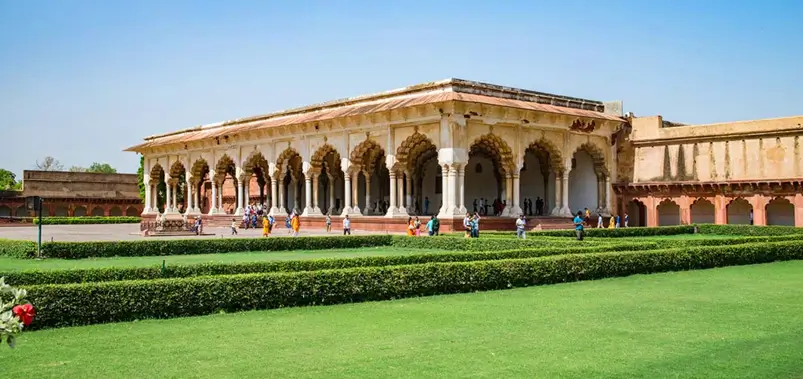
Moving deeper into the complex, visitors reach one of the most politically important buildings inside Agra Fort: the Diwan-i-Am, or Hall of Public Audience.
This large ceremonial hall served as the place where the emperor met ordinary citizens, government officials, military commanders, merchants, ambassadors, and petitioners seeking justice.
Unlike the emperor's private chambers, the Diwan-i-Am represented royal accessibility. Subjects from across the empire travelled to Agra hoping their cases would be heard before the emperor himself.
The structure consists of elegant rows of sandstone columns supporting broad arches that create a spacious open hall capable of accommodating large gatherings.
At the far end stands the imperial throne platform where the emperor would appear before his subjects.
Imagine the scene nearly four centuries ago:
Officials carrying important state documents.
Foreign ambassadors presenting diplomatic gifts.
Military commanders reporting victories.
Merchants requesting trading privileges.
Citizens seeking justice from the ruler of one of the world's largest empires.
Many significant administrative decisions affecting millions of people across the Mughal Empire were announced from this very hall.
Today, visitors can still appreciate the remarkable symmetry of the building while imagining the ceremonial grandeur that once filled the space.
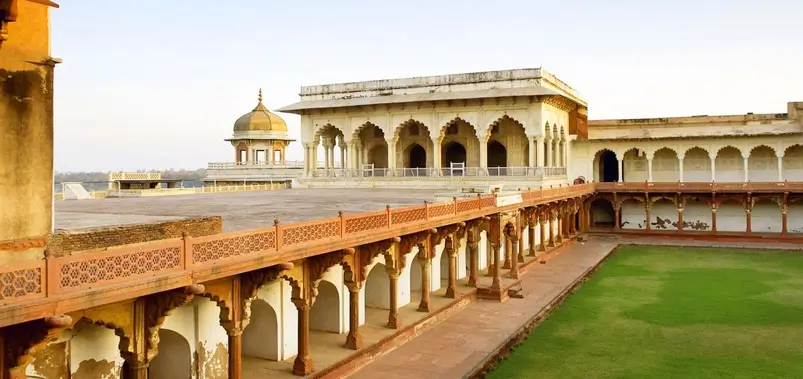
While the Diwan-i-Am welcomed the public, the Diwan-i-Khas, or Hall of Private Audience, served a very different purpose.
Only trusted nobles, senior ministers, foreign envoys, and distinguished guests were invited here.
This was where confidential political discussions, diplomatic negotiations, and strategic military planning took place.
Compared with the simplicity of the Diwan-i-Am, the Diwan-i-Khas displays a noticeably higher level of refinement. Delicate marble decoration, graceful arches, floral carvings, and carefully proportioned spaces reflect Shah Jahan's preference for elegance over military strength.
Although parts of the original decoration have disappeared over the centuries, visitors can still appreciate the sophisticated craftsmanship that once surrounded the emperor's closest advisors.
Standing here, it is easy to imagine representatives from Persia, Central Asia, Europe, and other kingdoms discussing trade agreements, political alliances, and diplomatic relations within these walls.
The building also demonstrates the evolution of Mughal architecture. Earlier sandstone structures built during Akbar's reign gradually gave way to the lighter marble style favoured by Shah Jahan, creating a fascinating visual contrast throughout the fort.
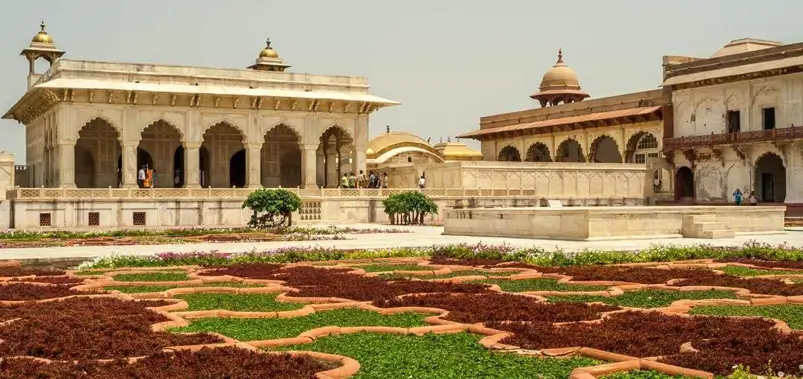
Among the most elegant structures inside Agra Fort is the Khas Mahal, one of the finest examples of Shah Jahan's residential architecture.
Constructed almost entirely from white marble, the palace served as part of the emperor's private living quarters.
Unlike Akbar's bold red sandstone buildings, the Khas Mahal feels delicate and luxurious. Beautiful floral carvings, fine lattice windows, graceful arches, painted ceilings, and marble pavilions create an atmosphere of royal comfort rather than military power.
The open pavilions were carefully positioned to capture cooling breezes from the Yamuna River, helping reduce temperatures during Agra's hot summers.
Visitors will also notice numerous jali (carved marble screens). These screens allowed members of the royal household to observe ceremonies taking place outside while remaining hidden from public view.
Natural light filtering through the intricate lattice work creates constantly changing patterns across the marble floors, making this one of the most photogenic interiors inside the fort.
Historians believe the Khas Mahal formed part of a larger residential complex that included royal apartments, private gardens, fountains, and water channels designed to create a comfortable environment for the emperor and his family.
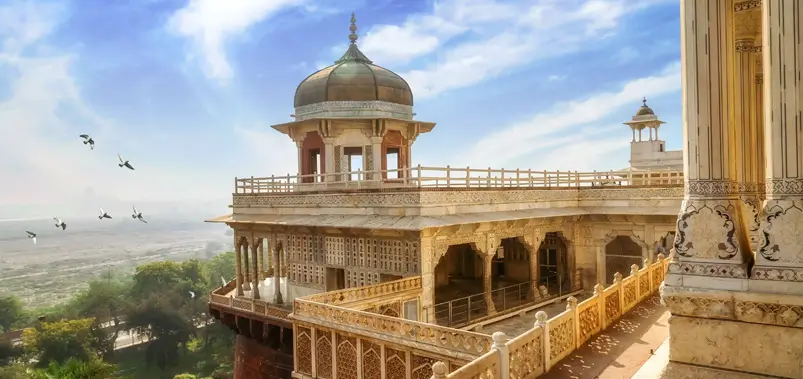
Perhaps no place inside Agra Fort carries greater emotional significance than the Musamman Burj.
This elegant octagonal marble tower projects outward toward the Yamuna River, providing one of the most famous views in Agra.
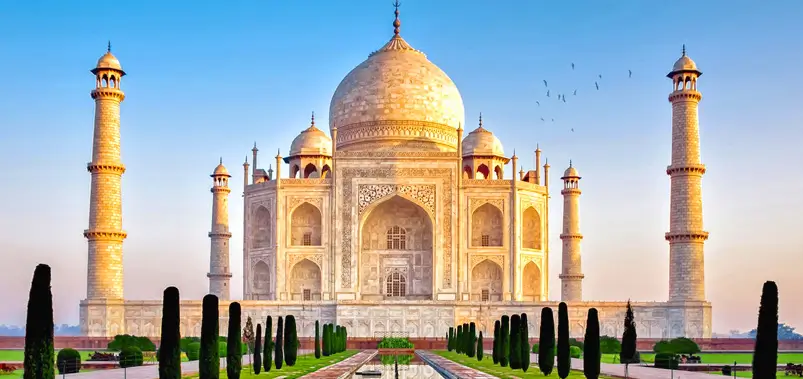
From here, visitors can clearly see the distant white dome of the Taj Mahal.
According to historical tradition, this was where Emperor Shah Jahan spent the final years of his life after being imprisoned by his son Aurangzeb.
Although he remained within the luxurious surroundings of the palace, he was effectively a prisoner.
Every day, he could look across the river toward the magnificent mausoleum built in memory of Mumtaz Mahal, the wife whose death had inspired the construction of the Taj Mahal itself.
Whether every detail of this story is historically documented or partly symbolic, standing at Musamman Burj creates one of the most moving moments during a visit to Agra Fort.
The viewpoint also offers one of the best photography opportunities inside the monument.
Using a moderate zoom lens, visitors can capture beautiful images of the Taj Mahal framed by the marble arches of the pavilion itself—a perspective unavailable anywhere else in Agra.
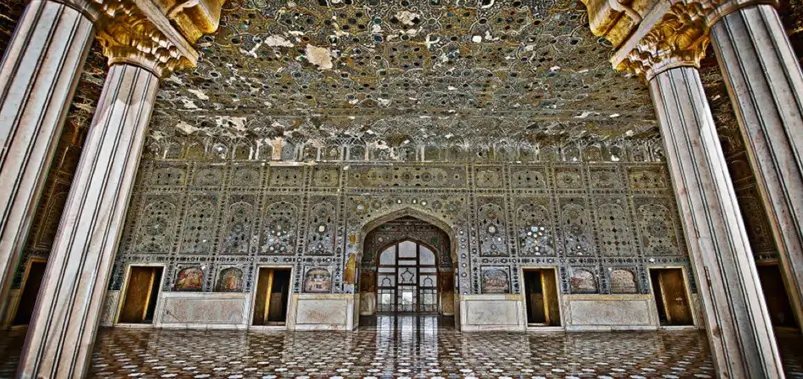
Among the most fascinating structures inside Agra Fort is the Sheesh Mahal, or Palace of Mirrors. Although visitors cannot enter every section of the building because of conservation work and restricted access, it remains one of the finest examples of Mughal interior decoration.
Constructed during the reign of Shah Jahan, the Sheesh Mahal served as part of the royal private apartments and is believed to have functioned as a luxurious dressing room and summer retreat for members of the imperial family.
Its name comes from the thousands of tiny mirror pieces that once covered the walls and ceilings. These mirrors reflected candlelight and oil lamps, creating a sparkling effect throughout the chambers. Imagine entering the palace during the evening when hundreds of reflections shimmered across polished marble surfaces, producing an atmosphere unlike anything seen in ordinary royal residences.
The walls also featured intricate floral designs, delicate stucco work, and beautifully carved niches. Combined with a sophisticated water cooling system that circulated water through marble channels, the Sheesh Mahal provided a comfortable escape from Agra's intense summer heat.
Although much of the original mirror decoration has faded over time, the surviving craftsmanship still demonstrates the extraordinary artistic skills of Mughal artisans. Even from the accessible viewing areas, visitors can appreciate why this palace remains one of the architectural highlights of Agra Fort.
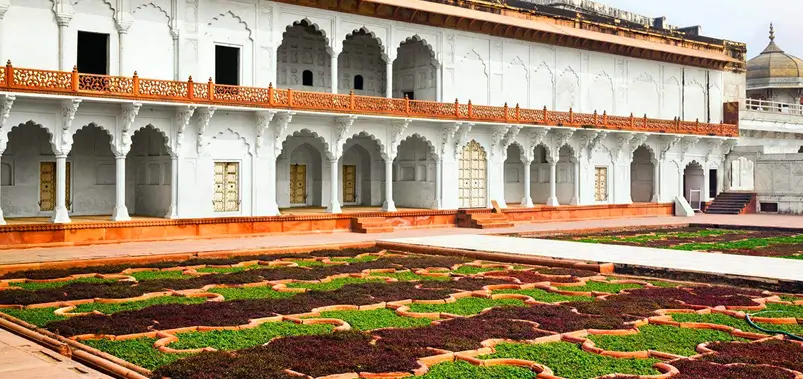
Leaving the palace buildings behind, visitors arrive at Anguri Bagh, one of the most elegant garden courtyards inside the fort.
The name translates roughly as "Grape Garden," reflecting the vineyards and ornamental plants that once flourished here during the Mughal period. While grapes are no longer cultivated within the garden, its symmetrical layout remains remarkably well preserved.
Designed in the classic Charbagh style, Anguri Bagh features geometric flower beds, neatly divided lawns, stone pathways, and carefully planned water channels. Like many Mughal gardens, it symbolised paradise on earth and provided a peaceful environment within the royal palace complex.
The surrounding marble pavilions overlook the garden from several sides, allowing members of the royal household to enjoy pleasant views while remaining inside the private palace area.
During spring and winter, seasonal flowers add colour to the garden, making it one of the most attractive locations for photography.
Visitors often overlook Anguri Bagh while focusing on the larger palace buildings, yet it offers one of the best opportunities to pause, appreciate Mughal landscape design, and imagine how the imperial family once enjoyed these carefully maintained gardens.
Although the Taj Mahal is Agra's most photographed monument, Agra Fort offers equally rewarding opportunities for photographers interested in architecture, history, and panoramic landscapes.
The changing colours of red sandstone throughout the day create dramatically different images depending on the sunlight.
Some of the finest photography locations include:
The massive entrance walls immediately convey the scale of the fortress. Early morning light highlights the warm sandstone colours while avoiding harsh shadows.
The richly carved pillars, balconies, and spacious courtyard provide beautiful architectural compositions. Morning light produces excellent contrast across the detailed stone carvings.
Symmetrical garden patterns combined with surrounding marble buildings create balanced landscape photographs.
Intricate marble lattice screens, elegant arches, and natural light filtering through the palace windows make this one of the most photogenic interiors within the fort.
This is undoubtedly the most famous viewpoint inside Agra Fort.
Standing beneath the marble arches, visitors can photograph the distant Taj Mahal framed perfectly across the Yamuna River.
A lens between 70 mm and 200 mm is ideal for highlighting the monument while preserving the surrounding architectural details.
For smartphone photographers, portrait mode works particularly well around the marble pavilions and garden courtyards, while wide angle mode captures the impressive scale of the fortress walls.
Tripods are generally not permitted without prior permission, so handheld photography remains the best option for most visitors.
Because the fort covers a vast area, having a simple walking route helps visitors avoid unnecessary backtracking while ensuring they do not miss the major attractions.
A comfortable sightseeing route looks like this:
|
Stop |
Main Attraction |
Suggested Time |
|---|---|---|
|
Amar Singh Gate |
Entrance & Fortifications |
15 minutes |
|
Jahangiri Mahal |
Royal Palace |
25 minutes |
|
Diwan-i-Am |
Public Audience Hall |
20 minutes |
|
Diwan-i-Khas |
Private Audience Hall |
20 minutes |
|
Khas Mahal |
Marble Palace |
25 minutes |
|
Musamman Burj |
Taj Mahal Viewpoint |
20 minutes |
|
Anguri Bagh |
Royal Garden |
20 minutes |
|
Sheesh Mahal (Viewing Area) |
Mirror Palace |
15 minutes |
Following this route allows visitors to explore the principal highlights comfortably within 2.5 to 3 hours while allowing additional time for photography.
Hiring a government approved guide can enrich the experience considerably, particularly for visitors interested in Mughal history and architecture.
Typical guide charges range between ₹700 and ₹1,500, depending on language, experience, and tour duration.
Audio guides may also be available for visitors who prefer independent exploration.
A few simple preparations can make your visit significantly more enjoyable.
Unlike the Taj Mahal, Agra Fort contains many shaded courtyards and palace interiors, making it a comfortable attraction even during warmer weather.
Visitors interested in both history and photography often find Agra Fort every bit as rewarding as the Taj Mahal itself.
Agra Fort fits easily into a full day sightseeing itinerary.
A recommended schedule is:
|
Time |
Activity |
|---|---|
|
Sunrise |
Visit the Taj Mahal |
|
9:00 AM |
Breakfast |
|
10:30 AM |
Explore Agra Fort |
|
1:00 PM |
Lunch |
|
Afternoon |
Visit Itimad-ud-Daulah (Baby Taj) or local handicraft workshops |
|
Evening |
Sunset at Mehtab Bagh |
This itinerary allows visitors to experience Agra's three UNESCO World Heritage landmarks while avoiding unnecessary travel across the city.
Luxury travellers frequently spend one night in Agra rather than attempting a rushed day trip from Delhi. This schedule provides enough time to appreciate each monument without feeling hurried.
Post Date : 📅 25 Jul 2026

We promise you a holiday where everything is taken care of from the moment you land. Trusted drivers waiting for you, handpicked hotels that fit your style, personalized itineraries designed just for your family, and a dedicated team on call 24/7. All you need to do is relax, explore, and create unforgettable memories, while we take care of every detail behind the scenes.
Yes. Most visitors combine the Taj Mahal, Agra Fort, and Mehtab Bagh in a single full day, while those staying overnight can enjoy each attraction at a more relaxed pace.
Early morning or late afternoon provides the most comfortable temperatures and the best lighting for photography.
Many sections are accessible through level pathways, although some historic areas include steps and uneven surfaces.
Yes. Licensed government-approved guides are available at the entrance, and many private tour companies also include guided visits.
Yes. Families usually enjoy exploring the large courtyards, gardens, and impressive palace buildings.
Yes. The best view is from Musamman Burj, where Shah Jahan is believed to have spent his final years.
The approximate entry fee is ₹650 for foreign tourists.
Yes. Agra Fort is generally open seven days a week, including Fridays.
Most visitors spend 2–3 hours, while history enthusiasts may wish to stay even longer.
Absolutely. Agra Fort offers a completely different experience focused on Mughal history, imperial architecture, and panoramic views of the Taj Mahal.