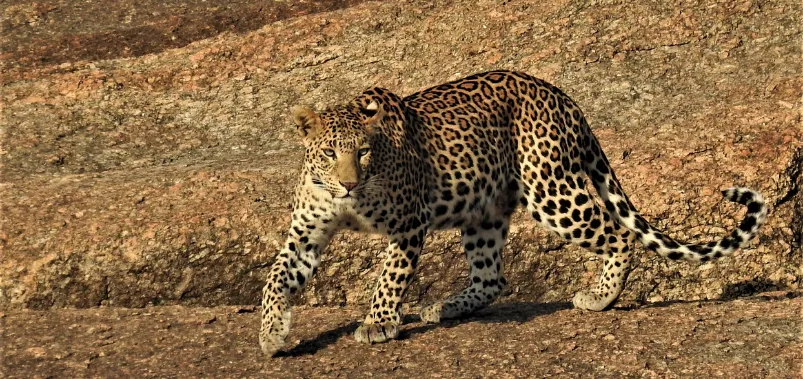
Picture a leopard stretched out on a warm granite boulder at sunrise, a temple bell ringing somewhere below, and a Rabari herder in a red turban walking his goats along the track as if nothing unusual were happening. That scene is ordinary in Jawai, a patch of rocky hills in southern Rajasthan, and it is the reason a Jawai leopard safari feels so different from the tiger drives most travellers know from Ranthambore.
This guide sets out the practical differences: who runs the safaris, how much a night in a camp really costs, which months give the best odds, how to get there by road or train, and how Jawai fits alongside Ranthambore and the Delhi, Agra and Jaipur circuit. Prices quoted are on the higher side and can change from season to season, so treat them as a realistic budget rather than a fixed tariff. One honest point before anything else: no camp, guide or driver can promise a leopard. Jawai gives some of the best odds in India, but these are wild cats moving freely across open country, and a blank drive is always possible.
Jawai sits in Pali district, roughly halfway between Jodhpur and Udaipur, in a dry, scrubby stretch of country broken up by huge domes and ridges of granite. The name comes from the Jawai River and the Jawai Bandh, a dam built in the mid 20th century by the Maharaja of Jodhpur. It is the largest dam in western Rajasthan and still the main water source for the district, so the reservoir is full of life even when the surrounding fields turn brown. The villages most travellers hear about are Bera, Jawai Bandh and the farming settlements scattered around the hills, with small towns like Sumerpur and Sheoganj supplying fuel, markets and the odd roadside restaurant.
What makes Jawai unusual is not wilderness but the lack of it. There is no national park here, no fence and no forest gate. The granite hills are riddled with caves and crevices, and leopards use them as dens, resting places and lookout points. Below the rocks are wheat and mustard fields, goat pens, wells and village homes. Camps and naturalists estimate that a few dozen leopards live across the Jawai and Bera hills, which is a high number for an area that is also home to thousands of people.
The Rabari herders are the other half of the story. They are a semi-nomadic pastoral community who have grazed camels, goats and sheep in these hills for generations, and their attitude to leopards is strikingly tolerant. Many families regard the cat as connected to the goddess and accept that it will occasionally take a goat or a calf. Some lodges and local groups help with compensation when livestock is lost, which keeps that tolerance alive. You will see Rabari men in white clothes and bright red turbans, and women in heavy silver jewellery, going about their day while a leopard dozes a few hundred metres away.
Temples add another layer. Hundreds of small shrines are tucked into the hills, and several of them sit right among leopard rocks. The Devgiri temple, dedicated to the local goddess, is built between boulders and is a well known resting place for leopards, which sometimes walk the temple steps after dark. Kambeshwar Mahadev temple near Sumerpur is another landmark you are likely to pass. Priests and villagers here talk about leopards the way people elsewhere talk about stray dogs: a familiar neighbour that deserves respect.
For a visitor, this means the setting is gentle and human rather than jungle green. You drive past tractors, stop for herders, and scan rocks above a village pond. It is a quieter, more personal kind of wildlife trip, and it explains almost every practical difference from a tiger reserve.
Experience Jawai's legendary leopard country with private jeep safaris, expert naturalists and handpicked luxury camps. Discover Rajasthan's wilderness through an unforgettable wildlife escape crafted around your travel style.
The biggest change is who controls the drive. In Ranthambore, the Rajasthan Forest Department controls everything. The park is split into ten safari zones, vehicles are allotted to a fixed zone and route, and you can only enter in a government registered vehicle. In Jawai, safaris run on community and revenue land, so the drive is organised by your camp or by an independent local operator. Naturalists simply go where leopards have been seen recently, change route mid-drive, and stay at a sighting for as long as it is respectful and safe.
The vehicles differ too. A Jawai drive is usually an open 4x4 jeep with one group in it, a driver and a naturalist or tracker who often grew up in the area. Most camps include two drives a day in the room rate. If you book directly with a local operator, a private jeep for up to six people costs around INR 4,000 to 5,000 per drive (roughly USD 45 to 60), and pickups from hotels in Sumerpur or Sheoganj can add another INR 1,500 or so. There are no permits to apply for and no booking portal.
Ranthambore safari booking is a different exercise. Seats are sold through the Rajasthan Forest Department online system for two vehicle types: the gypsy, a six seat open jeep, and the canter, a 20 seat open truck. You need passport details at the time of booking and must carry the same original passport to the park. Peak dates from December to March often sell out weeks or even months ahead, so travellers usually book as soon as their dates are fixed. For a foreign visitor, a shared gypsy seat typically works out at about INR 3,500 to 4,500 once booking charges are added (around USD 40 to 50), and a canter seat at about INR 2,500 to 3,500. A fully private gypsy reserved through a luxury hotel can cost INR 40,000 or more per vehicle plus tax. Bookings are generally non-refundable, and the forest department can change or close a zone at short notice.
Timings in Ranthambore are fixed by season. From 1 November to 31 January the slots are about 7am to 10:30am and 2pm to 5:30pm. October, February and March run about 6:30am to 10am and 2:30pm to 6pm, and summer slots start at 6am. The core zones close from July to September for the monsoon. In Jawai, start times are set by your camp and the light, usually leaving around first light and again in mid afternoon.
The feel of the drive is also different. A Ranthambore tiger safari is a forest experience: dry deciduous jungle, lakes, old ruins, sambar and spotted deer, and a convoy of vehicles that gathers when a tiger is found. A Jawai drive involves more waiting and scanning. You park below a granite hill, glass the rocks with binoculars and wait for a spotted shape to lift its head. When a leopard does appear, there may be only one or two jeeps around it. Many travellers do both, because they are complementary rather than competing experiences.
Leopards in Jawai are seen often, which is why the area became famous, but sightings are never guaranteed. A realistic expectation for a two night stay with four drives is a good chance of at least one leopard, sometimes several, and occasionally a mother with cubs. Some guests see a cat on the first evening; others go two drives without one and then get a long view on the last morning. Naturalists rely on fresh pugmarks, alarm calls from peacocks and langurs, and reports from herders, so a little patience pays off. Staying three nights improves the odds and makes the trip less rushed.
Leopards here behave in a particular way. They spend the hottest hours deep in caves and come out onto the rocks around dawn and dusk to warm up, groom and scan for prey. That is why both drives are timed around first and last light. Morning drives often leave around 5:30am to 6am in winter and return by about 9am. Evening drives head out at around 3:30pm to 4pm and stay until it is too dark for photographs. Drives last roughly three hours. Some camps run a short evening drive after dark with a spotlight where permitted, which can turn up hyenas or jungle cats.
The best time for Jawai leopard safari visits is October to March. Days are pleasant, roughly 15 to 25 degrees Celsius, and nights from November to January can drop close to 10 degrees, so a fleece and a warm hat are worth packing for the open jeep at dawn. These months also bring winter birds to the reservoir. October and early November can still feel warm in the afternoon, while late December and early January are the busiest weeks for camps, so book well ahead.
From April to June, temperatures climb towards 40 degrees and beyond. Leopards are still present and morning drives can actually be productive because the cats come out early to drink, but the heat is hard on most visitors. The monsoon months from July to September bring rain and muddy tracks, and many of the top camps close. SUJAN Jawai, for example, usually runs from early September to mid May and closes in the hottest part of summer.
A common mistake is to arrive late in the evening, do one drive and leave the next morning. Jawai rewards slow travel. A good pattern is to arrive by lunchtime, rest, go out on the afternoon drive, then spend the next full day with a morning drive, a village walk or temple visit at midday, and another drive in the afternoon. Expect early starts, cold mornings, dusty roads, and long quiet stretches broken by a sudden whisper from the tracker. That rhythm is the heart of a leopard trip here.
Escape into Jawai's dramatic granite hills with luxury tented stays, personalised safari experiences and seamless private transfers. Let us create an exceptional wildlife journey with comfort at every step.
Accommodation in Jawai ranges from global luxury to simple farm stays, and it decides a large part of your experience because the camp also runs your safaris. Prices below are approximate, lean to the higher side and can change, so check current rates when you book.
SUJAN Jawai is the best known name. It is a luxury tented camp of ten tents set among the rocks, run by the same family company behind SUJAN Sher Bagh in Ranthambore. Rates are all-inclusive, covering meals, two game drives a day, laundry and high tea, and typically sit around INR 100,000 to 150,000 per night for two, roughly USD 1,150 to 1,700, with peak weeks higher still. It has appeared on international best hotel lists, and its trackers have a strong reputation. Excursions to Ranakpur and Kumbhalgarh are extra.
Brij Pola is a newer ultra-luxury option with just four very large tents, some with private plunge pools, and rates reported at about INR 120,000 per night before tax. Bera Safari Lodge, a boutique cottage property, works out at roughly INR 27,500 per night for two including meals and safaris, and puts weight on community visits and cooking sessions. Aaramgah Jawai Resort is a family-friendly option starting at around INR 23,000 per night.
In the middle range, Castle Bera is a heritage home run by a local noble family, with courtyards, old furniture and jeep drives led by trackers who know individual leopard families. Expect around INR 15,000 to 25,000 per night for two with meals and drives. Jawai Leopard Camp offers luxury tents with en-suite bathrooms and air conditioning, with full board and morning and afternoon safaris usually included; online rates start at about INR 6,300 per person per night, and a realistic budget for two is INR 15,000 to 20,000. Varawal Leopard Camp, run by a naturalist family, is in a similar bracket, and the Jawai Leopard Safari Lodge starts at about INR 13,500 per night.
When choosing among the Jawai luxury camps, check four things. First, whether safaris are included and if they are private or shared with other guests. Second, how far the camp is from the main leopard hills, since a 30 minute drive each way eats into prime light. Third, which meals are included, because there are very few independent places to eat. Fourth, transfer costs from Udaipur or Jodhpur, which some camps quote separately at INR 6,000 to 9,000 each way for a private car.
To put the Jawai safari cost in context, two people at a mid-range camp for two nights, including drives and meals, should budget roughly INR 35,000 to 50,000, about USD 400 to 575, plus transfers. The same stay at SUJAN Jawai runs into several thousand dollars. In Ranthambore, by contrast, the room and the safari seats are usually separate bills, which makes the comparison less simple than it first looks.
Leopards are the headline, but the reservoir at Jawai Bandh gives the area a second personality. In winter, more than 100 bird species have been recorded around the water and the surrounding fields. Birdwatching at Jawai Bandh is best from roughly October to February, when bar-headed geese arrive after flying over the Himalaya, flocks of lesser and greater flamingos wade in the shallows, and sarus cranes, ruddy shelducks, painted storks and pelicans gather on the edges. Raptors such as the laggar falcon and shikra hunt over the fields. An early morning visit, with tea from a flask and binoculars on the bonnet, is one of the quiet pleasures of a stay here.
Marsh crocodiles, also called mugger crocodiles, live in the reservoir in good numbers. On cool mornings you will see them hauled out on the banks and rocky islands, mouths open, warming up. Keep a sensible distance from the water's edge and listen to your naturalist. Other mammals in the area include striped hyenas, which are seen more often than in many parks, Indian foxes, jungle cats, nilgai antelope, wild boar and grey langurs. Sloth bears and wolves are present but rarely seen.
Leopard photography in Jawai has its own rules. Because cats sit on open rock, there is often no foliage in the way, and the warm granite looks beautiful in low golden light. The challenge is distance. Leopards are frequently 150 to 400 metres away on a ridge, so a long lens matters. A 100 to 400mm zoom is a good minimum, and a 150 to 600mm or similar gives more flexibility. A beanbag or window clamp helps, since you shoot from a parked jeep. At dusk the light fades fast, so practise higher ISO settings before you arrive, and keep a second body or a wide lens for scenes that include temples, herders and the hills.
Behaviour matters as much as gear. Good naturalists keep engines off at sightings, stay on tracks, avoid surrounding a cat and never use spotlights or calls to provoke a reaction. Some operators have been criticised for crowding leopards on busy weekends, so ask your camp how it handles sightings. If a driver pushes too close, it is entirely reasonable to ask him to back off. A good photograph is not worth stressing an animal that has to keep living beside people.
Away from the jeep, many travellers enjoy a guided walk to a Rabari settlement, a climb up a granite hill for sunset, or a visit to a hill temple. Always ask before photographing people, especially women, and accept a polite refusal. A small purchase of local craft or a donation to a village school, arranged through your camp, is a more welcome way of saying thanks than handing out money.
How to reach Jawai depends on where you are coming from, but almost everyone arrives by road in a private car. Udaipur airport is about 130 to 145 kilometres away, roughly two and a half to three and a half hours by road depending on the camp. Driving Jawai from Udaipur is the most popular approach, and many travellers stop at the Ranakpur Jain temples on the way, which adds a superb half day. Jodhpur airport is about 150 to 170 kilometres away, around three to four hours. Mount Abu is also within about three hours.
By rail, Jawai Bandh station sits on the main line between Ahmedabad and Ajmer, about 12 kilometres from SUJAN Jawai. A handful of express trains stop here, but more trains halt at Falna, a slightly larger station on the same line, and at Mori Bera, a small stop close to Bera village. Rail is useful if you are travelling from Ahmedabad, Ajmer or Jaipur on a budget, but you still need a camp pickup from the station, and timings can be awkward early in the morning. Check schedules on the Indian Railways site or a booking app before you commit.
Fitting Jawai into a longer Rajasthan wildlife tour is easy if you think of geography. Ranthambore is near Sawai Madhopur in eastern Rajasthan, about three and a half to four hours from Jaipur, while Jawai is in the south west. A natural route runs Delhi, Agra, Ranthambore, Jaipur, then Jodhpur, Jawai and Udaipur, finishing with a flight out of Udaipur. That gives you tigers in the forest and leopards on the rocks without doubling back. Allow two nights in Ranthambore for at least three drives, and two to three nights in Jawai.
If your trip begins with the classic triangle, the Golden Triangle tour with wildlife adds Ranthambore to Delhi, Agra and Jaipur, and Jawai can be added at the end for those heading to Udaipur. A dedicated Rajasthan Jawai leopard safari tour covers the camps, drives and transfers in one route.
A few practical tips help the logistics. Mobile signal can be patchy in the hills, so download maps and booking details before you leave Udaipur or Jodhpur. ATMs are limited, so carry some cash for tips, roughly INR 500 to 1,000 per drive for the naturalist and driver team if you are happy with them. Pack layers, a warm jacket for winter mornings, a scarf against dust, sunscreen and a head torch. Golden Triangle Tours can arrange a private car and driver for the whole Rajasthan stretch, which takes the stress out of long transfers between Ranthambore, Jaipur and Jawai.
We promise you a holiday where everything is taken care of from the moment you land. Trusted drivers waiting for you, handpicked hotels that fit your style, personalized itineraries designed just for your family, and a dedicated team on call 24/7. All you need to do is relax, explore, and create unforgettable memories, while we take care of every detail behind the scenes.
No. Jawai has some of the best leopard viewing odds in India, but the cats are wild and move freely over open hills. A stay of two to three nights with four to six drives gives you a good chance of at least one sighting, though no honest operator will promise it.
Booked directly with a local operator, a private open jeep for up to six people costs about INR 4,000 to 5,000 per drive, roughly USD 45 to 60. Most camps include two drives a day in the room rate, so check before paying separately. Prices can change by season.
No. Jawai is not a national park, and safaris run on community and revenue land, so there is no government permit or online booking portal. Your camp or local operator organises the drive, which is one of the main differences from Ranthambore.
October to March is the most comfortable period, with mild days and cold mornings, and November to February also brings flamingos and bar-headed geese to the reservoir. Leopards are present all year, but April to June is very hot and many top camps close during the monsoon.
Seats in a six seat gypsy or a 20 seat canter are booked through the Rajasthan Forest Department online system, with passport details needed at booking. Foreign visitors usually pay around INR 3,500 to 4,500 per gypsy seat once booking charges are added. Peak dates from December to March fill early, so book as soon as your dates are fixed.
Jawai is about 130 to 145 kilometres from Udaipur, a drive of roughly two and a half to three and a half hours. Jodhpur is about 150 to 170 kilometres away, around three to four hours by road. Most visitors arrive by private car.
Yes. Jawai Bandh, Falna and Mori Bera stations are on the Ahmedabad to Ajmer line and serve the area. You will still need a pickup from the station to your camp, so arrange it in advance and check train timings carefully.
SUJAN Jawai is the best known luxury tented camp, with all-inclusive rates of roughly INR 100,000 to 150,000 per night for two. Brij Pola is a newer, very exclusive alternative with four large tents. Both include meals and safaris, but rates change by season.
The Jawai Bandh reservoir has marsh crocodiles and, in winter, over 100 bird species including flamingos, bar-headed geese and sarus cranes. Striped hyenas, nilgai and jungle cats are also seen, and village walks with Rabari herders and visits to hill temples are popular.
Yes. A common route runs Delhi, Agra, Ranthambore and Jaipur, then Jodhpur, Jawai and Udaipur, flying out of Udaipur at the end. Allow two nights in Ranthambore and two to three nights in Jawai to give yourself enough drives in each.