The first time most travellers see a Kalbelia dancer, it happens by accident. You are sitting on a rooftop in Jaisalmer or on the lawn of a palace hotel, a drum starts up, and a woman in a black skirt begins to spin so fast that the mirrors on her costume blur into a circle of light. A few minutes later a man with a long beard picks up a bowed instrument made of wood and goatskin and sings a song that has been passed down through his family for generations. It is one of the best evenings you will have in India.
The trouble is that Rajasthani folk performances range from the genuinely moving to the tired and touristy. The same dance can be performed by a hereditary family of artists at a festival, or by a hotel's hired group running through a 20 minute routine between dinner courses. This guide explains the main dances, music and puppet traditions, then shows exactly where to see them in Udaipur, Jaipur, Jodhpur and Jaisalmer, with timings and prices, plus honest advice on telling real from staged, tipping and photography.
The Kalbelia dance is the one that ends up on most travellers' phones. The Kalbelia are a community traditionally known as snake charmers, who once moved from village to village with cobras and earned a living from performances and herbal remedies. When wildlife laws ended snake charming, the community's music and dance became their main living, and UNESCO has since added Kalbelia folk songs and dances of Rajasthan to its Representative List of the Intangible Cultural Heritage of Humanity. The dance imitates the movement of a snake: women in black flared skirts, heavily embroidered with mirrors and silver thread, sway, twist and spin, sometimes bending backwards to pick up a ring or a coin with their eyelids or mouth. The men play the gourd pipe used by snake charmers, a frame drum and a two headed hand drum. Gulabo Sapera, the best known Kalbelia dancer, took the form from village fairs to stages around the world.
Ghoomar dance is quieter and more graceful. It comes from the Marwar region around Jodhpur and was traditionally performed by women at festivals, weddings and in royal courts. The dancers wear long, very full skirts and a veil, and turn slowly in a circle, so the skirts open out like flowers. The name comes from the spinning movement itself. In palace hotels you will often see a short Ghoomar performed as a welcome.
Bhavai dance is pure skill and nerve. A dancer, usually a woman, balances a tower of earthen or brass pots on her head, often seven or more, and then dances on the rim of a brass plate, the edge of a sword or broken glass without the pots falling. The audience in Udaipur gasps every night when the last pot goes up.
Chari is associated with the Kishangarh and Ajmer area. Women dance with brass pots balanced on their heads, and inside each pot burns a cotton wick soaked in oil, so the performance is done with small flames above the dancers' heads. It was traditionally danced at weddings and festivals, and it looks most impressive after dark.
Terah Taali is one of the most unusual forms you can see. It is performed by the Kamad community of Pali district as devotion to Baba Ramdev, a folk hero of western Rajasthan. Women tie small brass cymbals to their wrists, legs and feet, sit on the floor and strike them in a rapid pattern, the name referring to thirteen ways of playing the cymbals, while sometimes balancing a pot or holding a small sword in their teeth. It is gentle and hypnotic rather than showy.
You may also see the fire dance at desert camps, the Gair stick dance of the Bhil and other communities around Holi, and Kachhi Ghodi, in which men dance inside dummy horse costumes and mock fight with swords. Knowing what each dance is called makes the evening much more interesting, so ask your guide to name them as the programme goes on.
Discover Rajasthan's vibrant Kalbelia performances, traditional puppetry and soulful folk music. Enjoy authentic cultural encounters, private journeys and handpicked heritage stays for an unforgettable experience.
If the dances are the colour of Rajasthan, the music of the Thar Desert is its soul. Manganiyar musicians come from hereditary Muslim families in the Jaisalmer and Barmer districts who for centuries sang for Rajput patron families at births, weddings and festivals, keeping their genealogies and stories alive in song. Many still live in villages such as Hamira, near Jaisalmer. Their songs move between Sufi poetry, devotional verses to Hindu deities and love ballads like the story of Moomal and Mahendra, and the voices are powerful enough to fill a fort courtyard without a microphone.
Langa musicians are a related but separate community, traditionally serving Muslim herding patrons in the same desert region. You can often tell them apart by their instruments. The Manganiyar are known for the kamaicha, a bowed instrument carved from a single piece of wood, with a round belly covered in goatskin and a deep, buzzing tone. The Langa favour the Sindhi sarangi, a smaller bowed instrument, and the double flute played with circular breathing.
Three other instruments appear in almost every performance of Rajasthan folk music. The khartal is a pair of wooden clappers held in each hand, played with astonishing speed, and a good khartal player will often get the biggest applause of the night. The morchang is a small metal jaw harp held against the teeth, producing a twanging, rhythmic hum that sounds a little like a camel's footsteps. And the two headed hand drum keeps time underneath everything.
A good Manganiyar concert starts slowly, with long, unaccompanied opening lines, then builds through faster songs until the khartal and drum are racing and the audience is clapping along. If you only see one performance in Rajasthan, make it this kind of music played by a family group at night.
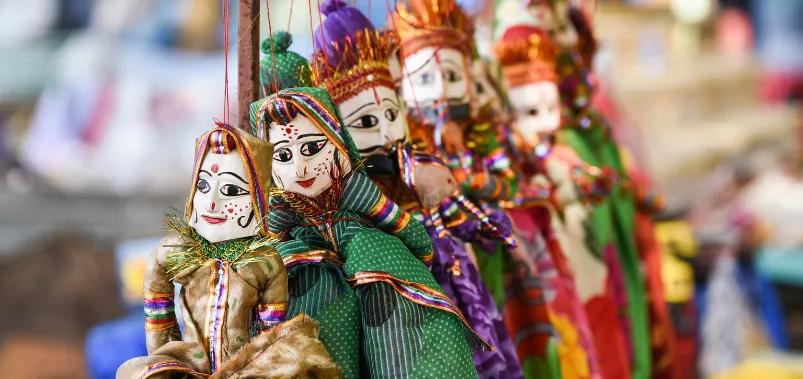
Then there are the puppets. Kathputli, the string puppetry of Rajasthan, is one of the oldest forms of storytelling in the region. The puppeteers come mainly from the Bhat community, who traditionally travelled between villages and royal courts. Each wooden puppet has a carved head, a bright cloth costume and strings attached to the head and hands, and the puppeteer works them from above while a partner plays a drum and sings. The puppeteer often uses a small reed whistle held in the mouth to give the puppets their squeaky voices.
A typical Kathputli puppet show includes a few classic routines: a snake charmer and his snake, a dancer who twirls and loses her head, a juggler, and a horseman galloping across the stage. Longer shows tell the legend of Amar Singh Rathore, a 17th century Rajput hero. In Udaipur, the folk arts museum at Bharatiya Lok Kala Mandal has a large puppet collection and usually runs short puppet shows during the day, while the Dharohar show at Bagore ki Haveli includes a puppet segment most evenings. In Jaipur, puppeteers regularly perform at Chokhi Dhani and in the courtyards of heritage hotels.
For a single evening that covers almost everything, the Dharohar dance show in Udaipur is hard to beat. It is staged every evening in the courtyard of Bagore ki Haveli Udaipur, an 18th century mansion beside Gangaur Ghat on Lake Pichola, now a museum run by the West Zone Cultural Centre. The programme usually includes Chari, Terah Taali, Bhavai, Ghoomar, a puppet segment and a closing pot balancing act that brings the house down. Many of the performers come from hereditary artist families, including Kamad women from Pali district.
The practical details, which can change:
The single biggest mistake travellers make here is arriving at 6:45pm. The courtyard fills well before the start in season, so arrive by about 6pm, buy tickets at the gate and sit near the front. If you can, visit the museum rooms in the afternoon, which close earlier, and then come back for the show.
In Jaipur, the city's arts centre, Jawahar Kala Kendra, is the most authentic choice. Designed by the architect Charles Correa, it hosts the annual Lokrang festival in late October and early November, which this season ran from 27 October to 6 November, bringing folk dancers and musicians from across Rajasthan and other Indian states to its open air amphitheatre and the craft village of Shilpgram. Entry to many performances is free or very low cost. Through the winter it also hosts theatre, music and dance evenings, so check its programme for the dates you are in town.
Chokhi Dhani Jaipur, about 20 km south of the city on the Tonk road, is a different experience: a large mock village resort with folk dancers, puppet shows, magicians, camel rides and a Rajasthani dinner served on the floor. It opens from about 5pm to 11pm, and entry packages including dinner run roughly from INR 1,100 to 1,700 per adult (about USD 13 to 20); prices change through the season. It is staged and busy, especially at weekends, but families with children love it, and some of the Kalbelia and Bhavai performers are very good. Go on a weekday, arrive early and eat later.
The light and sound show at Amber Fort is worth knowing about, though it is not a live folk performance. It tells the story of the Kachhwaha rulers through narration by the actor Amitabh Bachchan, set to Rajasthani folk music, with the fort walls lit in colour. The English show runs at 6:30pm from October to February, a little later in spring, and tickets have been around INR 295 (about USD 3.50). Combine it with dinner at the fort or nearby for a relaxed evening.
Go beyond sightseeing and experience Rajasthan's living traditions. Discover mesmerising Kalbelia dance, colourful puppetry and local music through thoughtfully planned private cultural experiences.
To hear desert music where it was born, head west. A night at a Jaisalmer desert camp is the most popular way. Most camps sit at Sam, around 40 to 45 km west of Jaisalmer, or at Khuri, around 45 to 50 km south west. The evening follows a familiar pattern: a sunset camel ride on the dunes, then a fire lit in the centre of the camp, then Manganiyar musicians and Kalbelia dancers performing for an hour or so while dinner is prepared.
Quality varies enormously. At Sam, where dozens of camps line the road, the busiest places run loud amplified shows for large groups. Khuri is quieter, and the better luxury tented camps in both areas keep numbers small, hire the same family of musicians all season and let them play unamplified around the fire. Ask before booking whether the music is live and acoustic and how many guests are expected that night.
The festival calendar adds two outstanding opportunities. The Jodhpur RIFF, the Rajasthan International Folk Festival, takes place each October inside Mehrangarh Fort, timed around the full moon of Sharad Purnima. The latest edition ran from 22 to 26 October, with more than 250 folk musicians from Manganiyar, Langa, Kalbelia, Bhopa and Bhil communities alongside artists from around a dozen countries. The dawn concerts at Jaswant Thada, the white marble memorial below the fort, are the moment people talk about for years: Langa and Manganiyar musicians playing unamplified as the sun comes up over the city. Passes are not cheap, around INR 7,300 for a day and INR 17,800 for the full festival (about USD 88 and USD 215), and they sell out, so book as soon as next year's dates are announced.
The Jaisalmer Desert Festival is held in February around the full moon of the Hindu month of Magh, and for the coming season it is expected around 18 to 20 February, though official dates are confirmed only a few weeks ahead. It opens with a parade from the fort through the city, includes camel races and camel polo, turban tying and moustache contests, and builds to an evening finale on the dunes at Sam with folk music, Kalbelia dancing and fire dancers under the moon. Most events in the city are free. Hotels in Jaisalmer fill quickly for these dates.
Jodhpur also offers good performances outside RIFF. Several heritage hotels have nightly folk music, and Mehrangarh Fort often has musicians playing at the entrance and in the courtyards during the day. Leave a few coins or a small note when you stop to listen.
If your route goes through the desert, our Golden Triangle tour with Rajasthan shows how Jodhpur and Jaisalmer fit together with Delhi, Agra and Jaipur, and the fairs and festivals tours are built around dates like these.
Some of the most memorable performances happen far from any stage. Most palace and heritage hotels in Rajasthan arrange evening folk music on the lawn or terrace, often with a puppet show for children. The quality depends on the hotel. At the best properties, the musicians are a hereditary family who have played there for years, they perform without amplification, and they are happy to talk about their instruments afterwards. At others, a group runs through the same four songs every night, the volume is high and the dancers look tired.
For something special, ask about a private folk music concert. In Jaisalmer, Jodhpur and Udaipur, a good guide or hotel can arrange for a Manganiyar or Langa family group to play for you alone, on a rooftop at sunset, in a courtyard after dinner or in their own village. A visit to a musicians' village such as Hamira, near Jaisalmer, can include an informal performance in a family courtyard, a chance to see a kamaicha up close and tea with the family. Expect to pay the musicians directly or through your guide, typically from around INR 5,000 to 15,000 (about USD 60 to 180) for a small group playing for an hour or two, depending on the number of artists and travel; agree the fee in advance.
So how do you tell an authentic performance from a staged one? A few signs help:
Staged does not always mean bad. Dharohar is a staged show, but its performers come from real artist communities and the standard is high. The aim is not to avoid every arranged performance, but to give your best evenings to the ones where the artists clearly care.
A final point that many visitors miss: these communities have faced real hardship. The Kalbelia lost their traditional livelihood when snake charming was banned, and many musician families now depend largely on tourism. Paying fairly and listening properly is one small way to keep these traditions alive.
Tipping folk performers is normal in Rajasthan, and it is how many artists make most of their income. At a ticketed show such as Dharohar, the ticket covers it and you do not need to tip. At desert camps and heritage hotels, the musicians usually pass a small plate or come round at the end; INR 200 to 500 (about USD 2.50 to 6) per couple is fair, more if you have made requests or enjoyed a long session. For a private concert, agree the fee in advance and consider a little extra at the end for an exceptional evening. Hand money to the lead musician directly and politely; throwing notes at dancers is an old custom at weddings, but it can feel uncomfortable from a foreign visitor, so it is better avoided.
Musicians at fort gates and in streets often play for donations. If you stop to listen or take a photograph, leave INR 50 to 100. If you do not want to stop, a polite smile and walking on is perfectly acceptable.
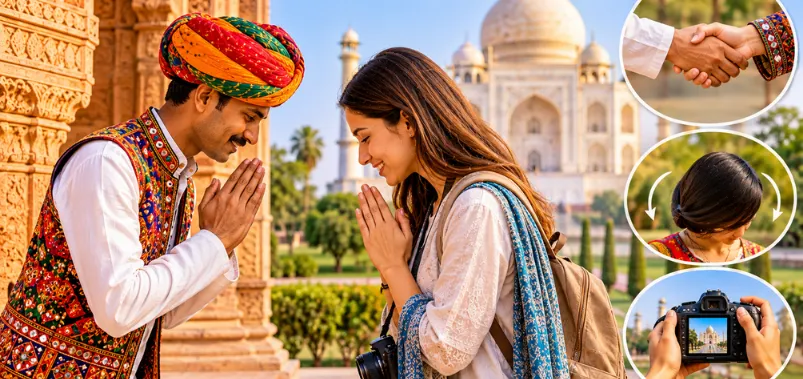
Photography is usually welcome but has its own rules. At Bagore ki Haveli, a camera fee is charged for anything beyond a phone, and you should not use flash, as it distracts dancers balancing pots on their heads. At desert camps, ask before filming close up, and never step onto the performance area to get a better angle. In villages and private homes, always ask permission before photographing women, children or the inside of a house, and offer to send copies through your guide. Some musicians will ask for a small payment for posed photographs, which is reasonable.
Simple courtesy goes a long way. Do not talk loudly through a slow song, sit facing the performers and applaud between pieces. If you are invited to join a dance at the end, which often happens at camps, it is good fun to accept; nobody expects you to be good at it. Ask the names of the songs and the musicians, and if you enjoyed them, buy a CD or follow their pages online, as many family groups now post recordings.
With a little timing, you can see the best of it in a single trip: Dharohar in Udaipur, music on a Jodhpur rooftop and a fire on the dunes at Khuri. Golden Triangle Tours can arrange a private driver and guides who know the musicians personally, which is often the difference between a show and a real evening of music.
We promise you a holiday where everything is taken care of from the moment you land. Trusted drivers waiting for you, handpicked hotels that fit your style, personalized itineraries designed just for your family, and a dedicated team on call 24/7. All you need to do is relax, explore, and create unforgettable memories, while we take care of every detail behind the scenes.
Kalbelia is the dance of a Rajasthan community traditionally known as snake charmers. Women in black flared skirts imitate the movements of a snake while men play the gourd pipe and drums. It is on UNESCO's Representative List of the Intangible Cultural Heritage of Humanity.
The Dharohar folk dance show runs daily from 7pm to 8pm in the courtyard of Bagore ki Haveli in Udaipur. Foreign adults have paid around INR 250 to 300, with an extra camera fee. Arrive by about 6pm in season for a good seat.
Both are hereditary musician communities of the Thar Desert in western Rajasthan. The Manganiyar traditionally sang for Rajput patrons and are known for the kamaicha, while the Langa served Muslim herding patrons and favour the Sindhi sarangi and double flute. Both use the khartal and morchang.
In Udaipur, Bharatiya Lok Kala Mandal runs short puppet shows and Dharohar includes a puppet segment. In Jaipur, puppeteers perform at Chokhi Dhani and many heritage hotels. Most desert camps and palace hotels can also arrange a show on request.
It is a staged resort village rather than an authentic setting, but it shows many dances and puppetry in one evening. Packages with dinner cost around INR 1,100 to 1,700 per adult. It suits families best; go on a weekday and arrive early.
The Rajasthan International Folk Festival takes place every October at Mehrangarh Fort, timed around the full moon of Sharad Purnima. The latest edition ran from 22 to 26 October. Day passes have cost around INR 7,300 and full passes around INR 17,800.
It is held in February around the full moon of the month of Magh. For the coming season it is expected around 18 to 20 February, but official dates are confirmed only a few weeks ahead. Most events in Jaisalmer city are free to watch.
Sam is closer to Jaisalmer and has many large camps with amplified shows. Khuri is quieter, with fewer camps and a more relaxed atmosphere. In either place, choose a camp that keeps numbers small and uses live acoustic musicians.
At camps and hotels, around INR 200 to 500 per couple is fair, handed directly to the lead musician. Street musicians appreciate INR 50 to 100 if you stop to listen or take photos. Ticketed shows like Dharohar do not need a tip.
Yes. Guides and hotels in Jaisalmer, Jodhpur and Udaipur can book a Manganiyar or Langa family group for a private performance. Expect around INR 5,000 to 15,000 depending on group size, duration and travel, and agree the fee in advance.